








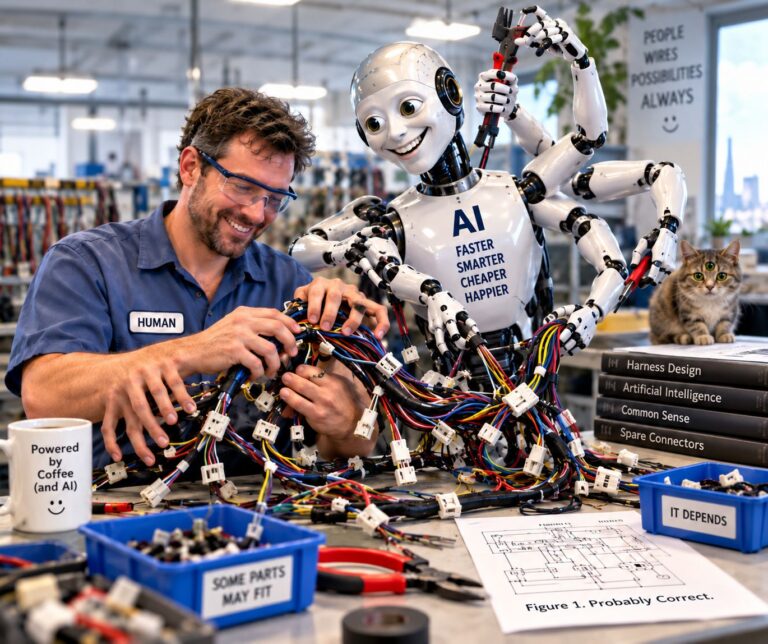













When AI enters the quoting room, the transformation goes deeper than speed
(Part III of series) by Joanne Harris, on behalf of Cableteque
In the first article in this series, we asked why manufacturers keep delaying the decision to modernize quoting. Then we looked at how to bring a skilled team with you when you finally make the move. This article closes the series with the question that matters most: once the platform is in place and the team is on board, what actually changes? The answer, it turns out, goes well beyond faster turnaround times. For shops that have reached the AI layer of this technology, something more fundamental is shifting in how quotes get built and how errors get caught before they cost real money.
To find out what year one really looks like, we spoke with leaders who are living it now.
The speed dividend pays in unexpected currency
Speed was the reason most companies started this journey. It’s rarely the most interesting thing they discover once they’re on the other side of it.
Mike Vargeson is Estimating Manager at Electri-Cord Manufacturing, overseeing estimating for a contract manufacturer serving industrial, medical, energy, defense, and automotive customers. ECM started as a power cord company over 26 years ago and has since grown into a full-service operation producing wire harnesses, panel assemblies, box builds, and high-level assemblies.
Before Cableteque, turnaround times ranged from a couple of days to a couple of weeks. Certain RFQs, fast-turnaround, multi-level, with tight deadlines, were simply not pursued.
“We would typically walk away from those in the past because we just didn’t have the resources to turn that,” Vargeson says.
That’s the kind of statement that sounds routine until you sit with what it means. The problem isn’t just losing bids, it’s never getting the chance to bid. When customers send RFQs to three manufacturers, and two respond in days while you take weeks, they don’t wait. A shop can lose deals before a quote ever leaves the building. The quoting bottleneck was setting a ceiling on growth that had nothing to do with capacity, pricing, or quality.
Now, ECM can complete complex quotes the same day they come in. Multi-level RFQs with three-day deadlines are turned in one to two days. But Vargeson is not talking primarily about speed when he describes what changed. He’s talking about eligibility.
“More swings at the plate potentially get you more base hits.”
Kelly Grato, VP of Procurement and Estimating at RESCO Electronics, described the same dynamic when we spoke with her for Part 2. Quote backlogs that had stretched to 30 days disappeared. New business came in. But the more durable shift was strategic: the team finally had space to be selective. “Now we can focus on the quotes where we need to be strategic,” she said. “Before, every quote felt equally urgent, and you couldn’t tell which ones really were.”
How the estimator’s role evolves
When we spoke with experienced estimators in earlier parts of this series, the question underneath every conversation was the same: what happens to my role when the platform handles what I used to spend my days on? Steve Pilipchuk of Wallace Electronics gave the clearest answer: “Our estimators are way too qualified to be doing data entry. What’s left is the work that actually requires a skilled human.”
Twelve months in at ECM, that framing holds. Before Cableteque, Vargeson’s estimating engineers spent the bulk of their time on BOM setup and pricing lookups. That work shrank. What expanded into that space was customer contact.
“It allows them to reach out to customers or our internal sales teams and discuss the project, which is a big thing for us,” Vargeson says. “It has opened those doors to all of our estimating engineers to introduce themselves and ask if there’s anything additional we could do to support their projects.”
Customers who have a relationship with the person quoting their work don’t shop around as readily. Estimators who understand the context of a project catch the problems that save rework on the floor. The quoting function shifts from a transactional step to a point of competitive differentiation.
What happens when AI enters the room
For shops that have worked through the foundational layer – automated BOM creation, live supplier pricing, labor estimation – a second wave is arriving. The early reports from ECM are worth examining.
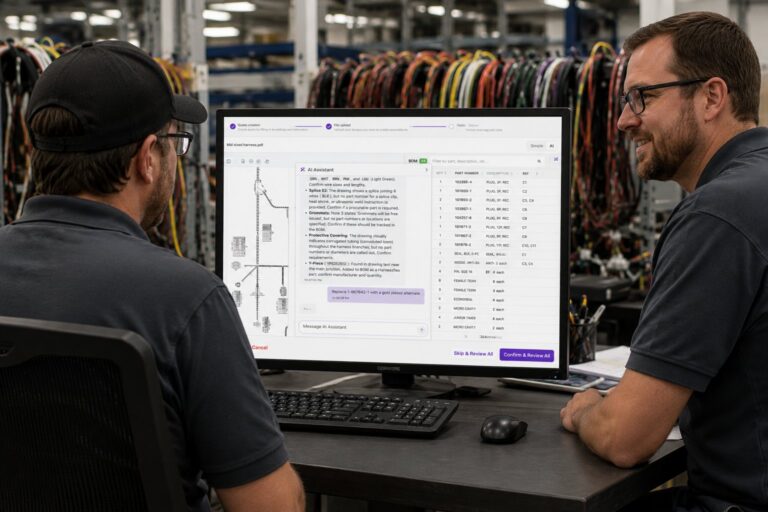
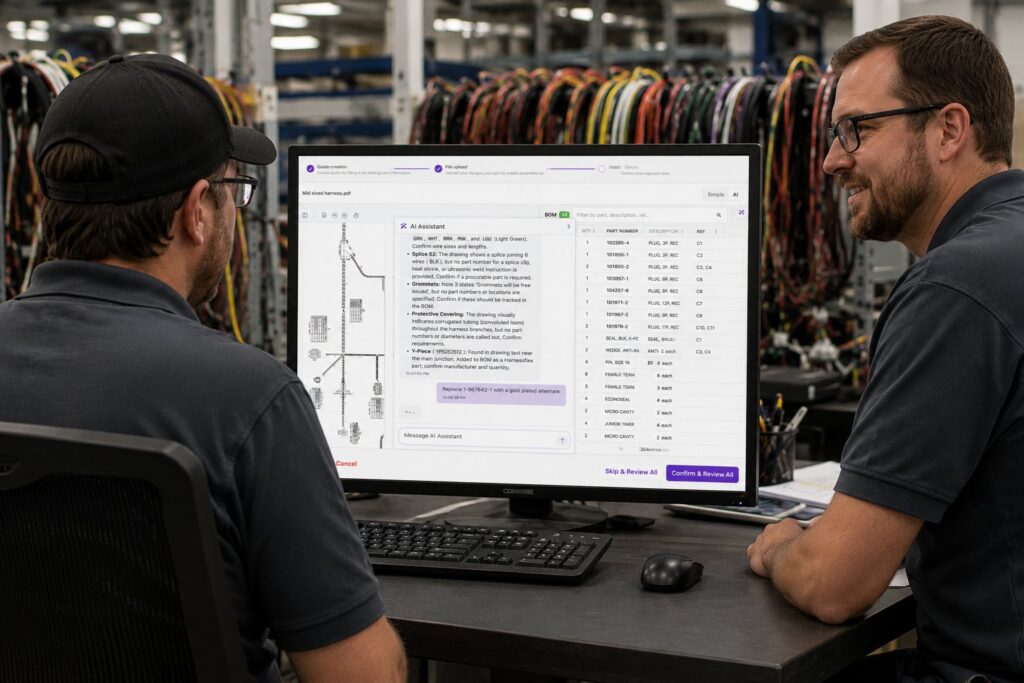
Vargeson’s team began using Cableteque’s AI BOM creation features recently and had applied it to somewhere between half a dozen and a dozen RFQs when we spoke. Adoption was fast, partly because the team is young and enthusiastic, and partly because they’ve already been through one successful transition. They know how trust gets built with new tools.
“They’re trying to stump it,” Vargeson says. “With all AI programs, everyone’s trying to find where it can’t work.”
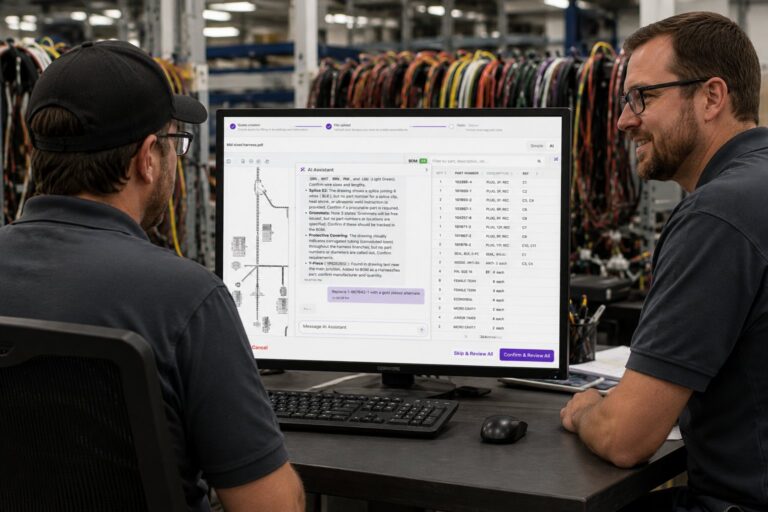
What they found is that it works better than expected, and in a different way than expected. The AI doesn’t just pull components from a drawing. It reads the drawing, including the notes, and flags items that manual review often misses.
“AI is asking you some questions where it looks in the notes, or it might see something on the print and say, hey, you do have a label required here,” Vargeson explains. “Sometimes you glance over that thing when you’re doing it manually and just forget about it.”
This is a different category of value than speed. It’s accuracy. The system catches a line item that would have required a revision, a delay, or a margin hit after the job reached the floor by reading what experienced estimators read, just without the fatigue or distraction that causes things to slip. And it doesn’t add time to the process. Across a range of job types, Vargeson’s team found it didn’t slow them down.
For shops still on spreadsheets, this is a useful frame for where the technology is heading. The floor is faster and more accurate BOM creation. The ceiling is a system that actively assists with quality review, drawing on a broader view of the data than any single estimator can hold at once.
The competitive gap, from inside
ECM’s strategic planning process now revolves around a question the team couldn’t ask before: which RFQs do we want to go after? Not which ones can we turn in time, but which ones align with where the business wants to grow.
“The speed is always going to be the thing,” Vargeson says. “But what will happen in the next strategy cycle is that it will start going out to the sales team to make sure they’re bringing in the right types of quotes, because we know we can do them quickly and accurately.”
That is a fundamentally different conversation from the one happening at shops that are still managing a quoting backlog. One organization is optimizing for growth direction. The other is managing capacity constraints.
There’s a supplier dimension to this, too. ECM’s distributor relationships had been strained by the volume of manual outreach required by manual quoting. Once live pricing replaced that, suppliers noticed. Several reached out to ask what had changed. Some who weren’t on the platform asked to join.
“It’s basically starting from scratch,” Vargeson says, describing how the team now approaches supplier relationships on genuinely competitive jobs. “That has been good with our suppliers.”
What to measure
The initial metrics are obvious: turnaround time, backlog size, and quote volume. The measures that reflect sustained competitive advantage are less so.
RFQ eligibility matters more than win rate. A shop that couldn’t turn a multi-level RFQ in three days is invisible to that customer. That invisibility doesn’t show up anywhere in the data.
Quote-to-close rate by job type is worth tracking as the quoting function becomes more strategic. Knowing you can turn anything quickly allows the sales team to be selective about what they bring in, and that selectivity should show up in results over time.
The accuracy dividend is harder to measure but increasingly tractable as AI becomes part of the workflow. When a system flags a label requirement in the drawing notes that the estimator would have missed, that catch has a real downstream value. Building the habit of tracking it gives you a picture of ROI that goes well beyond speed.
Where this ends up
This series began with a simple observation: the business case is solid, the logic holds, and yet shops keep pushing the decision back. The year-one evidence shows that the cost of waiting compounds. Not just in turnaround time, but in RFQs never bid, customer relationships never deepened, and AI capabilities not yet in hand.
The shops that moved first are no longer asking whether the platform works. They’re deciding what to do with the capacity it created. And now, with AI beginning to assist with accuracy as well as speed, the distance between those shops and the ones still deliberating is growing in more than one direction.
That’s a harder gap to close than it looks.
Joanne Harris writes on behalf of Cableteque. Part 1 and Part 2 of this series are available at wiringharnessnews.com.