



















Joanne Harris, on behalf of Cableteque
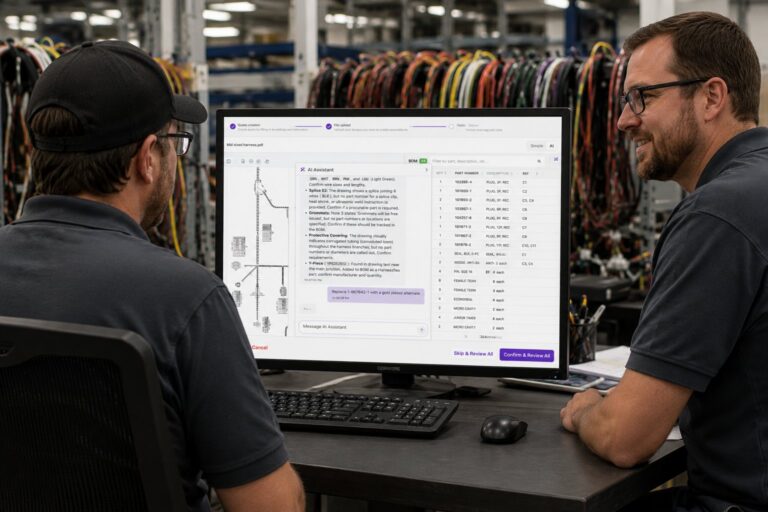
The business case for modernizing quoting is solid. The logic holds. Yet for many wire harness manufacturers, the move keeps getting pushed back. Not because the case is wrong, but because change—even obviously beneficial change—runs into forces a spreadsheet can’t capture.
To understand why, we spoke with manufacturers and industry veterans at different stages of the journey: a shop owner who believes in the technology but isn’t moving yet, a VP who spent two years championing it before committing, and a CTO who has led modernization across multiple companies and seen the same resistance play out repeatedly.
This is the first of three articles examining that problem: why some organizations are slow to move, how companies that do move bring their teams with them, and why the benefits in the first year extend far beyond faster quotes.
What the numbers say
A recent survey by the WHMA’s Innovation and Automation Technology group found that nearly three-quarters of wire harness manufacturers describe their quoting process as manual, time-intensive, and too slow to meet customer expectations. More than half say it depends heavily on engineer or tribal knowledge—the kind that disappears when someone retires. Only one in ten described their process as highly automated.
David Bergman, VP International Relations at the Global Electronics Association and Executive Director of WHMA, has been hearing these concerns across the membership. “We’re hearing from industry that it can take a month to put together a quote,” he says. “Companies are refusing business, not because they don’t want it, but because the quoting process is so painful. I had no idea, until recently, that there was this much pain in this industry.”
The tools to change that already exist. So why aren’t more shops using them?
Convinced but not moving yet
Parker Garrett is CEO of EMSCO, a Virginia-based wire harness manufacturer that has grown twelvefold in twelve years without a sales force. Built on Naval-engineer discipline, near-zero staff turnover, and a philosophy of simplicity and keeping promises, EMSCO runs efficiently by design.
Garrett knows Cableteque, the end-to-end wire harness quoting platform. He believes the technology is ‘ than what his company currently uses. But he hasn’t made the move.
His reason isn’t resistance. EMSCO does around ten new-from-scratch quotes a month and wins most of what it bids, largely from long-standing customers. Existing harnesses that need repricing are already mostly automated.
“Cableteque’s technology is better, there’s no question about that,” he says. “We do so little quoting because we have long-standing customers, and we win 98% of what we bid. So, the volume just isn’t there to make the economics work.” He’s not ruling it out. “There will be a day when it makes sense for us.”
Steve Pilipchuk’s version of this story is different—and in some ways harder to explain. As VP of Wallace Electronics, a Dallas-based cable and harness shop serving aerospace, medical, military, and industrial automation customers, Pilipchuk has been talking with Cableteque for two years. In fact, he’s recommended it to others across the industry. Only now is Wallace onboarding the platform.
“I’ve been championing Cableteque’s cause for two years,” he says, “and yet I’m probably one of the slower adopters of the platform.”
His quoting team has grown from one or two people to four just to keep up. “The only way to increase my bandwidth was to add more people. But it’s just not a sustainable model for continued growth. You can’t exponentially grow a quoting team to grow a business.”
So what took so long? “We got caught putting out fires, and day-to-day stuff,” he says. “But it was like Groundhog Day; the same problems weren’t going to go away until we finally forced the issue.”
Pilipchuk had considered onboarding a year earlier, but the timing wasn’t right for his team. What ultimately changed his mind was seeing the platform evolve based on feedback from customers like him.
When the labor estimation module arrived—making it possible to produce a fully costed quote with real labor rates rather than just a BOM—that became the turning point. “That made it a complete revamp of the quoting process, not just a piece of it. That resonated.”
Where the resistance actually lives
In both Herman Rozenberg’s and Steve Pilipchuk’s organizations, the resistance didn’t come from the top. It came from the quoting desk.
Rozenberg is CTO at Onshore Technologies and has led modernization efforts at several companies over his career. He’s seen the same reaction repeatedly. “They say, ‘I know those components better than the software. I will do a better job.’”
It’s not irrational. These are people who have spent years building expertise. They recognize when a drawing will cause problems on the floor, which suppliers actually deliver, and where cost surprises hide.
“They have years of expertise and a lot of pride in what they do. You come along and say there’s a platform that can do this in hours, and they think, wait a minute. That fear is legitimate. You have to address it directly.”
And once uncertainty appears, it spreads. “When the person doing the work isn’t sure, the manager gets nervous too. If your worker has doubts, those doubts go up the chain. As a boss, you think: if they’re not confident, maybe I’m going to lose a customer over this. So, the uncertainty compounds.”
Pilipchuk saw the same dynamic at Wallace. His team has relied on some version of their hybrid ERP-and-Excel quoting system for more than twenty-five years. “The resistance was across the board. It was different, it was unknown, and there’s a real sense of ownership in a system you’ve been using for twenty-six years. Pride of ownership and fear of the unknown, those were probably the two biggest holdups.”
Much of the hesitation centered on edge cases—particularly tariff complexity—rather than the broader improvement. “They were focusing on the 5%, not the 95%. The job was getting them to see the 95%, the time they’d get back, and the work they could actually do with it.”
The most persuasive argument focused on how the role changes, not what disappears. Today, quoters spend hours manually entering parts into ERP systems for quotes that may never convert to orders. With automation handling that data entry, the remaining work becomes more analytical.
“They’re way too qualified to be doing data entry. What’s left is the work that actually requires a skilled human: analyzing lead times, evaluating alternatives, catching problems before they reach the floor. It should be much more rewarding for them.”
Pilipchuk also ran a simple test to make the numbers tangible. His team had set their own benchmark: prove a 25% time savings and the system would justify itself. “We did a quick one-case analysis, and it came back at almost 75% savings. You’re probably not going to get 75% every time, but you’ll get way more than 25%. And these aren’t minimum-wage jobs you’re paying your quoters. A 25% saving in that department is a significant number.”
Rozenberg’s approach is even more direct. When a customer needs a quote quickly, he uses the moment as a demonstration. “I like to challenge people. When a customer needs a quote in two days, and the team says they can’t do it, I get them to use the platform. And then I say, ‘You see?’ With this, you can make it. Without it, you can’t.”
His other strategy is to start small. “Assign one person. Make them the trustee. When they start to become capable and confident, the others will follow.”
What staying put costs
Onshore Technologies has already felt the consequences of slow quoting. “We lost orders because of slow response and long cycle times,” Rozenberg says. “With leading OEMs in Medical, Defense, Commercial Space, and Aerospace, it’s all about timing. They don’t care how much it costs. If you can’t turn it fast, they go somewhere else.”
And the cost compounds over time. “You’re losing revenue. You’re losing growth. You’re sometimes losing the customer. Innovation today isn’t just technical, it’s operational. And you can’t push it to next month or next quarter. There is no time.”
Wallace Electronics faces a quieter version of the same problem. “There are quotes we don’t even go after right now, because I know we can’t turn them fast enough,” Pilipchuk says. “There’s no point getting a quote to a customer in a month when they’ve already bought the parts.”
He believes the competitive implications are inevitable. “You might keep your one or two best customers for a while, but you’re not going to be competitive, and you won’t be able to grow. Eventually, someone like me, or one of Cableteque’s other customers, is going to sneak into your bubble.”
“A new purchasing agent, a quality issue, or something will open the door. And there’s a lot of power in getting a quote back within a day rather than two weeks. By the time two weeks are up, they’ve forgotten who you are.”
Where to start
No one interviewed for this article argues for ripping out existing systems overnight. The practical starting point is smaller. Run a side-by-side quote comparison before making any decisions. Let the output speak for itself. Bring the quoting team in early. The resistance is real, and presenting a done deal only hardens it. Find the person already drawn to new tools and start there. And be honest about what staying put is costing—not just in time, but in the quotes you’re not pursuing, the accounts you’re not protecting, and the competitive gap opening between you and the shops that moved first.
As Pilipchuk puts it: “Eventually you have to do something. The problem isn’t going away.”
In the next issue, we will look at how companies are leading this transition—the change-management strategies, the internal dynamics, and what the first 90 days really look like.
Join us for Part 2: Winning Hearts and Minds.