












Improving Identification, Traceability, and Production Efficiency in Modern Manufacturing
By Tri-Star Technologies
Permanent wire identification has become a fundamental requirement across aerospace, defense, transportation, and industrial harness manufacturing. As harness designs become more complex and expectations for traceability increase, manufacturers must deliver durable, legible identification without slowing production lines or introducing additional handling.
Historically, marking was often treated as a secondary operation performed downstream of extrusion or as a stand-alone process prior to harness assembly. In today’s manufacturing environment, that approach introduces unnecessary complications. Additional labor, work-in-process staging, potential misidentification, and surface handling risks all add variability to what should be a controlled and consistent process.
As production requirements evolve, more manufacturers are integrating marking directly into continuous production through in-line UV laser systems. UV laser marking systems are now being designed specifically for in-line production, supporting both continuous wire and filament processing as well as cable and harness manufacturing. These systems enable identification during wire production and can also support unique identification of individual wires during downstream harness manufacturing.
From Secondary Operation to Integrated Process
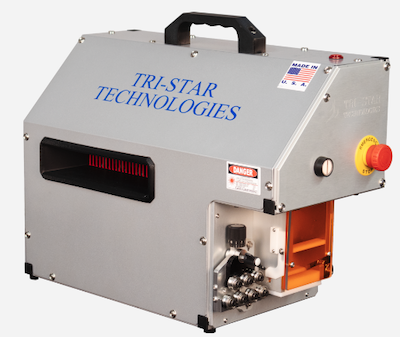
The M100LFGTTA-METEOR In-Line UV Laser Marking System from Tri-Star Technologies is designed to operate in-line with continuous wire, cable, and filament production. Integrating permanent marking into the production flow allows manufacturers to maintain throughput while improving traceability and process consistency. Extrusion environments present particularly demanding conditions. The marking system must maintain consistent spacing, adapt to changes in line speed, and preserve insulation integrity.
The M100LFGTTA-METEOR system is designed for direct integration into extrusion lines and supports production speeds up to 300 feet per minute (100 m/min). It accommodates laser-markable wire, cable, and tubing across a broad diameter range from 0.8 mm to 76 mm (3 inches). Encoder-based synchronization ensures consistent mark placement even when line speeds fluctuate. The result is repeatable, high-quality marking while preserving insulation integrity.
Continuous Reel-to-Reel and Fine-Gauge Applications
Many specialty wire producers, particularly those serving aerospace and high-performance sectors, rely on reel-to-reel processes for fine-gauge conductors and insulated filaments. These products require exceptionally stable tension and precise presentation within the marking zone. Thin insulation layers and small diameters leave little tolerance for mechanical disturbance, and marking systems must maintain consistent repeat intervals while operating at high linear speeds.
Mechanical contact-based marking can introduce subtle tension variations that affect winding consistency. Ink-based systems may struggle with uniformity on small-diameter substrates. Off-line marking increases handling and the risk of product mix-ups.
UV laser marking offers a distinct advantage in these environments because it is entirely non-contact. By eliminating physical interaction with the conductor, the process preserves tension stability and insulation geometry. Encoder-controlled synchronization maintains accurate mark spacing during ramp-up and speed changes, while the precision of UV laser technology supports clear identification on fine-gauge wires used in complex harness assemblies.
Impact on Harness Manufacturing
Although extrusion and filament marking often occur upstream of final harness assembly, mark clarity directly affects downstream operations. Marks must remain clear and permanent after winding, cutting, stripping, and final harness assembly. In harness manufacturing environments where operators may handle dozens or hundreds of wires within a single assembly, clear and durable marking reduces the time required for wire selection and verification while minimizing errors during assembly.
The Tri-Star Technologies M100LFGTTA-S laser marking system is designed to integrate with Schleuniger cut-and-strip machines. Integrated with Schleuniger’s Cayman software, the M100LFGTTA-S provides MIL-SPEC compliant laser marking, cutting, and stripping capabilities for optimized wire harness production.
Applying identification during production rather than as an isolated secondary step reduces the chances of labeling mistakes or misidentification. UV laser marking is widely used in aerospace and defense applications. Where MIL-SPEC compliance is required, UV laser marking supports non-destructive identification while helping manufacturers meet stringent marking requirements when materials and process parameters are properly qualified.
Engineering Integration Considerations
Successful implementation of in-line UV laser marking requires careful attention to wire presentation and synchronization. Stable guidance through the marking zone ensures consistent results, while proper encoder calibration is critical for maintaining spacing accuracy at varying speeds. Insulation compatibility should be validated during qualification to confirm mark contrast and permanence.
Tri-Star’s laser marking systems are designed to address these variables through automated focus control, encoder synchronization, and modular system configuration. Encoders synchronize marking with variable line speeds to maintain consistent spacing. The systems accommodate various wire and tubing diameters, helping maintain proper laser focus without requiring manual adjustment of laser height. Because the systems are modular, they can be configured for both large-diameter cable extrusion and fine-gauge reel-to-reel systems without requiring separate marking platforms.
This flexibility allows manufacturers to standardize marking technology across multiple production lines, reducing complexity while supporting diverse product portfolios.
Conclusion
The future of wire harness manufacturing is defined by precision, traceability, and seamless automation. As production environments evolve toward greater digital integration and data-driven quality control, every process step must contribute to overall efficiency rather than operate independently.
Identification is no longer just a compliance requirement. It links material tracking, assembly verification, and certification records throughout the manufacturing process. In that environment, marking must operate at full production speed while delivering consistent and permanent results.
The Tri-Star Technologies M100LFGTTA laser marking product line reflects this shift. By embedding high-speed, non-contact UV laser marking directly into extrusion and reel-to-reel operations, these systems transform identification into an integrated production function. Their ability to maintain speeds of up to 300 feet per minute across a wide diameter range supports the increasing demands of aerospace, defense, transportation, and advanced industrial markets.
With modular integration capability and consumable-free operation, the M100LFGTTA series positions marking as part of the intelligent manufacturing infrastructure shaping the next generation of wire and harness production.
In an industry where reliability defines reputation, the ability to apply permanent identification at production speed has become a competitive advantage.
About Tri-Star
Tri-Star Technologies specializes in advanced wire marking, laser identification, and automation solutions for highly regulated industries including aerospace, defense, medical device, and industrial manufacturing. With decades of experience in precision marking technologies, Tri-Star develops systems designed to integrate into modern production environments.
For more information, visit:
www.tri-star-technologies.com