












What really happens before the quote
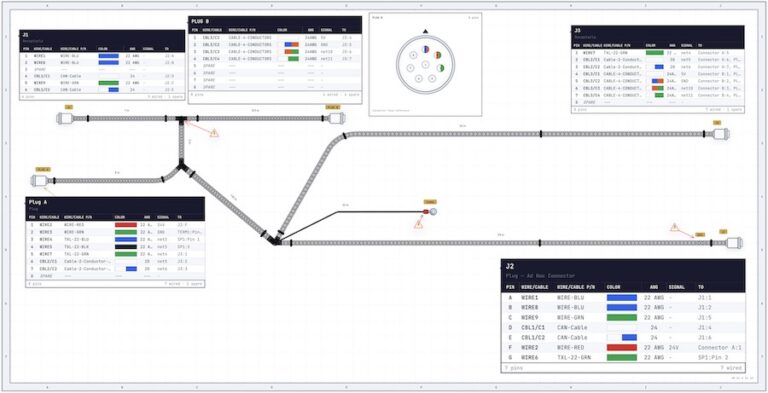
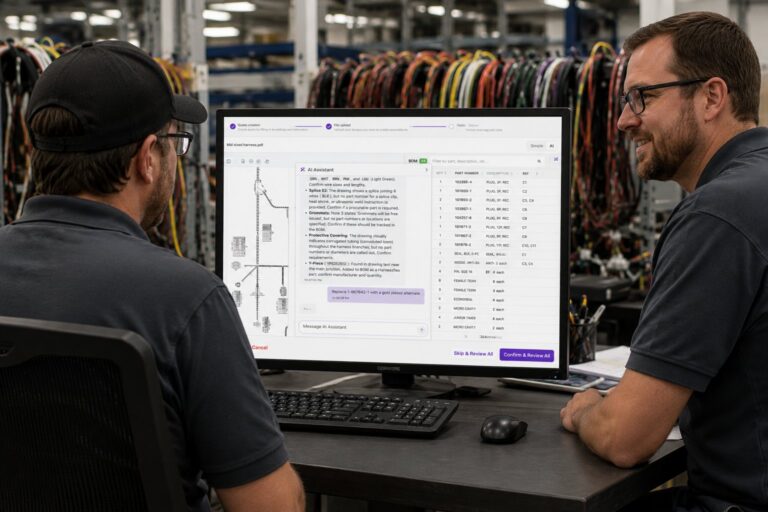
We’ve had some fantastic technical articles lately in Wiring Harness News, a few of them thanks to Cableteque, and it got me thinking. We spend a lot of time talking about quoting. Labor, materials, margins… all the stuff that comes after. But what about the step before the quote? That moment when a drawing first hits your desk.
What are you actually looking for? What jumps out? What makes you nervous? And maybe most importantly, how much of the quote is already forming in your head before you’ve even touched a spreadsheet?
So I reached out to four folks in our industry, Steve Pilipchuck, Vice President of Wallace Electronics; Kory Ewell, President of KCM Cable and Manufacturing; Carl Wisniewski, President of W3 Design & Engineering (you’ll want to read more about W3 Design & Engineering at the end of this article); and Jason Starkey, President of Starkey Products. I asked a simple question: what really goes through your mind when you first look at a harness drawing?
Start with the Basics… But Everyone Has Their Own Way
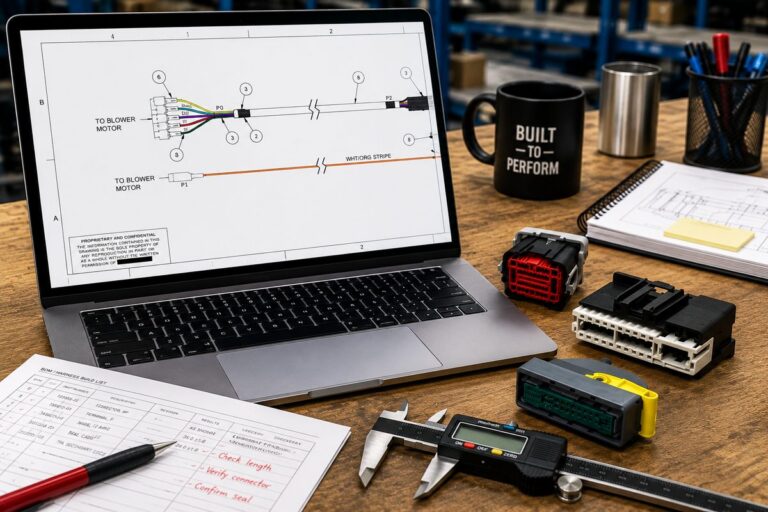
There’s no single “right” place to start, but there are definitely some common threads. For Steve, it begins with the fundamentals. “The first thing I’ll look at is to make sure there’s a bill of materials,” Steve said. “And not just internal part numbers…manufacturer part numbers.” If that’s not there, the job doesn’t even make it to the quoting team.
Kory is looking at much of the same, but with a slightly broader lens. He wants to see a BOM, clear measurements, and notes. If those elements are present, he knows he’s at least working with something usable. “If those things are there, I know I’ve got a 60 or 70 percent chance I’m not going to have any questions.”
Carl takes a slightly different approach. He goes straight to the title block, looking at things like the customer, harness name, and revision level to get his bearings. A low revision level might mean a new design that hasn’t been fully vetted. A higher revision level usually means there’s some history behind it. “That rev level is kind of critical. With a lower rev, you’ve got to dig in deeper and be more careful,” he said.
And then there’s Jason, who comes at it from a slightly different angle. Before he even gets deep into the drawing, he’s thinking about what’s already on his shelf. “Are the components something we already have in house? …because that translates to a lower price and a higher chance we can actually win the job.”
These are slightly different starting points, but they all drive toward the same outcome. Can we build this, and is it going to make sense for us?
That First Scan Tells You More Than You Think
It doesn’t take long to get a feel for a job. Within the first minute or two, most experienced people already have a sense of what they’re dealing with. Carl is looking at overall complexity, circuit count, number of connectors, general layout. That quick scan helps him estimate how much time he’s about to invest. “It kind of gives me a feel for how long it’s going to take me to do the rest of the work,” he revealed.
Kory takes it a step further. For him, the drawing is a reflection of the company behind it. If it’s clean, organized, and complete, that’s a good sign. If it’s messy or unclear, he knows what’s coming. “If a drawing isn’t clear… I know I’m going to have questions throughout the entire build and that’s more work and more time.”
And sometimes the warning signs don’t even come from the drawing itself. “If the email says, ‘you’re probably going to have a lot of questions,’ that’s already telling you something,” Kory advised. “It’s a red flag… they know themselves that their drawing isn’t good.”
Red Flags Are Everywhere If You Know Where to Look
Every one of these leaders had a slightly different list of red flags, but they all pointed to the same underlying issue: lack of clarity. Carl pays close attention to how things are dimensioned. Something as simple as where a measurement is taken from can make the difference between a harness that fits and one that doesn’t. “If you don’t know how they’re dimensioning things, you could build it too long or too short.”
Kory notices communication breakdowns. Notes that don’t clearly tie back to the drawing are a big one. “If the notes are there but there’s no arrow showing where they apply, that’s another huge red flag.”
Steve is focused on missing fundamentals. No tolerances, incomplete BOMs, or part numbers that don’t trace back to a manufacturer. Those are immediate stop signs. “With things like that, we know we have to go back to the customer right away.”
And then there are the situations that just don’t pass the smell test. Kory shared an example of receiving a drawing with key information redacted, even after signing an NDA. That was enough for him to walk away from the job.
Trust Nothing, Verify Everything
If there’s one universal rule that came out of these conversations, it’s this. Don’t assume the drawing is correct. Kory said it plainly. “I don’t ever trust anything and I double check everything. And when you don’t, it comes back to bite you.” He shared a situation where he trusted the BOM quantities, didn’t double-check them, and ended up delaying the job and increasing his costs.
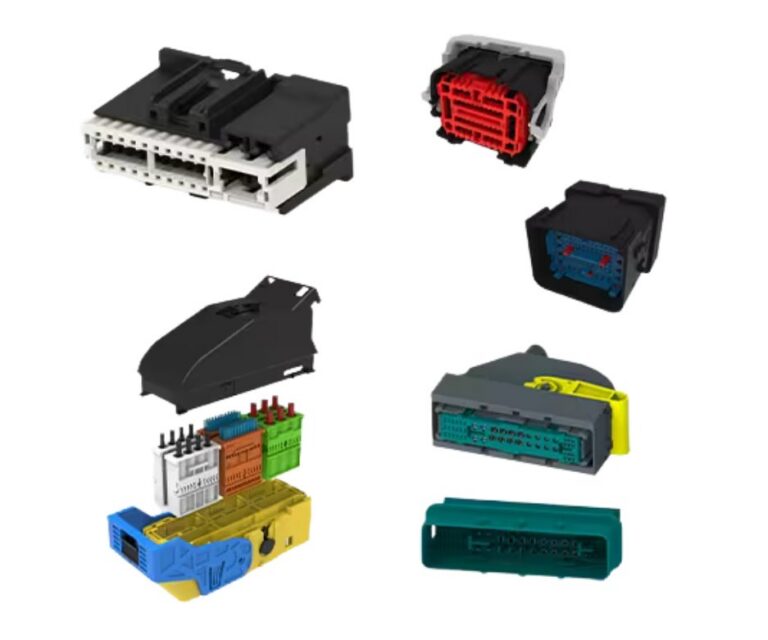
Carl approaches verification in a very structured way. Cross-referencing part numbers, checking manufacturer data sheets, and making sure terminals, seals, and wire sizes all work together. It’s not glamorous work, but it’s necessary. “You have to go to the manufacturer specifications to make sure you’ve got the correct terminal types, sizes and seals that actually match. Because at the end of the day, everything might look fine on paper, but that doesn’t mean it will work in the real world.”
The Same Mistakes Keep Showing Up
It probably won’t surprise anyone reading this that most of the issues these guys see aren’t new. They’re the same problems over and over again.
Missing information is a big one. Carl sees drawings where only the connector part number is listed, leaving everything else to be figured out. “It’s really nice when it’s all specified… but a lot of times it’s not.”
Kory pointed to a major root cause. Inexperience. Engineers who have never actually built a harness can design something that works in theory but creates problems in production. “They don’t know the downstream process, so they design things that don’t really work in the real world.”
Steve sees a lot of copy-and-paste errors. Notes that don’t apply, tolerances that don’t make sense, and inconsistencies that come from reusing old templates. “They’ll have notes that don’t even apply, just because they used a template. That’s always concerning.”
When Do You Know It’s Actually Buildable?
At some point, every drawing has to pass the ultimate test. Can it be built without guessing?
For Carl, that’s the line in the sand. “If you can produce a complete cut sheet from the drawing without guessing, then it’s probably good enough.”
Kory takes a slightly more hands-on approach. He can usually tell after a thorough review, but sometimes it takes building that first article to really know.
Steve’s team often reaches that conclusion during the quoting process itself, where a deeper technical review happens. By that point, you’re already invested, so the goal is to catch anything that could cause problems downstream.
Not Every Job Is a Good Job
One of the more interesting takeaways was how much emphasis was placed on deciding what not to take on. Jason is constantly evaluating whether a job fits what his shop already does well. Do they have the materials, the tooling, the familiarity?
Kory looks just as closely at the customer as he does the drawing. If communication is poor or expectations seem unrealistic, that’s usually a sign to move on. “If I have to babysit them, it’s not going to work for us.”
Steve’s team evaluates capability. Testing requirements, wire sizes, equipment limitations. If it falls outside their wheelhouse, they won’t quote it. “If we’re not tooled for it, it just doesn’t make sense for us.”
One common thread in these discussions was that sometimes the best decision is to say no early.
The Quote Has Already Begun
Everyone agreed on one thing. The quote starts taking shape the moment you look at the drawing. Carl is mentally building out material costs as he pulls parts together. Kory describes it as an explosion of thoughts. Tooling, labor, suppliers, training, all coming together. “It’s like fireworks… things just start going off.”
Steve’s team is already structuring labor and costing materials. Jason is thinking about efficiency and margin from the moment he sees the components.
In other words, the quoting process doesn’t begin after the drawing review. It begins during it.
One Last Thing (Especially for Newer Folks)
I asked each of them what the biggest mistake is for someone new to the industry looking at a customer drawing. The answer came quickly and consistently.
“Assuming it’s correct.”
That might be the most important takeaway in this entire article. If you trust the drawing without verifying it, you’re setting yourself up for failure.
Final Thoughts
Reading a harness drawing isn’t just a technical skill. It’s a combination of experience, pattern recognition, and a little bit of instinct. It’s about understanding not just what’s on the page, but what might be missing, what might be wrong, and what questions still need to be asked. Before the quote, before the numbers, before the spreadsheets, there’s a moment where you look at that drawing and make a judgment call. Is this going to go smoothly, or is this going to be a problem? The experienced folks know the answer faster than you might think.
About W3 Design & Engineering
W3 Design & Engineering is an electrical engineering services company that specializes in wire harness design and support. They work closely with contract manufacturers, providing technical and engineering assistance in areas where many shops may not have dedicated internal resources.
Their services include support with quoting, design validation, and test fixture setup, along with ongoing remote engineering support. By helping manufacturers navigate the technical side of harness design and documentation, W3 Design plays a key role in bridging the gap between engineering and production, especially during the quoting and early evaluation stages of a project.