







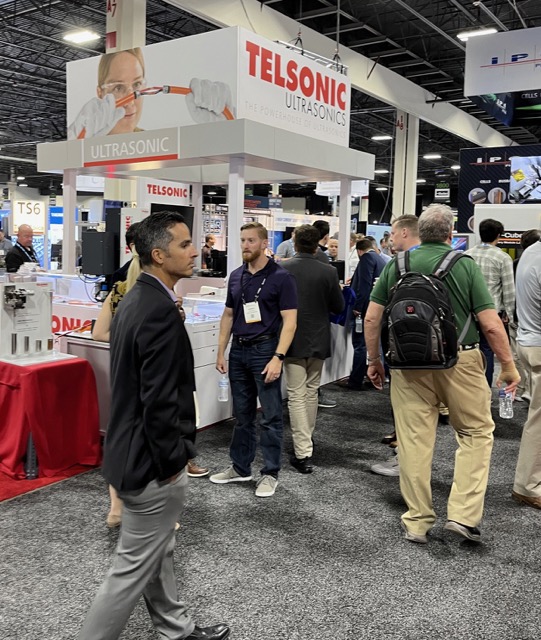










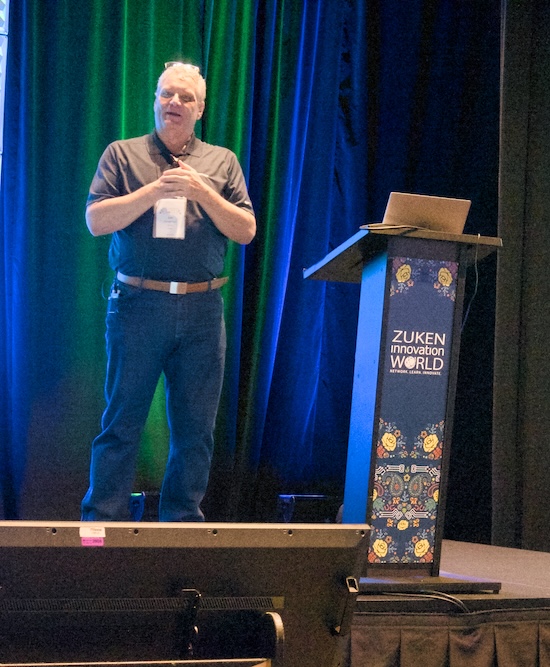
Editor’s Note: At this year’s Zuken Innovation World in Dallas, WHN attended a presentation by Lee Humphreys, Regional Sales Manager for Komax Corporation, titled “Closing the Loop: Extending the Digital Thread from Design to Production.” What follows is not a transcript of the session, but rather a look at the ideas that resonated most strongly and why they matter to manufacturers navigating an increasingly complex production environment.
Early in Lee Humphreys’ presentation, I scribbled a note in my notebook that had nothing to do with software, automation, or digital manufacturing. It simply read: “We don’t lose money until we take a job and don’t perform.”
Lee attributed the remark to one of his customers, although the exact wording may have been slightly different. The sentiment, however, was unmistakable. Winning work isn’t what puts manufacturers in trouble. Trouble starts when a company wins the work and then discovers it can’t execute the job the way it expected. Labor takes longer than estimated. Scrap exceeds assumptions. Engineering changes ripple through the shop floor. Quality issues emerge late in the process. Margins disappear one small problem at a time.
By the end of Lee’s presentation, it became clear that everything he had discussed, from automated wire processing to feedback dashboards, ultimately traced back to that simple observation. The digital thread wasn’t really about technology for technology’s sake. It was about improving an organization’s ability to perform consistently and predictably.
And Lee should know. Before joining Komax in 2014, he spent 31 years with Packard Electric and Delphi Automotive, eventually serving as North American Engineering Superintendent for Delphi Packard Electric. He helped develop automated assembly equipment, oversaw wire process equipment selection and support, and spent decades watching manufacturers struggle with the same fundamental challenge. The products changed and the technology evolved, but many of the underlying challenges remained surprisingly familiar.
As Lee told the audience in Dallas, quality itself is no longer enough. “Quality is expected,” he said. “It’s a given. It’s no longer, ‘My quality is better than the other guy’s.’ If your quality isn’t the best, you’re not in the game.”
Lee believes many manufacturers are solving the wrong problem. The machines aren’t usually the bottleneck. The information flow is.
One of his first comments drew laughter because of how bluntly it cut through the industry’s tendency to view automation as a cure-all. “I go out and I talk to a lot of panel manufacturers who want our equipment,” he said. “The first thing I tell them is, if you want to buy my machine just to build wires and you’re not going to change your operating system, I’m just going to make more expensive wires for you.”
That remark gets at a common assumption in manufacturing. For years, companies have pursued improvement by targeting individual processes. They invest in a machine that cuts and strips wire more efficiently. They purchase testers that improve inspection speed. They add equipment that boosts throughput in one department. Yet if the information feeding those machines remains fragmented and disconnected, many of the underlying inefficiencies remain intact.
“You can’t have this disconnected manual step and not have automation going all the way through,” Lee explained. “You’ve got to really be looking at the digital integration and what it takes to make the machine that you’re going to purchase fit into your design and fit into your operating system.”
Lee wasn’t arguing against automation. His point was that automation delivers its greatest value when the processes surrounding it evolve as well. Otherwise, companies simply automate inefficiency.
To illustrate that point, Lee painted a picture that anyone who has spent time on a production floor would recognize immediately.
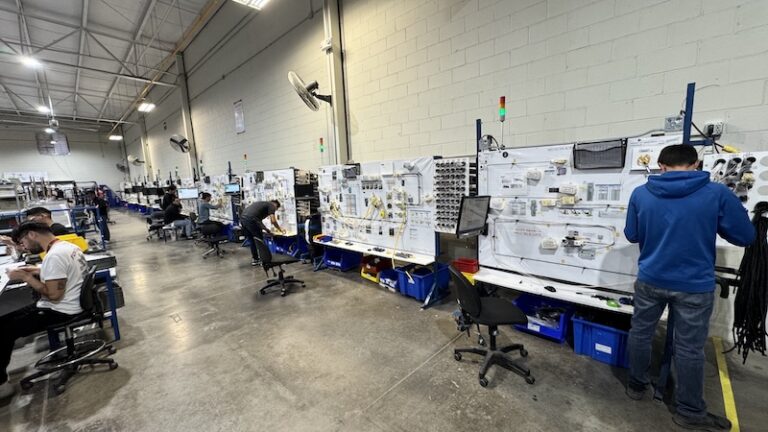
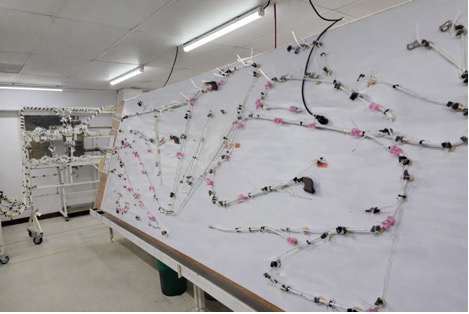
A design package arrives as a PDF. Someone prints multiple copies. One set goes to the people preparing wires. Another goes to panel assembly. Quality maintains its own documentation. Supervisors track progress manually. If revisions occur, somebody has to hunt down outdated paperwork and distribute updated versions.
“It seems pretty simple,” Lee said. “It’s the way we’ve done it. Xerox machines are pretty cheap, and they’re ubiquitous in our operations.”
The problem is that every manual touchpoint introduces another opportunity for delay, confusion, or error. Maybe someone transcribes a wire length incorrectly. Maybe production continues working from an outdated revision. Maybe engineering assumes everyone has the latest information when they don’t. Even something as straightforward as answering a customer’s question about delivery status can become an exercise in detective work.
“How far along is the harness or panel?” Lee asked. “Can I look down the sheet and say he’s gotten through sixty percent of the wiring? That’s all invisible without somebody going out there and doing that manually.”
Then there is the labor issue. The strategy of simply adding more people to keep pace with growth has become increasingly difficult to sustain. Skilled labor shortages have forced manufacturers to reconsider how they build products and how much institutional knowledge their processes require. When critical information exists only in someone’s head, every retirement, resignation, or reassignment creates another vulnerability.
Perhaps the most revealing story Lee shared involved a major manufacturer in the Dallas area.
Representatives from engineering, production, and quality gathered to discuss automation opportunities. On the surface, everything appeared to be functioning reasonably well. Each department understood its responsibilities. Everyone had their own metrics and priorities. Then Lee examined the design data.
One engineer favored Molex terminals because he knew those part numbers by heart. Another routinely specified a different manufacturer’s equivalent part. Others had their own preferences. In the end, four different versions of essentially the same ring terminal found their way into the product.
No one had deliberately created waste. Engineering was optimizing engineering. Production focused on production. Quality focused on quality. Yet each terminal variation carried consequences. It translated into different applicators, different tooling, additional inventory, and more setup complexity. “That’s $35,000 for every press that they put on that machine,” Lee recalled.
The room suddenly understood that the issue wasn’t one bad decision. It was the accumulation of disconnected decisions made in isolation. The organization wasn’t functioning as a unified system. It was functioning as a collection of departments, each making reasonable decisions without visibility into the broader impact those decisions created downstream. “Those silos of information,” he said, “make everything far less efficient and far more difficult.”
That’s the problem the digital thread is intended to solve.
At its simplest, the digital thread means the same engineering data follows a product from design through production, testing, and feedback. Rather than repeatedly translating information into different formats, everyone operates from the same source of truth. Design intent remains intact because production is drawing from the same information engineering created. Quality verifies against the same specifications used upstream. Feedback returns to the beginning of the process so that future decisions benefit from present experience.
“It’s one true piece of information,” Lee said. “Everybody knows all of the information at the same time.”
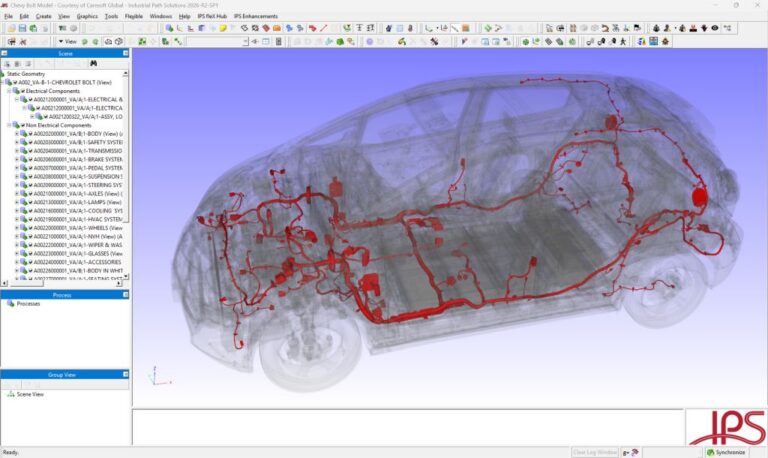
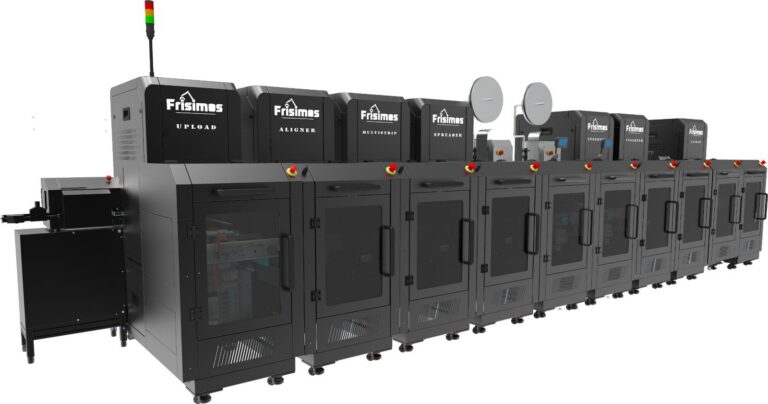
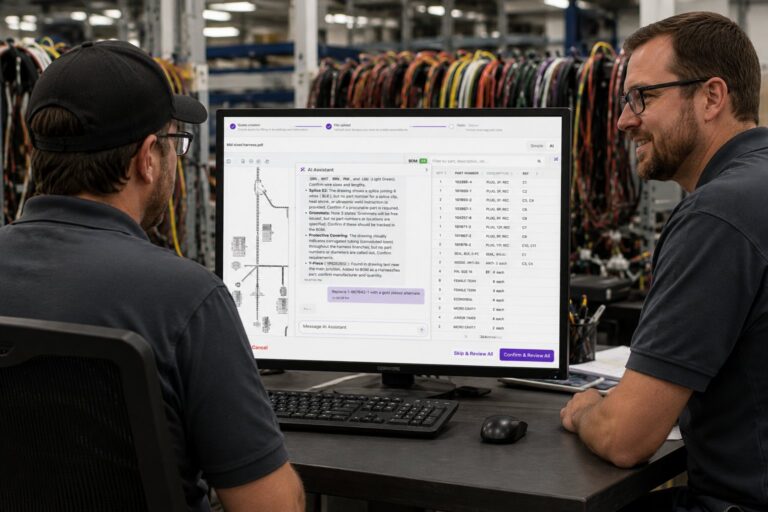
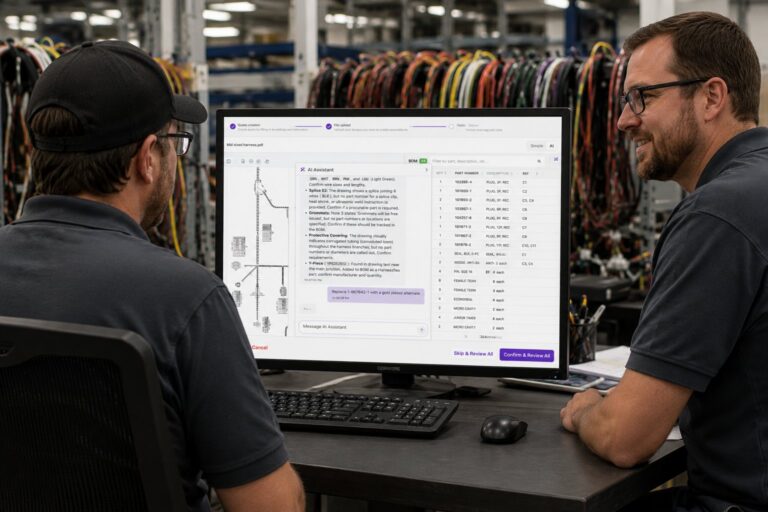
In the workflow Lee described, Zuken’s E3.series serves as the starting point, creating the engineering data that drives downstream processes. That information can then be used by Komax production equipment and Cirris testing systems, allowing everyone to work from the same validated dataset rather than multiple versions of the same job.
The strongest example involved a customer whose facility contained several large trash cans positioned beside production areas. Workers preparing wires for panel assembly routinely cut them longer than necessary. If a two-foot lead wasn’t available, they grabbed a four-foot lead. When those ran out, they used six-foot leads. Excess wire was trimmed away and tossed into the nearest drum. “They had 55-gallon trash cans next to the panel,” Lee recalled.
The practice had become so routine that nobody questioned it anymore. It was simply how things were done. Like many inefficiencies that develop over years of growth, the trash cans had become part of the landscape. People walked past them every day without asking whether there might be a better way.
Eventually, that customer committed to a broader digital strategy. Design data flowed directly into production. Wire lengths became precise rather than approximate. Processes were standardized and operators worked from validated information instead of estimates. The drums disappeared.
According to Lee, the results stunned everyone involved. “They recouped the investment in equipment and processes in scrap savings alone in under a year,” he said. It had little to do with making wires faster. It came from eliminating waste that had become institutionalized through familiarity.
Later, Lee brought prospective customers through the facility to see the operation firsthand. The visitors listened as the manufacturer described the effort required to implement the changes. New equipment had been installed. Processes had been redesigned. Employees had adapted to different ways of working. The transition had required commitment, investment, and patience.
Eventually, one visitor asked the obvious question. After all that effort, would they do it again? “The manager turned to the customer,” Lee said, “and said, ‘I already am.'” The company had already ordered another machine, larger and more expensive than the first. “As a salesperson,” Lee admitted, “I couldn’t do any better.”
It was a strong endorsement of the digital thread, but Lee argued that even these examples represent only part of the opportunity.
Many manufacturers already do a reasonable job of moving information downstream. Engineering releases a job, production builds it, and quality verifies the finished product. What Lee was really talking about was the flow of information in the opposite direction. Production data should help improve future estimates. Quality findings should make their way back to engineering. Managers should be able to see exactly where a job stands without chasing paperwork, and customers should be able to get answers about revisions or delivery schedules without waiting days for someone to investigate.
Lee stressed that manufacturers need to move beyond educated guesses. As he described it, the goal is not simply to automate production. It’s to create enough visibility and confidence in the process that a manufacturer can quote work more accurately, respond faster, and execute more consistently than the competition.
Which brings us back to the note I scribbled in my notebook at the beginning of the presentation: “We don’t lose money until we take a job and don’t perform.”
It may not have been the official theme of the presentation, but it captured the underlying message perfectly. Manufacturers rarely lose money because they fail to win business. More often, they lose money because the assumptions they make before accepting the work fail to survive contact with reality. The job takes longer than anticipated, scrap exceeds expectations, engineering changes ripple through production, and communication breaks down at precisely the wrong moment. Individually, none of those problems may seem catastrophic. Together, they can quietly drain the profitability from what once looked like a successful project.
By the time Lee concluded his presentation, it was difficult not to view the digital thread through that lens. It wasn’t really about software integration or machine connectivity. Those are simply tools. The larger objective is creating an organization capable of executing consistently, preserving design intent from engineering through production and quality, and learning from itself over time.
Most importantly, it’s about building the confidence that when the next project arrives, the company can perform exactly the way it believes it can.
——-