






















Defense programs are asking the wire harness industry for greater volume, shorter lead times and lower costs. Meeting that challenge may require much more than simply adding workers.
Sometimes the most interesting industry conversations are the ones you were never invited to in the first place.
This one began with a LinkedIn post from Greg Shine, Managing Director of Blue Valley Capital, discussing the growing demand for high-reliability wire harnesses and cable assemblies for the defense market. Nadav Ofir, Business Development at Frisimos Technologies, commented on the post and suggested the two have a conversation. I saw the exchange and, with perhaps more enthusiasm than etiquette, asked if I could listen in.
Fortunately, they said yes.
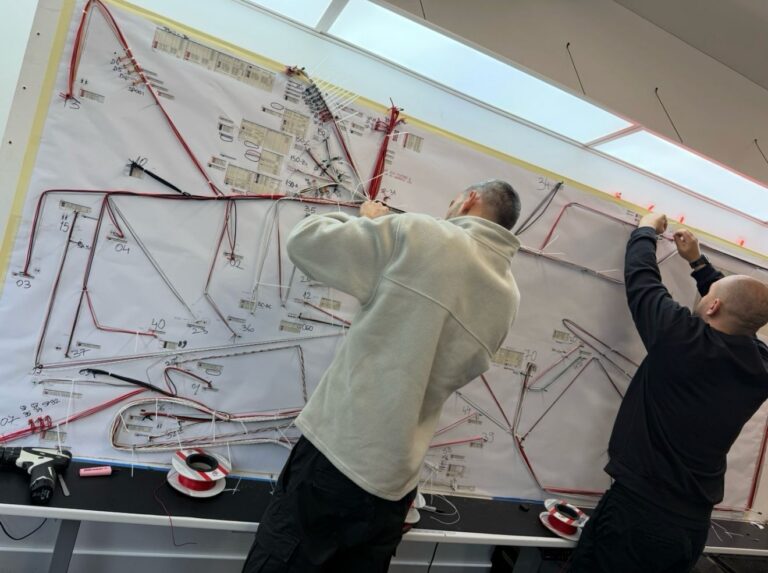
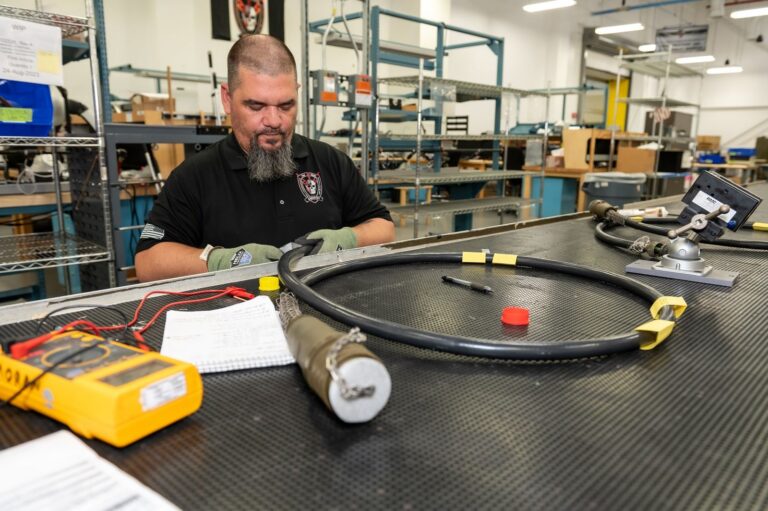
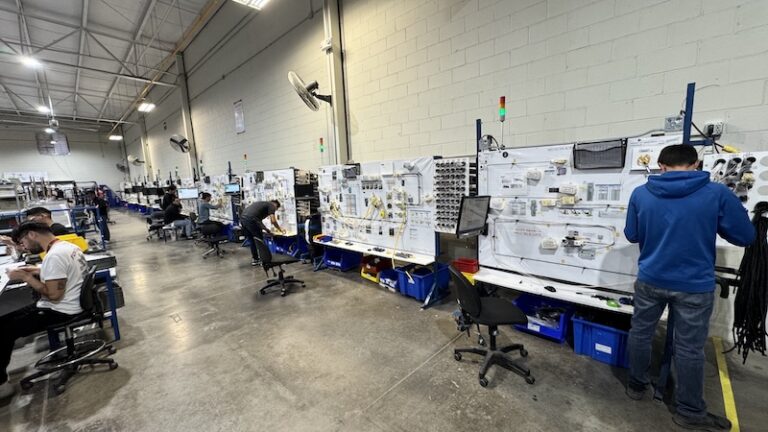
What followed was less an interview than a pretty wide-ranging discussion about a problem that is becoming increasingly important to the wire harness industry. Defense customers need more product, and they need it faster. It’s no secret wire harness manufacturing remains heavily dependent on skilled manual labor, which is exactly the resource manufacturers are having the most difficulty finding. So where is all that additional capacity going to come from?
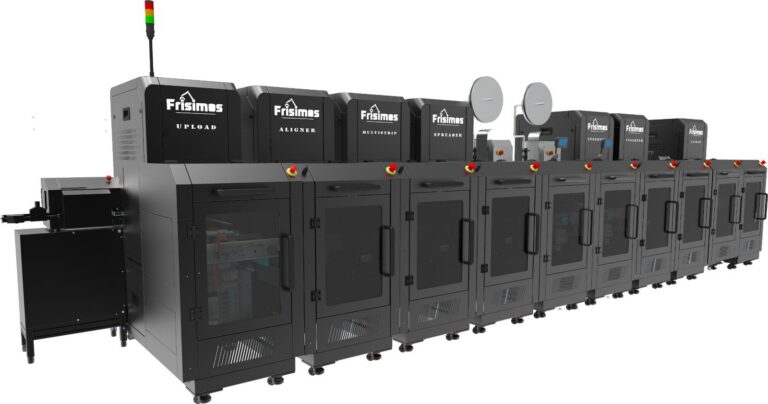
Nadav and Greg approach that question from very different directions. Frisimos Technologies, based in Israel, develops automation for cable assembly manufacturing. When Wiring Harness News first profiled the company (May/June 2024), Frisimos was developing a modular approach to automated cable assembly, including robotic systems capable of recognizing and manipulating individual wires. So naturally, Nadav tends to look at the capacity problem from a manufacturing technology and engineering perspective.
Greg comes at it from a different direction. Blue Valley Capital specializes exclusively in sell-side advisory for wire harness and cable assembly manufacturers. Greg spent more than 35 years in the industry himself, including building and eventually selling SHINE Wire. Through Blue Valley and its HarnessPoint exit readiness program, he now spends a great deal of time talking with harness company owners, buyers and investors. More and more of those conversations involve defense opportunities.
As the discussion got going, it became apparent that they were seeing a lot of the same things from two very different vantage points.
A Different Demand Equation
Nadav believes something fairly fundamental is changing in defense procurement. For decades, many military programs were characterized by relatively low production volumes, long development cycles and very sophisticated, high-value products. Those programs obviously still exist, but recent conflicts have also demonstrated the need to replenish inventories and produce certain systems in much greater quantities.
“The sheer volume that the Department of War is pushing in their new tenders and programs is 10, 15, 20 times bigger than before,” Nadav said. At the same time, he noted, customers are expecting significant reductions in per-unit cost.
His point was that the emphasis is increasingly on volume, affordability and speed. Eventually that finds its way down through every tier of the supply chain. For companies making wire harnesses and cable assemblies, that presents a fairly obvious problem.
Nadav put it in very simple terms. If you had to produce the wiring for one missile before and now you have to produce wiring for ten, you still have the same person sitting at the same table. “How are you going to do it?” he asked.
Greg is seeing another part of the same problem. OEMs are moving through engineering and product development more quickly, which means harness suppliers have to react just as quickly on the manufacturing side. The challenge isn’t simply producing more assemblies. Suppliers have to move faster from engineering through prototype and into production, and then be prepared to scale when the program ramps up.
“What we’re seeing is engineering working quicker, development is quicker from customers,” Greg said. “What the Department of War wants is scale. They want things quicker.”
And they want them at lower cost. For Greg, meeting all three demands, speed, scale and cost, will be difficult without greater use of automation. “Automation is the key,” he said.
I found that particularly interesting coming from Greg because he isn’t in the business of selling automation equipment. He’s talking to owners who are deciding where to invest, along with buyers looking at which harness businesses are positioned for growth. He said roughly half of the companies participating in Blue Valley’s HarnessPoint exit readiness program at the time of our conversation were focused on defense work.
And increasingly, those companies are trying to figure out how to do more and do it faster.
Capacity Cannot Be Acquired Into Existence
There certainly seems to be plenty of investment capital interested in the wire harness business these days.
Greg said private equity firms and strategic acquirers are actively looking at wire harness and cable assembly companies, particularly those with defense exposure. Some want to enter the defense market through acquisition. Others already have a defense platform and want additional capacity.
But Greg made a point that I hadn’t really considered before. “They’re buying companies but not really adding capacity to the equation.”
You can certainly buy a harness manufacturer and immediately gain its people, equipment, certifications, customer relationships and production capability. But after the transaction closes, the industry as a whole isn’t necessarily capable of producing any more harnesses than it could the day before. The name on the ownership documents has changed, but the same people and machines are still producing the product.
“I don’t have the answer to how we’re going to get more folks on the floor,” Greg said, “but it’s a combination of people and equipment.”
Finding the people is obviously part of the problem. Nadav talked about the difficulty manufacturers are having attracting younger workers into production jobs and apprenticeships. At the same time, the products aren’t exactly becoming less complicated. Modern defense systems may incorporate communications, satellite connectivity, GPS, anti-jamming capabilities and a tremendous amount of electronics.
And while customers want more product at lower cost, nobody is suggesting that reliability takes a back seat. “It has to be combat reliable,” Nadav stressed.
Interestingly, smaller harness manufacturers do seem to be more willing to make substantial investments in automation than they were in the past.
During our conversation, I mentioned a small harness manufacturer I had visited with roughly 20 employees that had invested approximately $250,000 in a fully automatic wire processing system. Ten years ago, I don’t think you would have seen many companies that size willing to make that kind of commitment.
Greg has noticed something similar, particularly among younger owners. “They take a more risky or aggressive stance than some of the older founders that I deal with,” he said. “We’re seeing it in CapEx budgets where they are looking for more automation.”
Still, it’s one thing to decide you need the equipment and quite another to justify the investment.
The ROI Problem
A lot of Tier 2 and Tier 3 harness manufacturers are relatively small companies. They may have 20, 50 or 150 employees, and many have spent years dealing with the ups and downs of program-based business. You win a program and suddenly you’re busy. Lose one, or have a program end, and you may have people and equipment without enough work to keep them occupied.
Under those circumstances, it’s understandable why an owner might think twice about a major capital investment.
That’s part of the problem Nadav sees. These companies are being told to produce more, produce it faster and reduce cost. Machinery can certainly help accomplish that, but now the owner has to buy it, integrate it, maintain it and have people capable of running it.
Nadav explained that the problem for many smaller manufacturers isn’t recognizing the need for automation but justifying the investment. Expensive equipment is difficult to pencil out when future production volumes are uncertain. Longer-term customer commitments and more reliable production forecasts can give manufacturers the visibility they need to calculate a reasonable ROI and invest with greater confidence.
That part of the discussion led Greg to something he’s been noticing in defense work. Historically, defense work had plenty of peaks and valleys. From an owner’s standpoint, that makes long-range planning difficult. It also makes a company harder for a potential buyer to evaluate because future revenue can be difficult to predict.
Greg said he is now seeing more long-term contracts and purchase orders extending for years.
“It used to be a real lumpy business,” Greg said. “But what we’re seeing now are more contracts and long-term purchase orders coming in for years.”
For a manufacturer trying to decide whether to buy a piece of equipment, that’s a big difference. An owner with several years of orders in hand can look at tooling, automation, hiring and other investments with a lot more confidence than someone wondering what the order book will look like six months from now.
Nadav immediately connected that to the investment activity Greg was seeing. More predictable revenue helps take some of the risk out of the business. An investor can look farther down the road and make some reasonable assumptions about revenue rather than simply hoping the company wins the next program.
I suspect that has at least something to do with why there is so much money looking at this industry right now.
Do Not Wait for Perfect Automation
Nadav made another point that I think is particularly important for smaller and midsized harness manufacturers. “You don’t need to automate everything.”
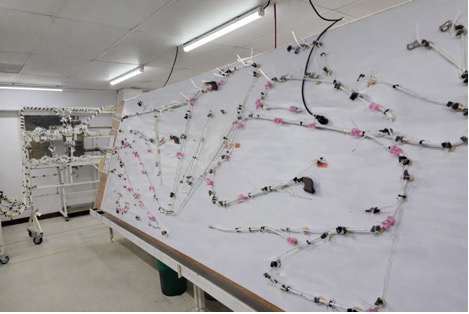
That’s worth remembering because when we talk about automating wire harness production, it’s easy to picture some giant machine where wire and connectors go in one end and a completed harness magically comes out the other. There has certainly been progress toward automating more of the process, but for most harness manufacturers that isn’t what the immediate decision looks like.
Nadav suggested looking at the bottlenecks first and applying automation or robotics where they can make the biggest difference. “Even some automation, some robotics where you have bottlenecks can make a big difference,” he said.
A manufacturer can automate a particular station or process, learn from it, and then move on to the next problem. “If you wait for the ultimate machine, it will never arrive,” Nadav said. “You need to break it down.”
Greg was essentially saying the same thing from the business side. “It doesn’t have to be perfect, but you still have to begin trying it,” he said.
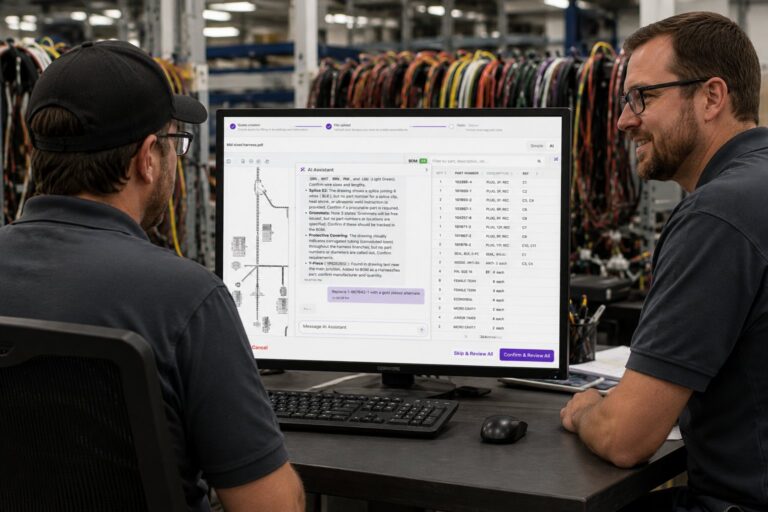
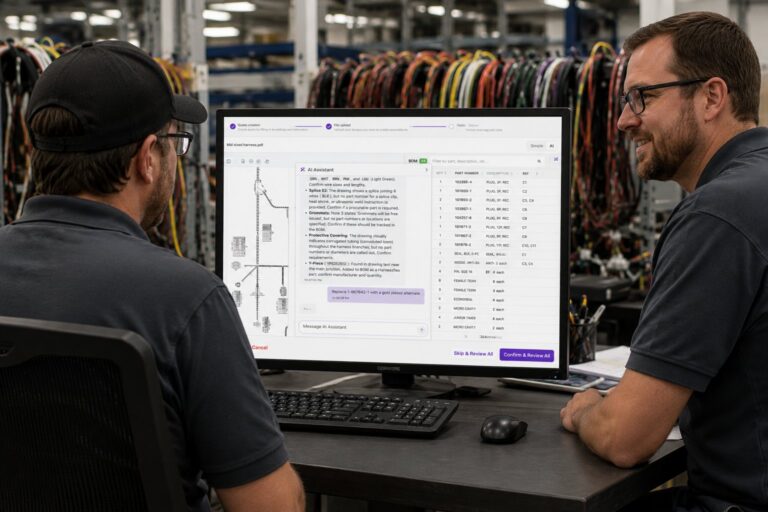
For a smaller harness company, that first step might be automated wire processing. It could be testing, digital work instructions, quoting software or some other process that is consuming labor and holding back throughput. It doesn’t necessarily mean tearing apart the factory and starting over.
Anyone who has spent much time around harness manufacturing knows why this is important. There are thousands of different products, relatively modest lot sizes in many cases, and plenty of operations that have stubbornly resisted automation. So perhaps the more useful question isn’t how to automate the wire harness factory. It is where automation can remove enough of a bottleneck to make a meaningful difference.
What If the Harness Itself Changes?
This was probably the point in the conversation where things took a direction I hadn’t expected.
Nadav’s argument was that we shouldn’t only be asking how to manufacture existing designs faster. In some cases, perhaps we should be asking whether they need to be designed that way in the first place.
Frisimos sees an opportunity to simplify some electrical architectures by moving portions of complex harness networks toward more standardized cable assemblies. Nadav wasn’t suggesting that complex harnesses are going away. His point was that perhaps every connection doesn’t need to remain part of one large, highly customized harness.
Even moving part of an architecture toward standardized cables could reduce manufacturing complexity and make replacement and maintenance easier.
“The same cable can be used in multiple platforms,” he said, using different sizes of unmanned aerial vehicles as an example. Rather than each platform requiring an entirely distinct design, some common cable assemblies might be used across several of them.
Nadav described this as moving, where practical, from “build to spec” toward what he calls “build to shelf.” By replacing portions of highly customized harness architectures with standardized cable assemblies, manufacturers could potentially produce common cables in volume and keep them in inventory. Those same assemblies might then be used across several platforms rather than designing a unique cable for each one.
There could be benefits later in maintenance and aftermarket support as well, since standardized replacement assemblies would be more readily available. It’s an interesting way to look at the problem because it moves the discussion upstream. If a particular assembly is difficult to manufacture at the quantities now required, there are really two questions. How do we build it faster, and could we design it differently?
That fits with something we’ve been seeing for years at Wiring Harness News. Twenty-five years ago, most harness manufacturers were overwhelmingly build-to-print operations. They certainly had manufacturing engineering expertise, but much of that expertise was focused internally on figuring out the best way to build whatever the customer sent them.
That’s changed quite a bit. Today, many contract manufacturers have substantial engineering teams working directly with OEM engineers. Some OEMs have lost legacy knowledge as experienced people retired, while others have simply become leaner and rely more heavily on suppliers for manufacturing expertise.
That may turn out to be an advantage as defense customers push for greater volume. If the harness manufacturer is involved early enough, its engineers may be able to help develop something that’s easier to manufacture and, ideally, easier to automate.
Nadav compared the idea to building with Lego. Greater modularity, fewer unique parts and more standardized building blocks can simplify manufacturing and support. Engineering still has to satisfy function and reliability, of course, but he believes speed, cost and volume increasingly have to be part of that equation as well.
A New Generation of Harness Companies
We also spent some time talking about who is going to own and run these companies.
Greg sees an interesting mix. A lot of longtime founders are approaching retirement and thinking seriously about succession or selling the company. At the same time, there is a younger group coming into the business through family succession, acquisitions and startups.
From what Greg has seen, some of those younger owners are more comfortable with technology and more willing to make substantial capital investments. That certainly tracks with what I’ve seen visiting harness companies.
There are even entrepreneurs starting new harness businesses from scratch, although Greg pointed out that the barriers to entry are still substantial. A defense harness manufacturer needs technical knowledge, customer relationships, quality systems, certifications and a reputation. None of those are things you acquire overnight.
Still, new companies are appearing, and some are approaching the business quite differently.
One example familiar to WHN readers is Senra Systems, which we profiled in the July/August 2026 issue. The company combines harness production with proprietary software and is a good example of a younger, technology-driven approach to scaling a harness business. Readers interested in that model may want to take another look at the profile in that issue.
Greg believes we’ll see more of that. “They are bringing innovation. They are bringing a lot of experience, but they’re also looking at ways to scale their business and take advantage of this DoD tailwind,” he said.
And he believes that tailwind has a pretty long runway.
What Makes a Harness Company Valuable?
All of the investment activity Greg described raised another question. If buyers are actively looking for harness capacity, what makes one company more attractive than another?
Certifications obviously matter, particularly for defense work. Greg specifically mentioned CMMC Level 2 as something carrying significant value. Companies that can move quickly through engineering and prototyping and then into production also have an advantage.
But a lot of what buyers are looking for comes down to some pretty basic business fundamentals. Greg mentioned quality of earnings, profitability, long-term customers, recurring revenue and whether the company can continue to function without the owner being involved in everything.
That last one is a familiar issue with privately held harness companies. An owner may have spent 30 or 40 years developing relationships with customers. He knows a particular customer will probably order another million dollars next year because that’s what they’ve done for the last ten years. The problem is that a buyer doesn’t have that 30-year relationship.
Nadav picked up on that immediately. A longstanding handshake relationship may work perfectly well while the founder owns the company, but what happens when somebody else owns it?
Greg pointed out another wrinkle. Even when long-term contracts exist, a buyer needs to know whether those contracts transfer when ownership changes. Blue Valley has seen cases where that question wasn’t addressed until shortly before closing and everyone was suddenly scrambling to get the necessary agreements in place.
That’s exactly the sort of thing Greg tries to get owners thinking about well before they decide to sell. He noted that after spending 30 years building a company, there isn’t much sense in rushing through the last year if some preparation could significantly improve the business and its value.
The current market creates an interesting decision for owners. Some older founders may see this as an opportune time to prepare for an exit. Younger owners may look at exactly the same conditions and decide this is the time to invest in equipment, people and engineering and grow the business.
There probably isn’t one right answer, but there certainly seems to be more reason to think about it now than there was a few years ago.
More Than a Manufacturing Problem
As our conversation wound down, I kept coming back to the original question. Where does the additional capacity come from?
More people would certainly help, but manufacturers can’t count on finding enough of them. Acquisitions are clearly going to continue, but as Greg pointed out, buying existing capacity doesn’t necessarily create new capacity. Automation can increase productivity, but the economics have to make sense, particularly for smaller companies. And perhaps some of the answer lies upstream, with OEMs and harness manufacturers working together to develop products that are easier to manufacture in volume.
Then you have the business side of the equation. Investors are interested, but they want predictable revenue, capable management, certifications and companies that aren’t completely dependent on the founder.
So there isn’t one answer.
Greg believes engineering, supply chain and management need to work more closely together, particularly at the larger companies where those functions have traditionally operated in their own silos. He is already seeing companies move faster from engineering through prototype and into production, and those capabilities are increasingly valuable.
Nadav sees a similar change happening on the manufacturing floor. Harness companies that traditionally managed people and manual processes are increasingly managing sophisticated equipment, robotics, software and a much larger engineering component.
None of this suggests that people are disappearing from wire harness manufacturing. Far from it. The people who are there are going to be asked to produce more, work with more sophisticated equipment and solve increasingly complex manufacturing problems.
There is clearly a tremendous opportunity developing in defense. Demand is growing, capital is available and longer-term programs may finally provide some of the visibility manufacturers need to make larger investments. At the same time, a younger group of owners and entrepreneurs seems willing to take a fresh look at how these businesses operate.
But someone still has to build all of those harnesses.
If tomorrow’s defense programs require ten times as many assemblies, we’re probably not going to find ten times as many people to sit at ten times as many workbenches.
Figuring out what fills that gap may be one of the biggest challenges, and opportunities, this industry has seen in a long time.