















An article in the last issue of Wire Harness News, “AI: Strategy Over Hype” by James F. Meyer got me nodding in agreement. AI isn’t a bolt-on tool, he argues; it’s a systemic shift on the scale of the PC revolution. And the companies getting real value from it share three habits: they target specific pain points rather than broad deployments, they choose tools built to integrate and learn over time, and they partner with specialized vendors rather than trying to build it all themselves.
His proof points come from JPMorgan, American Express, Walmart, and Maersk, companies saving tens or hundreds of millions of dollars a year. Fortune 500 companies with Fortune 500 budgets. It’s a fair question to ask what that same framework looks like at the scale of a wire harness manufacturer, not a bank or a shipping giant, but a 40- or 400-person shop trying to win the next RFQ.
The pain point isn’t abstract here
Meyer’s first principle is that the winners target a specific workflow rather than spreading AI across the business. In wire harness manufacturing, that workflow picks itself. According to WHMA survey data, 74% of manufacturers describe quoting as manual and too slow. 57% say BOM completeness is their top operational challenge. 83% regularly encounter design errors in customer drawings that they have to catch themselves, because nobody else will.
That’s not a vague efficiency complaint. That’s a bottleneck that decides which jobs a shop can even bid on. Meyer cites MIT research showing back-office automation is where AI spend actually returns value, while more than half of corporate AI budgets go toward flashier sales and marketing initiatives that tend to underperform. Quoting is about as back-office as it gets. It doesn’t have a headline. It has a queue.
Tools that integrate and learn, not generic AI
Meyer’s second point explains why so many AI initiatives fail. Generic tools with no memory or context get thrown at a workflow and never actually learn it. They don’t know your parts library. They can’t tell you what’s in stock at a supplier right now. They don’t recognize the shorthand your customers use on a drawing note.
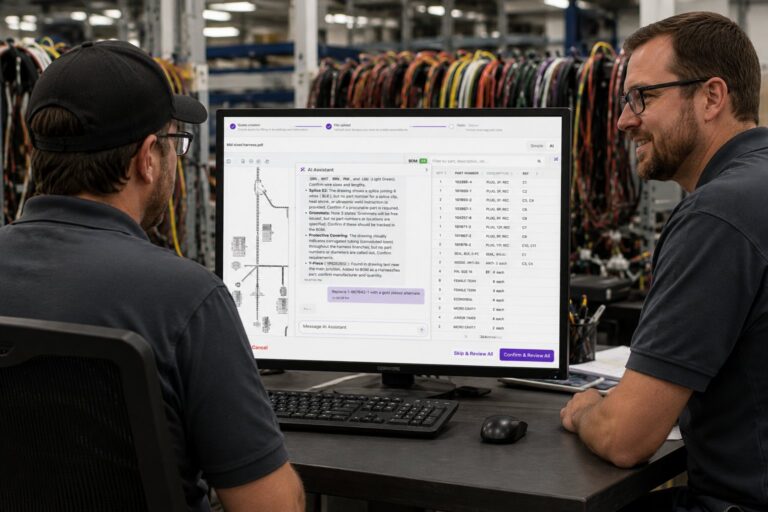
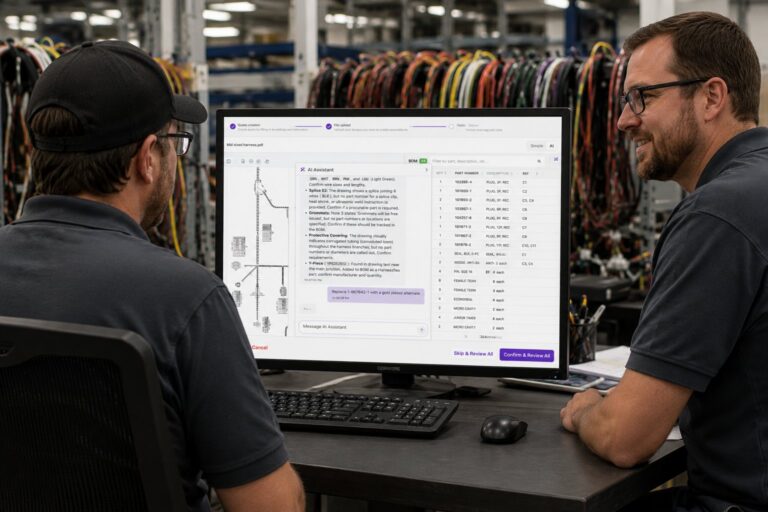
Tools that are built to solve a specific workflow close that gap in two ways: they connect directly to data that changes constantly, like supplier pricing and stock, and they learn from data that accumulates over time, like drawing conventions and parts history. Cableteque is one example of what that looks like in the wire harness world, connecting engineering and supply chain across the wider ecosystem instead of automating one side of the process in isolation, and reading a customer print the way an experienced estimator would, notes and all, instead of only pulling structured data off a table. It’s the gap Meyer keeps pointing to: a tool built for the job versus one that just automates the same manual step a little faster.
Meyer also points out that companies going it alone on AI fail at a much higher rate than those who partner with a specialized vendor. That tracks in wire harness manufacturing too. Estimating teams don’t have the bandwidth to build and maintain their own AI tooling on top of everything else on their plate, and most shouldn’t try. The realistic path is the same one Meyer describes elsewhere: partner with someone who has already solved the problem for the industry.
Proof: two speeds of success
Meyer’s framework favors incremental, milestone-based progress over trying to do everything at once. Wire harness manufacturers are living proof of it, and not in one uniform way. Sometimes that milestone takes time to reach. Sometimes it doesn’t.
For Steve Pilipchuk, VP of Wallace Electronics, that milestone took two years to reach. He’d been championing Cableteque the whole time, long before Wallace actually started onboarding. Not because the fit was wrong, but because, as he puts it, “we got caught putting out fires and day-to-day stuff. It was like Groundhog Day; the same problems weren’t going to go away until we finally forced the issue.” For him, the tipping point wasn’t a single big leap. It was labor estimation coming online, the piece that turned a partial BOM into a real, costed quote. “That made it a complete revamp of the quoting process, not just a piece of it. That resonated.”
Electro-Prep is the opposite end of the same curve. Kaylee Grodsky joined the Wareham, Massachusetts, manufacturer as a buyer with no prior wire harness experience and inherited a stalled RFQ that she estimates would have taken about a month to finish the old way. Onboarding was scoped at 60 days. She had her team working independently well before that, and finished her own onboarding checklist in about two days. “That took me, I would say, two days to finish, and that was easy,” she says. When she finally ran that stalled quote through Cableteque, she had vendors with stock in seconds. “It worked out way too easily. I got up from my chair and immediately told my colleague this was worth every penny.” Her team now clears 30 to 40 RFQs a week, up from a handful a month, freeing her up to support the sales team rather than quote on weekends.
Early milestone and fast start, from two different directions. What connects them isn’t speed; it’s that neither shop had to bet the business to get there. Wallace moved when the tool reached a real gap in his process. Electro-Prep moved fast because the fit was immediate. Meyer’s framework holds either way.
The back office truth
Meyer’s core argument is that the biggest AI ROI doesn’t come from headline initiatives; it comes from unglamorous back-office automation nobody puts in a press release. Quoting fits that description exactly. It’s not the sexy AI story. It’s the one that actually works, because it targets a real, specific, expensive problem instead of chasing a broad AI narrative.
That’s not a knock on ambition. It’s a case for starting where the ROI is provable before chasing anything bigger.
Strategy beats hype
Whether you’re JPMorgan or a 40-person harness shop, the framework doesn’t change. Target the workflow that’s actually costing you business. Choose a tool built to learn your operation, not a generic one. Build in milestones you can point to. The scale is different. The math is the same. Curious what that looks like in practice? Our case studies walk thro