









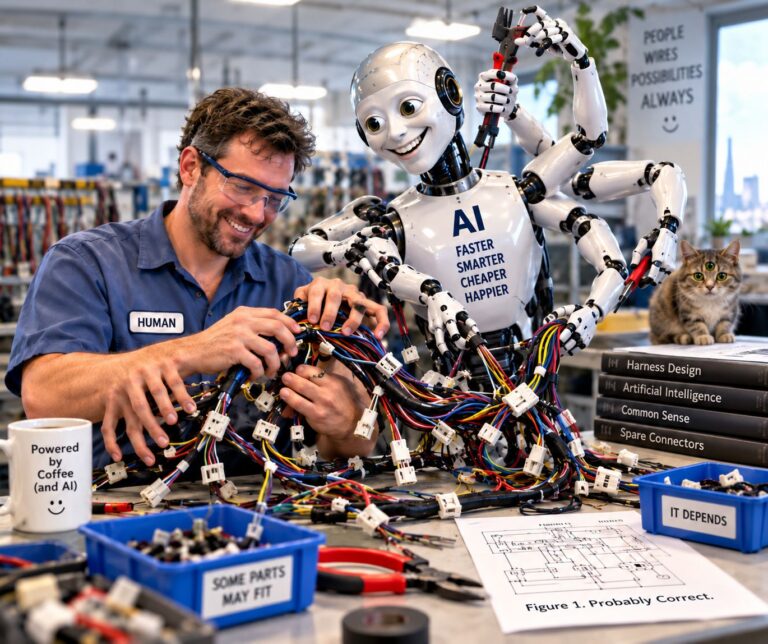













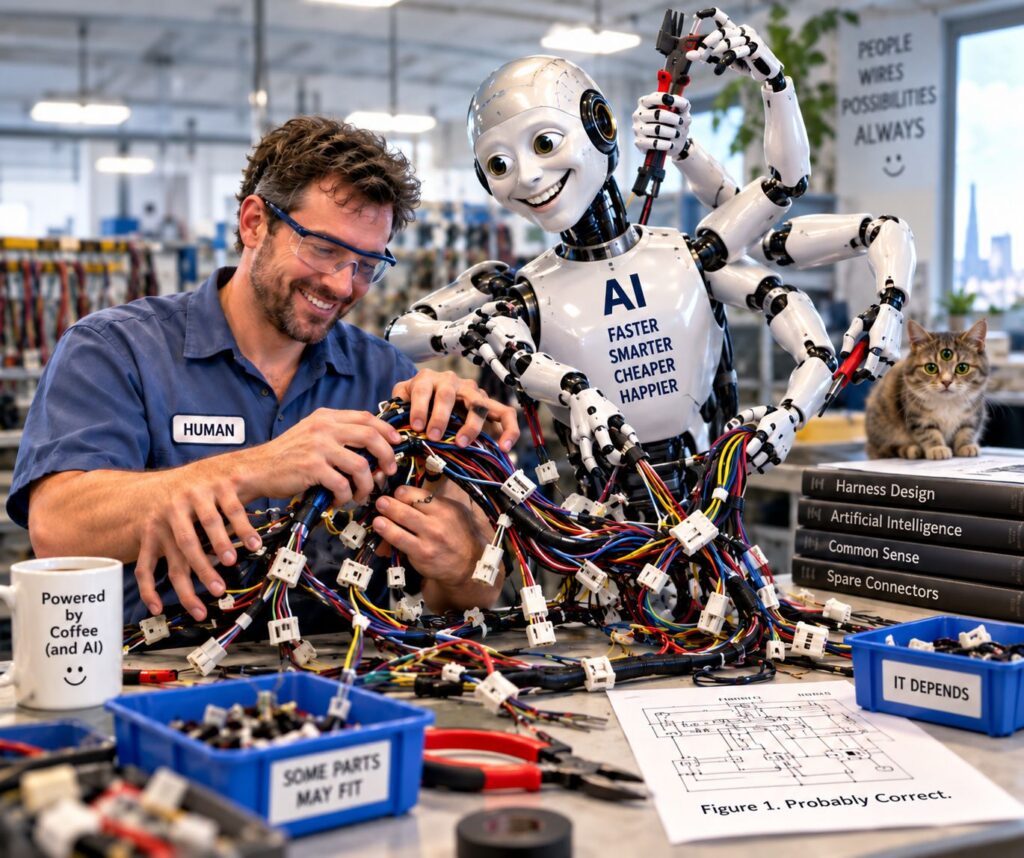
Artificial intelligence has been described as everything from the next industrial revolution to a technology that could eventually make many of today’s jobs disappear. As this article was being written, Evan Hubinger, Anthropic’s Alignment Science Lead, put his personal estimate of the chance that future AI could wipe out humanity within the next decade at greater than 10 percent. (No pressure.) Hubinger later clarified that he considers the risk from present AI models low and is concerned about future self-improving superintelligence. (Whew.)
Spend a little time talking with wire harness manufacturers, however, and you get a considerably more grounded picture. AI is already finding its way into the industry, but at least for now, it is not walking onto the production floor and taking over the harness board. Instead, some of its most promising applications are decidedly less glamorous, including sorting data, preparing quotes, searching for components, working with ERP systems and eliminating repetitive administrative work.
For this article, Wiring Harness News asked several harness manufacturers how they are actually using AI, what has worked, what has not, and where they think the technology is headed. We spoke with Doug Chowning, President of American Syscomptel Inc., Josh Holthusen, Vice President of Sales & Marketing at Elite Harness, Matt Zeilhofer, President of RPI, and Rick Bromm, President of Altex. Rick’s comments came during a follow-up conversation after our recent interview for the Altex company update.
Starting with the Work Nobody Wants to Do
At American Syscomptel, AI has already found several practical uses. Doug said the company has used it to better understand economic and manufacturing trends for strategic planning, sales and marketing. It has also been used with the company’s ERP system to simplify repetitive tasks and to better understand production constraints.
One of the company’s earliest successes provides a pretty good example of where manufacturers might want to start. American Syscomptel had more than 8,000 vouchers that had been paid but remained open in its system. Closing them manually would have consumed many hours of employee time, while AI completed the job in less than an hour.
RPI has found similar value in less glamorous but time-consuming work. Matt said the company’s primary AI applications are currently in the front office and engineering support, where it is being used for data parsing, initial technical documentation, translating foreign-language datasheets and repetitive administrative tasks. That can include cleaning up large component spreadsheets, drafting supplier correspondence and formatting internal procedures. Matt described the technology in its present form as essentially “an efficient administrative assistant.”
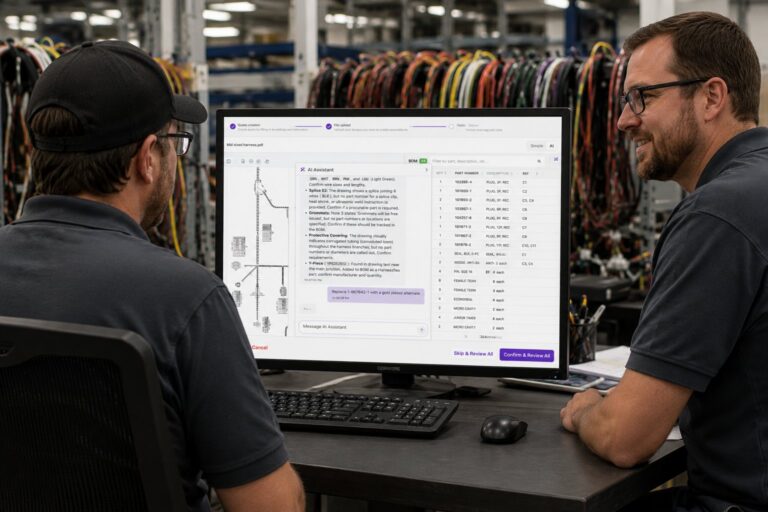
RPI’s first real breakthrough came from using AI to deal with customer RFQ information. Contract manufacturers receive bills of materials, technical specifications and other information in just about every format imaginable, and AI can help structure that raw data, cross-reference component part numbers and identify discrepancies. Matt said the resulting reduction in quoting and engineering time represents “tangible ROI.”
Elite Harness is taking a more cautious approach. Josh characterized the company as “dipping our toes into it.” Elite is not using AI on the production floor yet, but has experimented with it to generate ideas surrounding efficiency and good manufacturing practices.
Altex is also in the early stages. Rick said the company expects new software to create opportunities for AI functions such as comparing supplier invoices with packing slips and improving forecasting. In the meantime, his team has used tools such as Microsoft Copilot for inventory searches, part cross-referencing, composing emails and reviewing supply agreements.
“It’s not telling you anything that isn’t out there. It just finds it faster and organizes it,” Rick said.
The Quoting Opportunity
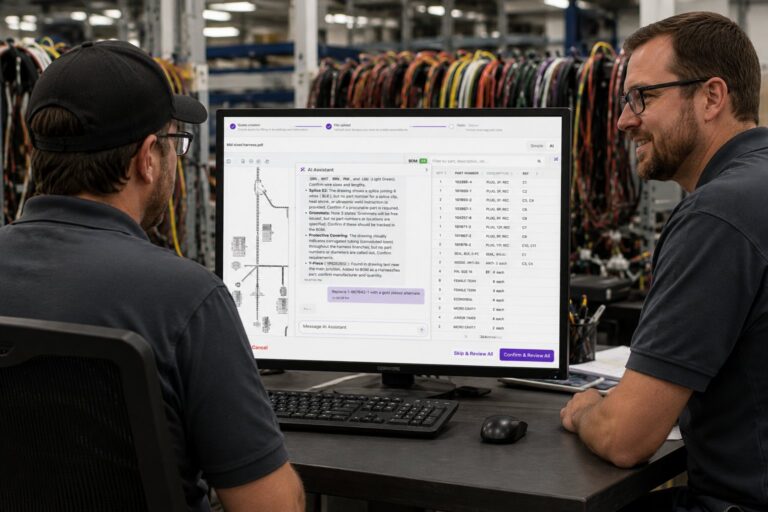
If there was one application that generated the most interest among the manufacturers we contacted, it was quoting. That should come as no surprise to anyone who has spent time preparing harness quotes. Customer information arrives in different formats, drawings have to be reviewed, BOMs need to be scrubbed, components identified and priced, and labor estimated. Meanwhile, the customer would preferably like the quote sometime yesterday.
Matt believes AI has tremendous potential to take some of that burden off skilled employees. RPI spends considerable engineering time breaking down RFQs, reviewing large BOMs, reading datasheets, checking component compatibility and researching historical pricing. He envisions AI performing much of that preliminary work, including identifying long-lead components and pulling historical costing information.
“It doesn’t replace the estimator, but it removes the hours of manual data entry so they can focus on strategy,” Matt said.
Rick reached much the same conclusion, describing quoting as “the single biggest resource consumption we have, and it’s never fast enough.” Altex takes a detailed approach that can include reviewing an RFQ against IPC/WHMA-A-620 requirements, checking the bill of materials and estimating labor at the process level. Rick sees the possibility of an AI system eventually handling much of that initial review and identifying issues that require an engineer’s attention.
The potential becomes even more interesting when that capability is combined with actual shop floor information. Altex is working toward gathering real-time production data that can provide a better picture of actual labor requirements. Combine that with current material and vendor pricing, and Rick believes much of a quote could eventually be assembled automatically.
“If you had it right, we could quote in 10 minutes,” he said, while acknowledging that unusual drawings and RFQs would still require human review.
Josh’s experience at Elite Harness provides a useful reality check. Elite has also explored software designed to assist with harness quoting, although Josh said the technology they have evaluated has not yet reached the point where it can deliver the time savings they are hoping for. The variety of customer formats and internal part numbers remains difficult for existing systems to handle, although Josh hopes the technology will improve quickly.
The same problem becomes even more apparent when AI moves from documents and databases onto the production floor. RPI experimented with AI-driven predictive scheduling intended to optimize order routing based on capacity and incoming components. The difficulty was that a high-mix manufacturing operation has an annoying habit of refusing to behave predictably. Shipments get delayed, machines require unexpected maintenance and important customers occasionally introduce hot orders that reshuffle everything.
Matt said the AI models required so much manual correction that it largely defeated the purpose. “We realized human production managers are still far better at navigating that daily chaos,” he said.
The same limitations can affect machine vision, where flexible wires do not always present themselves consistently enough for reliable inspection. Still, Doug expects AI to become increasingly connected with robotics for higher-volume and simpler manufacturing tasks, even though he does not expect manual labor to disappear from high-mix, low-volume harness manufacturing within the next decade.
Where People Still Matter
Before manufacturers can take fuller advantage of AI, there is another issue they will have to address. Harness manufacturers routinely possess customer drawings, BOMs, specifications, pricing information and other proprietary material that cannot simply be fed into a public AI system.
The companies we contacted are at different stages in developing formal policies, but the concern was universal. Altex, for example, has work instructions prohibiting employees from putting customer information into public AI systems because of customer NDAs. Rick believes closed systems may eventually allow manufacturers to make greater use of proprietary information without sending it outside the company.
RPI has developed one of the more straightforward approaches. The company brought engineering, IT and operations personnel together to create what Matt calls a “Traffic Light” system. Green applications include everyday text editing, formatting, coding help and analysis of public data. Yellow covers generalized company operational processes and requires management review. Red includes customer drawings, intellectual property and financial files.
“The goal was to create a framework that allows employees to innovate and work faster, without exposing the company or our customers to security liabilities,” Matt explained.
Rick even used AI to explore what an Altex AI policy might look like, after previously using the technology to draft a security policy for the company’s Indiana facility. He estimates he changed only about 10 percent of that earlier draft, making the experience another example of AI saving time on a fairly mundane task.
There is another reason human oversight remains important. AI can simply get things wrong. Doug noted that AI can fail to understand the context of a task, although he also acknowledged that poor results are sometimes caused by users failing to provide enough context or to clearly define what they expect.
The larger question, of course, is how much of this changes over the next decade and what work will remain firmly in human hands.
Josh believes customer relationships will be particularly difficult to replace. “Having that face-to-face contact and personal touch on quotes and transactions cannot be replaced,” he said.
Matt pointed to the physical manipulation of flexible materials as another challenge. Humans remain remarkably good at routing, twisting and taping complex harnesses, particularly in high-mix environments where designing robotics to duplicate that adaptability can become prohibitively expensive. More importantly, he believes crisis management and engineering collaboration will continue to require people. A line-down emergency or suddenly obsolete component often requires ingenuity, distributor relationships and engineering judgment rather than simply processing more data.
Rick sees much the same distinction. AI may become very good at identifying what management should look at, but apparently identical circumstances can lead to different decisions depending on the customer involved or the company’s larger strategy.
“It’s just not all math,” Rick said, questioning how all the experience accumulated in someone’s head can ever be completely transferred into a computer system.
Matt took the thought one step further. He can imagine a future in which a manufacturer’s ERP system communicates directly with a customer’s procurement system, negotiating pricing, lead times and capacity while comparing real-time information from both companies. In that environment, human judgment does not necessarily disappear. It moves higher up the ladder, with people establishing margins, risk tolerances and boundaries and stepping in when circumstances demand it.
As Matt put it, “the ultimate human skill ten years from now won’t be haggling over lead times, but knowing exactly when to step in, override the algorithm, and steer the machine.”
That may be the most realistic way to think about AI in the wire harness industry. The question is probably not whether AI replaces people or whether people reject AI, but where the line between their respective jobs eventually settles. Today, AI can close thousands of old vouchers, sort ugly spreadsheets, search for components and help prepare an RFQ. Tomorrow, it may assemble most of a quote before an estimator ever sees it and use shop floor information to help determine how work moves through the plant.
Assuming, of course, we make it past that 10 percent thing, AI is becoming remarkably good at working with the numbers, but knowing when the numbers aren’t the whole story may remain our job for quite some time.