










University of British Columbia team experiments with a ‘3D printer’ concept for routing and cutting wire harnesses
Every once in a while, something unexpected crosses my desk.
Recently I received a call from Gourbonn “Bonn” Herrera, an undergraduate student at the University of British Columbia who is part of the school’s New Venture Design program. The program brings engineering and business students together to develop startup-style technology ventures as part of their final-year coursework.
Bonn and his teammates, Dundee Wang, Zachariah Joseph, Owen Wang, Vidur Sahni and Yi Jia Zhou, are developing a technology platform they call SonicWire, which aims to automate portions of wire harness production while also simplifying how engineers source harness assemblies.
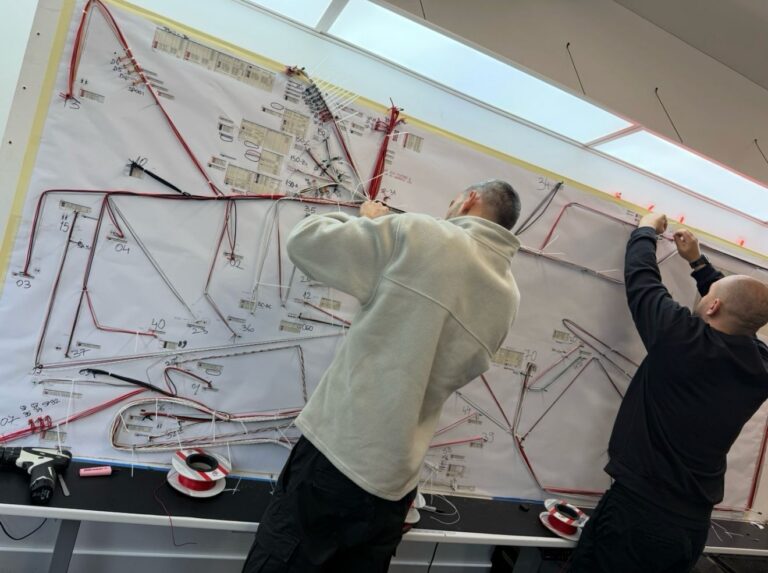
Their concept is straightforward to describe but ambitious in scope. The team is working toward a system that functions somewhat like a 3D printer for wire harnesses, capable of automatically routing and cutting wires according to a harness schematic.
The idea grew out of Dundee’s experience working in the electric vehicle and drone industries. During internships at Tesla and the delivery-drone company Zipline, he was surprised by how much of the harness manufacturing process still depends on manual labor.
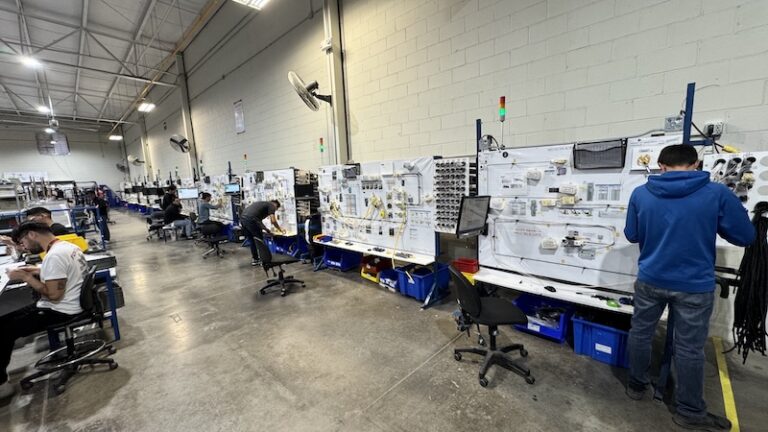
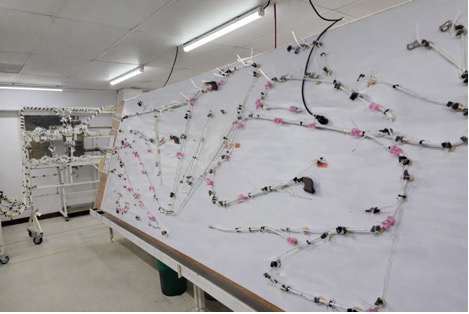
“Everybody’s still building these harnesses by hand on a jig board,” Dundee explained. After encountering lead times that could stretch for months, he began wondering whether portions of the process could be automated using relatively simple motion-control systems. That observation eventually became the foundation for SonicWire.
The team’s prototype repurposes an existing 3D printer platform as a gantry system, allowing wire to be routed along programmed paths derived from a schematic. The system interprets the design, converts it into instructions, and guides the wire across the workspace to reproduce the harness layout.
At this stage, the program has the team focused on developing a Minimum Viable Product (MVP). It’s the simplest working version of a product that allows developers to test a core idea and gather real-world feedback before investing in full-scale development. In this case, the MVP for SonicWire focuses on routing and cutting wire with enough accuracy to follow harness design standards. Additional capabilities, such as automatic stripping, could follow once the concept is proven.
Another well-known bottleneck in the harness supply chain is the quoting process, which often requires multiple rounds of communication between the customer and supplier before a design moves to production. The SonicWire team believes there may still be opportunities to simplify the way engineers move from a schematic to a manufacturable harness.
In many cases, drawings arrive incomplete or contain inconsistencies that must be resolved before work can begin. Engineers and harness manufacturers may spend days or weeks exchanging emails to clarify wire gauges, connector selections, or missing design details.
That realization led them to develop the second component of SonicWire: a web-based ordering platform designed to streamline the front end of harness procurement.
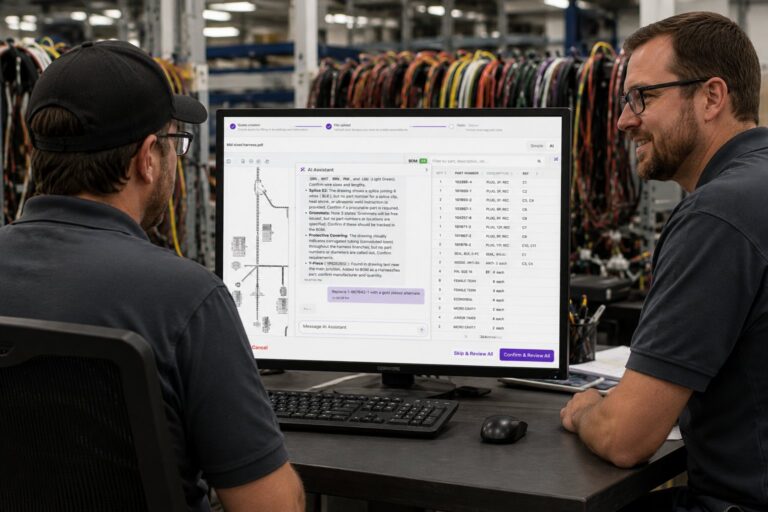
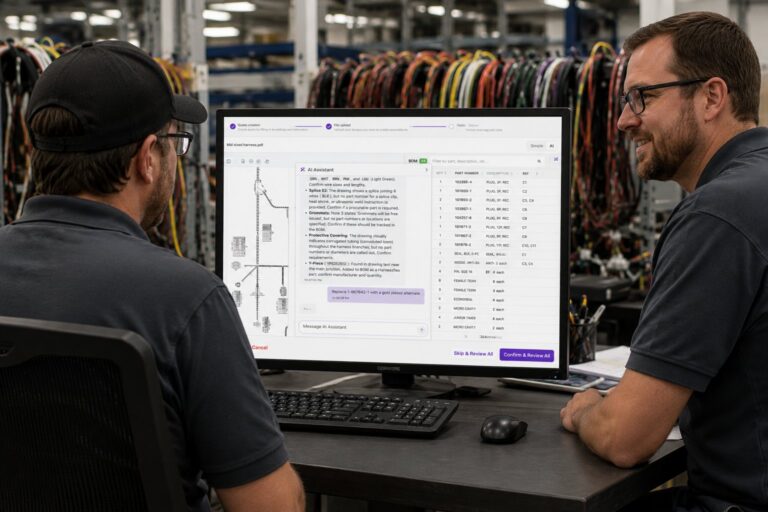
Through their website, engineers can upload a schematic and interact with the system as if the automated manufacturing equipment were already operational. The goal is to eventually provide rapid feedback on manufacturability, pricing, and delivery timelines. According to the SonicWire website, the vision is to allow engineers to upload a design, receive a quote quickly, and have production-ready harnesses delivered with dramatically reduced turnaround time.
For now, the system accepts PDF drawings, but the team hopes to eventually integrate directly with CAD files used by harness designers. The long-term vision is a platform capable of interpreting engineering data, identifying missing information, and flagging potential issues before an order moves forward.
Anyone who has spent time in the harness industry will immediately recognize one of the biggest obstacles to such a system: the quality of the data itself. Harness drawings frequently contain inconsistencies like incorrect wire gauges, obsolete part numbers, or connectors that cannot be sourced within a reasonable timeframe.
Zach acknowledged that variability in engineering data is one of the toughest challenges the team faces. Different companies design harnesses in different ways, which means their software must eventually learn to recognize when key information is missing and request clarification before production begins.
One interesting possibility discussed during our conversation was that SonicWire may not always need to deliver fully terminated harnesses to provide value. In some situations, engineers indicated they would be willing to receive bundles of accurately cut and stripped wires, essentially pigtail assemblies, if that significantly reduced turnaround time and avoided long connector lead times.
The project remains in the prototype stage, and the team is actively looking for feedback from people working in the harness industry. Their website, sonicwire.ca, currently serves as a testing platform where potential customers can explore how the ordering process might work and provide feedback on the interface and functionality.
That is one reason I wanted to introduce Bonn and his team to readers of Wiring Harness News. The harness industry has always been collaborative, and experienced manufacturers often share advice with newcomers who are trying to improve the way things are done. The team is particularly interested in hearing from engineers and harness manufacturers willing to test the concept and offer feedback from real-world production environments.
Whether SonicWire ultimately becomes a commercial technology remains to be seen, but it is encouraging to see a new generation of engineers examining a manufacturing process many of us have worked with for decades and asking how it might evolve.
Readers interested in learning more about the project, or offering insight from their own experience in the industry, can contact the team at [email protected] or explore the project at sonicwire.ca.