










Introduction – An Industry Under Pressure
Electrical Distribution Systems (EDS) have become one of the fastest evolving and most complex domains in modern vehicle development. What was once a relatively stable engineering discipline is now deeply intertwined with software, architecture changes, packaging constraints and regulatory requirements. Every functional update, design revision or system optimization ultimately flows into the wiring harness.
As a result, harness programs now experience an unprecedented volume of change. It is no longer unusual for a single vehicle program to undergo hundreds—or even more than a thousand—harness revisions over its lifecycle. Managing that level of complexity is straining processes that were never designed to handle it.
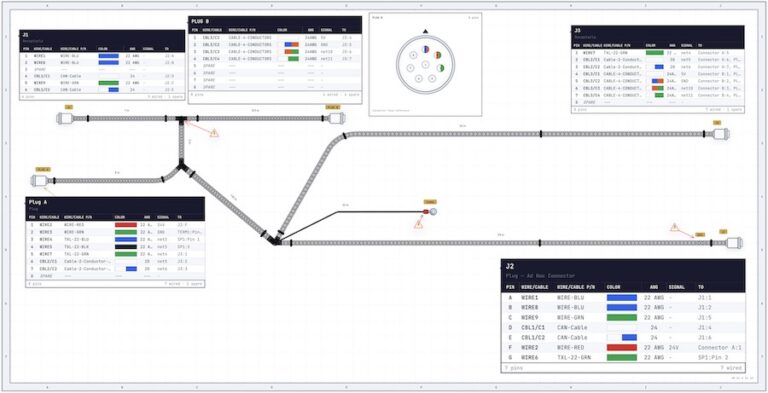
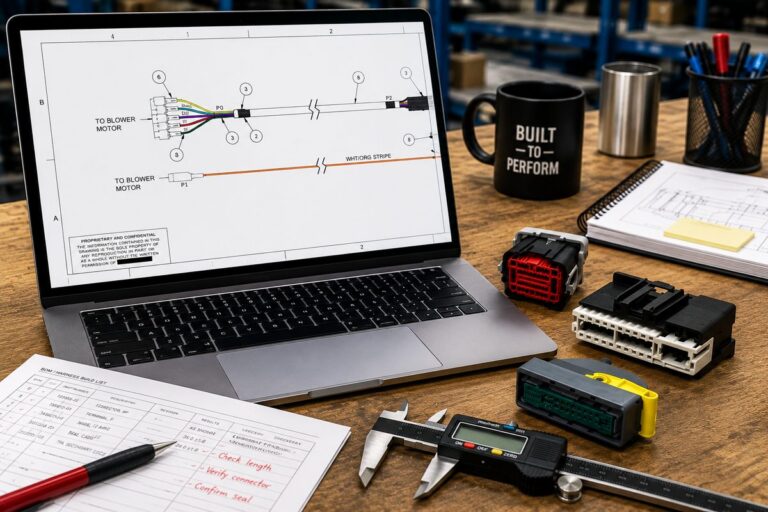
Despite decades of investment in digital tools, many core workflows in wiring harness development still rely on manual coordination. Engineers move between schematic systems, 3D packaging tools and 2D drawing environments that rarely communicate seamlessly. In practice, critical information is often exchanged through emails, spreadsheets or presentation files, leaving engineers to reconcile mismatched data by hand.
The wiring harness has become a bottleneck not because of a lack of engineering skill, but because the industry’s digital backbone has not kept pace with the speed and interconnectedness of modern vehicle development.
At voitas—a transatlantic engineering organization working with OEMs and Tier 1 suppliers across Europe and North America—we have experienced these challenges firsthand. That experience, combined with our role as both an engineering service provider and a software developer, led us to rethink how EDS development should function. The result was the creation of two complementary solutions: vit, the voitas interface tool, and vait, voitas AI technology.
Why the Problem Exists – A Brief Look Back
The roots of today’s challenges can be traced to the early digitalization of wiring harness engineering. Initial software tools were designed to replace paper-based processes, not to enable fully integrated workflows. Schematic design, 3D packaging and 2D manufacturing drawings each evolved within their own domains, optimized independently and rarely re architected as a unified system.
Many of these tools were built by software developers with limited exposure to real-world harness engineering. Over time, customer feedback led to incremental improvements, but the underlying structure remained largely unchanged. As vehicle complexity grew, the limitations became more visible.
To compensate, OEMs and suppliers built their own workarounds. Custom scripts, Excel macros, proprietary validation tools and manual checkpoints became standard practice. No two organizations—and often no two programs within the same organization—followed the same process.
The result is a fragmented ecosystem with no single source of truth. When changes occur, engineers become translators between systems, manually validating assumptions and resolving inconsistencies that should be handled automatically. These practices keep programs moving forward, but at the cost of time, efficiency and robustness.
The challenge is not simply outdated software. It is a structural problem rooted in disconnected data flows and legacy processes that no longer scale.
Change Management: The Daily Reality
Few topics resonate more with wiring engineers than change management. While initial design work is demanding, it is the constant stream of modifications that consumes the most time. ECU updates, new vehicle functions, packaging conflicts, EMC or thermal requirements, supplier changes and cost reduction initiatives all trigger downstream harness revisions.
Individually, these changes may seem manageable. Collectively, they create a system in continuous motion. Hundreds of updates can accumulate between release milestones, forcing teams into extended reconciliation phases before drawings can be released.
Because tools are not synchronized, coordination becomes the real bottleneck. Engineers spend weeks tracking versions, comparing screenshots, validating exports and determining which data set is current. During pre release phases, teams may invest two or three weeks simply aligning schematic, 3D and 2D data.
The risk is not only lost time, but increased exposure to errors. Every manual handoff introduces uncertainty. In an environment defined by constant change, even small misalignments can have costly downstream consequences.
This is the gap vit was designed to close.
vit – Connecting What Was Never Designed to Connect
voitas did not begin as a software company. Our core mission has always been engineering excellence. But as our teams worked across different OEMs, toolchains and regions, the same issue appeared repeatedly: even the best tools struggled to stay aligned with one another.
The insight was simple but powerful. The industry did not need another design tool—it needed a connective layer. A universal interface that could read, compare, validate and synchronize data across existing systems.
That idea became vit, the voitas interface tool. vit sits above the existing CAx environment rather than replacing it. It connects schematic, 3D and 2D systems, ensuring that data remains consistent across domains. It is tool agnostic, methodology independent and designed to work with unfinished data—reflecting how engineering actually happens.
One of vit’s most valuable capabilities is continuous synchronization. Instead of allowing discrepancies to accumulate until release, vit identifies inconsistencies early and supports resolution while designs are still evolving. This dramatically reduces the effort required during release preparation.
In one anonymized customer program, traditional reconciliation between schematic and 3D data took nearly three weeks. After implementing vit, the same effort was reduced to less than three days, including quality checks. Engineers were able to focus on engineering again, rather than administrative alignment.
vit was built by engineers, for engineers, and continues to evolve based on real world project demands.
The Human Factor – DREs, Designers and Productivity
Technology alone does not define efficiency. Organizational models play a critical role as well. Historically, many OEMs relied on Design Release Engineers (DREs) who owned the entire harness—from logic and packaging through drawings and release. This model was efficient because context lived with a single individual.
As complexity increased and cost pressures mounted, the industry shifted toward globally distributed teams. DREs remained close to OEM decision centers, while design work moved to lower cost regions. While hourly rates decreased, productivity often followed.
Communication slowed, context was diluted and additional process layers were added to compensate. The industry accepted these inefficiencies as a trade-off, even as vehicle complexity continued to rise faster than headcount.
At voitas, we focus on closing this productivity gap by equipping both DREs and designers with intelligent tools. Our vhi tool suite already supports tasks such as voltage drop analysis, EMC checks and complexity reduction. But the next leap forward goes beyond automation—it moves toward augmentation.
vait – Augmented Engineering Through AI
Many activities in harness development follow clear logical patterns: validating connections, adjusting routing, checking clearances or implementing connector changes. These tasks require precision but little creativity—and they consume a disproportionate amount of engineering time.
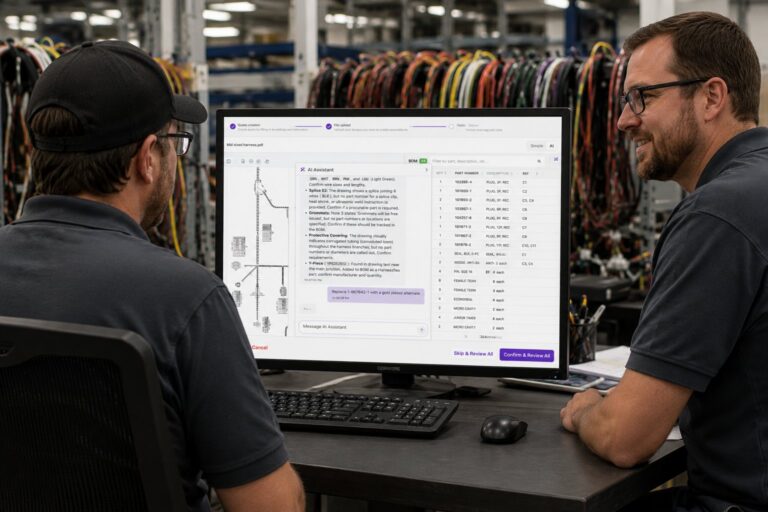
vait, voitas AI technology, was created to address this imbalance. The concept is straightforward: engineers define intent, and AI executes the mechanical steps.
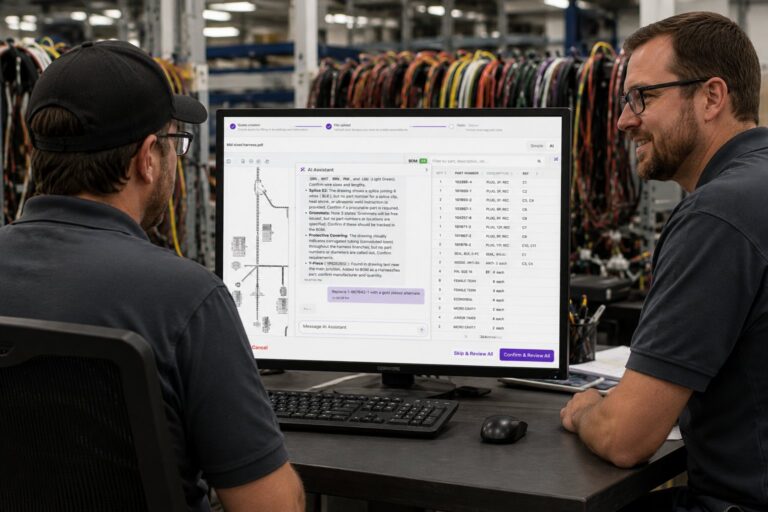
Instead of issuing a ticket for a connector change and waiting hours or days for execution, a DRE can describe the modification directly. vait evaluates the surrounding geometry, performs the required updates and presents the result for human review. Authority remains with the engineer; execution is accelerated by AI.
vait is not designed to replace designers. It removes repetitive work so skilled engineers can focus on decisions that require experience and judgment. Over time, vait will expand its ability to understand full harness architectures, anticipate impacts across domains and support engineers proactively.
This marks a fundamental shift. For decades, human coordination compensated for technological gaps. AI now enables tools to share that burden.
Looking Ahead – Engineering at the Speed of Change
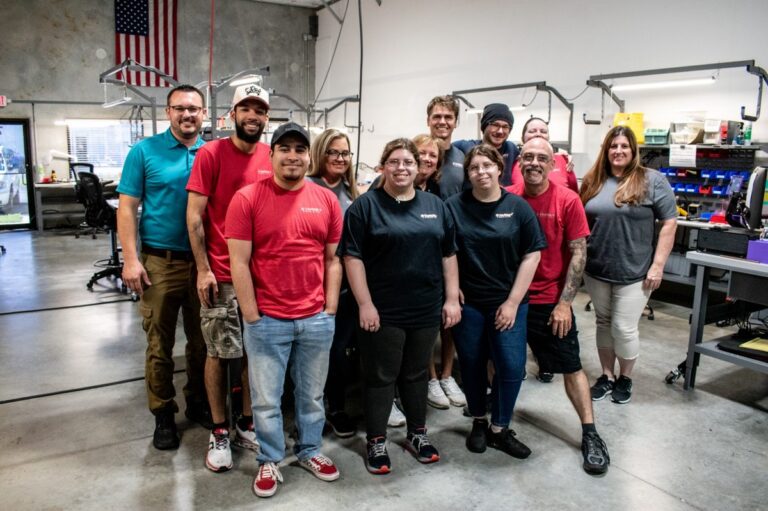
voitas operates on a simple principle: global expertise combined with local excellence. With teams in Germany, the Czech Republic and the United States, we bring both depth and agility to EDS development challenges.
Our vision is clear. Harness engineering should be synchronized, data-driven and resilient to change. Information should flow seamlessly across tools. AI should elevate engineers, not replace them.
vit addresses today’s bottlenecks by restoring data consistency. vait prepares the industry for tomorrow by enabling AI-assisted execution. Together, they form a foundation for a more efficient, integrated approach to wiring harness development.
The harness is no longer just a physical component. It is the nervous system of the vehicle. And it demands tools—and processes—that reflect its growing importance.
At voitas, we are building those tools to help engineers move faster than change itself.
As vehicles become increasingly software-driven and electrically complex, the cost of maintaining fragmented workflows continues to rise. The future of EDS development belongs to organizations that embrace integration, automation, and intelligent augmentation—tools that can keep pace with constant change while preserving engineering intent and data integrity.
vit and vait represent a deliberate step toward that future: restoring clarity where complexity has grown, reducing friction between domains, and enabling engineers to focus on decisions rather than reconciliation.
If you would like to learn more about how vit and vait can support your engineering teams, we welcome the opportunity to connect. Please contact Armin Hager at [email protected] for additional information.