











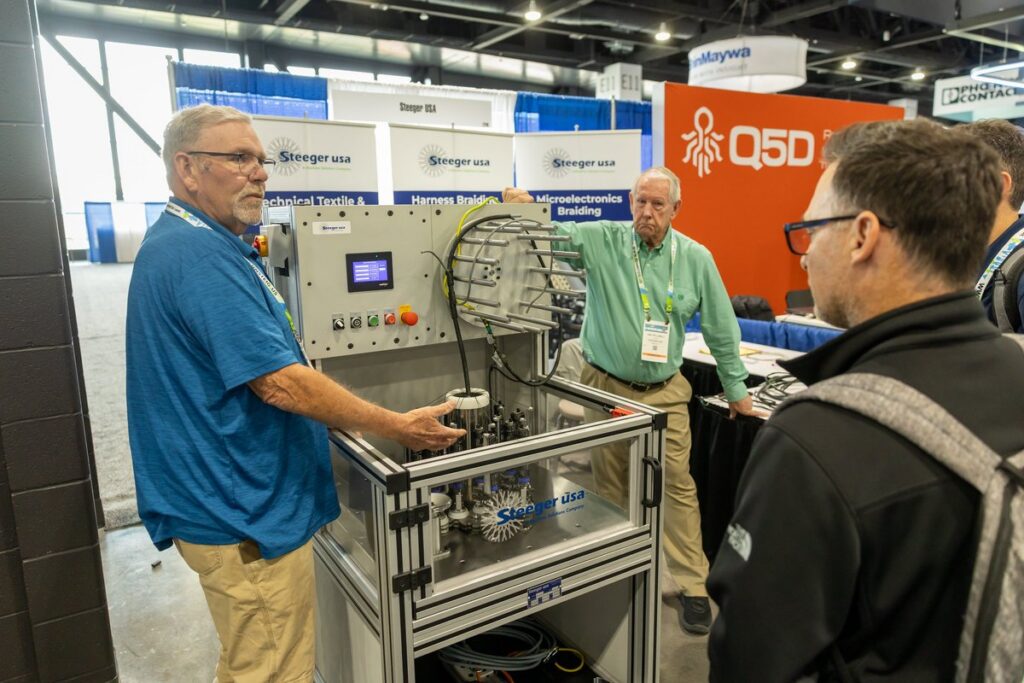
Steeger USA Brings a Different Level of Braiding to EWPTE
In the weeks leading up to the Electrical Wire Processing Technology Expo, a conversation with Tim Stillwell from Steeger USA turned into a closer look at where braiding technology is headed and how much of that direction is being shaped outside the traditional wire harness space.
I wasn’t very familiar with Steeger going into it. That turned out to be the key. Because to understand what they bring to the harness world, you have to start with where they’ve been operating for years.
“We’ve been doing so much work in the medical space,” Tim said. “The tolerances and the cleanliness requirements there are so much more stringent than anything you typically see in wire harness manufacturing.”
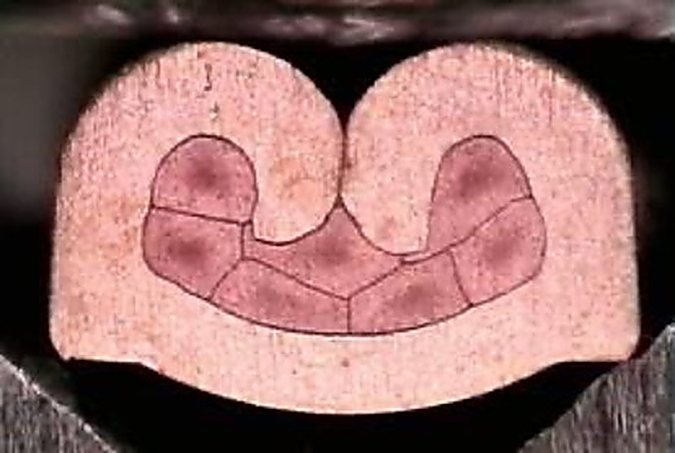
That is not an exaggeration. In medical applications like catheters and stents, Steeger’s machines are working with materials that are almost hard to comprehend from a harness perspective. We’re talking about wire as small as half a thousandth of an inch, smaller than a human hair, and fibers down in the 5-micron range. These are not lab experiments. This is full production, running at speed, with consistency. “We routinely braid materials so small our operators need magnification just to see them,” Tim described. “And we’re doing that at production speeds.”
On top of that, much of this work is done in clean room environments where contamination simply is not an option, whether that comes from lubricants transferring onto the product or debris introduced during the process. That level of discipline is starting to show up in harness production as new technologies push the limits of what manufacturers are being asked to deliver.
A lot of braiding in the harness world is still approached as a straightforward process. Cover the bundle, provide protection, and move on. For many applications, that is still exactly what is needed. Tim was clear about that point. Not every harness requires advanced capability, and not every shop needs to rethink its entire process. But there is a growing segment of the industry where that basic approach is not enough.
“What we’re seeing now is more interest from companies that need tighter control, especially when you get into more complex harnesses with branches and transitions,” Tim said. “It’s not just about covering wires anymore. It’s about how that braid behaves across the whole assembly.”
One of the clearest examples of this is something as simple, and as overlooked, as braid density. In many traditional harness setups, the braid is uniform from one end to the other. That works fine if the geometry and performance requirements stay consistent. But in more advanced applications, that consistency can become a limitation.
Tim explained where the next level of capability came from. “If you think about a catheter, the doctor needs it to behave differently along its length,” he said. “He wants it tighter and stiffer at the handle, but more flexible as it moves through the body. Almost like a bullwhip. You’ve got control at one end, but it needs to respond the right way at the other.”
That behavior is driven by changes in braid density along the length of the product. By increasing or decreasing the pick count in specific sections, the manufacturer can control how the catheter twists, flexes, and responds during use. “When the surgeon twists it on one end, he wants that movement to transfer exactly to the other end,” he said.
What makes that capability more than just a technical feature is how it affects the end product. In a traditional braid, you are working within a fixed structure. If the harness changes diameter or branches off, you are often adjusting around the braid instead of letting the braid adapt to the design. With variable control, that relationship starts to shift. The braid becomes something that can be tuned along the length of the assembly instead of something that has to remain constant.
That same concept applies directly to certain harness designs. As bundles branch, change diameter, or move through different environments, the ability to control braid characteristics along the length becomes a tool rather than a constraint. “When you’ve got branches feeding off, you’re trying to maintain coverage and consistency as the diameter changes,” Tim said. “Being able to control that transition and keep your tolerances tight is where this really starts to matter.”
Instead of overbuilding certain sections just to maintain integrity, the braid can be tuned to match the geometry of the harness itself. That can mean better flexibility where it is needed, more support where it is critical, and less material where it does not add value. For shops dealing with tighter packaging constraints or higher performance requirements, that kind of control starts to open new options.
That range of capability also comes from the types of materials Steeger has worked with over the years. “We’ve braided just about every material you can think of,” Tim said. “Every type of metal wire, every type of fiber.” In some cases, that has gone well beyond what most would expect. “I think the oddest thing we’ve ever put on a braiding machine was strands of living human tissue,” he said. While that kind of application sits firmly in the medical world, it speaks to the level of material control and process understanding behind the equipment.
Precision, in this context, is not just a talking point. It is measurable. Steeger machines control parameters like tension, pitch, and geometry through programmed settings. Once those parameters are set, the machine repeats them exactly. If a process calls for a specific number of picks per inch, that is what is produced, consistently, across the entire run. “The computer keeps it exactly where you set it,” Tim said. “When you measure what comes out, that’s what you get.”
From a shop floor perspective, that kind of repeatability has clear implications. The corporate team at Steeger emphasized reduced scrap, improved uptime, and more efficient use of labor. Those are universal concerns, regardless of industry. What Tim added to that was the ability to design for performance, not just protection. When the braid can be controlled this precisely, it becomes part of the functional design of the harness, not just a covering.
Another area where the medical background shows up is cleanliness. In medical manufacturing, contamination is not acceptable under any circumstances, and Steeger designs their equipment accordingly. That same capability carries over into applications where cleanliness is critical, including aerospace and space systems.
“We’ve built machines for products that go into space,” Tim said. “They need to be strong, they need tight tolerances, and they need to be extremely clean. That’s something we already know how to do.”
Despite these capabilities, a large portion of the harness industry is still running on equipment that has changed very little over the years. Tim described visiting facilities with dozens, sometimes hundreds, of braiders that have been in service for decades. They are functional and they get the job done, but they do not offer the level of control that newer systems can provide.
Part of the reason is that braiding has always been a hands-on process in the harness world. Unlike many automated systems, braiders often require an operator to stay engaged throughout the run, especially when working around branches or irregular geometries. That has shaped how shops think about the process.
“With a lot of the other industries we work in, the machines are set up and they run,” Tim said. “In harnessing, it’s a much more manual operation. The operator is right there the whole time.”
That difference makes it easy to overlook what Steeger’s largely custom equipment can actually bring to the table. When the process is already labor-driven, improvements in control, repeatability, and setup may not be obvious at first glance. But once those improvements start reducing rework, stabilizing output, and making complex jobs more predictable, the value becomes much clearer.
That gap did not go unnoticed by end users. In fact, it was aerospace companies that pushed Steeger to bring their technology into the harness space. “They basically came to us and said, you need to get into this,” Tim said. “We don’t have this level of capability available in the harness industry right now.”
At the same time, both Tim and the Steeger team were clear that not every application justifies high-end equipment. There is a practical balance to be maintained, and in many cases a basic braiding setup is still the right answer. “You don’t want to overkill it,” Tim said. “If someone just needs a simple process, you don’t sell them something they don’t need. But if they’ve got a complex application, you want to have the capability to handle it.”
One of the biggest challenges, according to Tim, is that many shops are simply not aware of what modern braiding equipment can do. They are used to their current processes and have built their operations around those limitations. When they see what is possible with newer technology, it often changes their perspective.
“A lot of times the reaction we get is, we didn’t know you could do that,” he said. “They start asking, is it possible to do this, is it possible to do that. That’s when things start to open up.”
The trend seems clear. Harnesses are getting more complex, materials are getting smaller and more diverse, and performance requirements continue to increase. The corporate team at Steeger pointed to areas like electric vehicles and advanced electronics as drivers of that shift, with a growing need for lightweight materials and more intricate designs.
Tim sees that shift already happening on the shop floor. “I think we’re already seeing it move in that direction,” he said. “The companies we’re working with are starting to realize what’s possible, and once they see it, it changes how they approach their processes.”
Increasing complexity, smaller wire sizes, and more exacting performance requirements are continuing to tighten the tolerances expected from braiding equipment. That shift is already happening, and more manufacturers are starting to respond to it.