





























(Part II of series)
Joanne Harris, on behalf of Cableteque
The business case for modernizing quoting is settled. The decision has been made. Now the harder work begins. And it has very little to do with technology.
Quoting wire harnesses is not a simple process. It draws on years of accumulated expertise: knowing the components, reading the drawings, understanding what a design will cost to build before a single part is ordered. A recent survey by the WHMA’s Innovation and Automation Technology Group found that nearly three-quarters of manufacturers still describe their quoting process as manual and time-intensive, with more than half saying it depends heavily on engineer or tribal knowledge. The people doing this work have built real skill around it, and they know it.
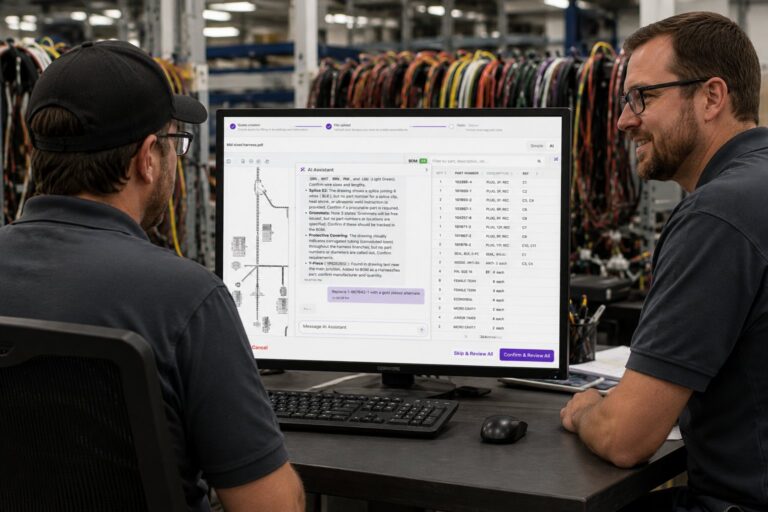
That is precisely why the human side of a quoting transition matters as much as the technical one. Done well, modernization doesn’t replace that expertise. It removes the manual, repetitive work that surrounds it, the data entry, the catalog lookups, the chasing of supplier pricing, and frees the people who know this industry to focus on the decisions that actually require their judgment. But getting a team to see it that way and trust it enough to change how they work takes more than a go-live date.
This article is about how to do that well. If you missed the first article in this series, which examined why so many shops are slow to move despite a clear business case, you can read it here: Automating Quoting: The Numbers Say Go. Your Team Says No.
Start with the why
Kelly Grato, VP of Procurement and Estimating at RESCO Electronics, led her company’s Cableteque rollout from the ground up. Before Resco made the move, quote turnarounds stretched to a month during peak periods. The team was constantly triaging priorities, chasing suppliers for pricing, and still falling behind. Quote turnaround time was identified as a pain point in customer surveys for two consecutive years.
When the decision was made to change, Grato’s first move was not to schedule training. It was to have a conversation.
“The first part was getting everybody on board with why we needed the change,” she says. “What we are now, what we hope to be, and how this could reduce the time and work they have to do. It was not a matter of forcing change upon them or insisting they comply simply because I demanded it. They understood the challenges. They were living the challenges.”
That framing mattered. The team wasn’t being asked to adopt a tool because management had decided to do so. They were being asked to solve a problem they already knew existed. The distinction changes how the transition feels from the team’s perspective. And for a group of skilled people who take pride in their work, being invited into the solution rather than handed one makes a meaningful difference to how they engage with it.
Building the rollout
From there, Grato carefully structured the training. She divided the team into blended groups of five to eight people, drawing from both procurement and sales, and ran three consecutive weeks of sessions with a different group each week. Before each group’s live session, she had them work through Cableteque’s tutorials independently. “When we got on the calls, they had questions right away. They weren’t just asking which button to press. They already knew what it was going to look like, and they had real questions ready.”
The sessions themselves were live and practical. The team was quoting real jobs while training, not watching demonstrations. At the end of each week, Grato brought the groups back together to share what had come up. “Each group came up with completely different questions. So the other groups needed to hear them too.”
She also identified champions ahead of the rollout, one in procurement and one in sales, and brought them in earlier than the rest. By the time the wider team arrived, there were already voices in the room who could speak to what the platform could do, not just from management, but from peers who had already worked with it.
“I wouldn’t call the others naysayers, but they weren’t excited,” Grato says. “They looked at it and thought: more change, slower at first, have to learn something new. Having the positive voice in the room, not just mine, made a real difference.”
The one thing she would change, looking back, is keeping those champions present throughout. A scheduling conflict meant they weren’t in the final two training weeks. “That’s something I’d do differently. You need that positive voice every week, in every room.”
Herman Rozenberg, CTO at Onshore Technologies, made the same point in Part 1 of this series. “Assign one person. Make them the trustee. When they start to become capable and confident, the others will follow.”
When resistance shows up
Some pushback is inevitable, and it is worth understanding its source before deciding how to address it. Daryll Scott is a coach and consultant with 30 years of experience helping organizations through significant change, working with clients including Apple, Barclays, and Virgin Atlantic. He argues that resistance to new tools is rarely irrational, and that treating it as an obstacle to overcome tends to make it worse.
Experienced estimators, in Scott’s view, may resist for three distinct reasons. The first is trust: when you can’t see how a system works, it’s hard to rely on output that feels like someone else’s calculation. The second is bandwidth: an already stretched team experiences the request to adopt something new as one more weight on an impossible load. The third, and the one he considers most underestimated, is loss of self-value.
“We only value things that we value ourselves for achieving,” Scott says. “If the platform does in an hour what took four days, the question they’re really asking is: what’s left that’s mine?”
The answer to that question is what a good transition makes visible. The work that remains, evaluating lead times, catching manufacturability problems, and making the judgment calls that only experience earns, is the most valuable part of what an estimator does. Steve Pilipchuk, VP of Wallace Electronics, put it plainly in Part 1: “They’re way too qualified to be doing data entry. What’s left is the work that actually requires a skilled human.” The goal isn’t to diminish the role. It’s to clear away the tasks that were getting in the way.
Scott also cautions against selling the change as easy. “Telling your team the new platform is quick and simple is almost dismissive. It sends a message that the work they’ve spent years mastering wasn’t that hard to replicate.” The stronger frame positions adoption as upskilling, as a step forward for people who are good enough to make the leap, rather than a convenience being handed to them.
At RESCO, the resistance Grato encountered was measured rather than entrenched. “It wasn’t total resistance. It was more: why do I have to do this?” Her answer was to show rather than tell. Time studies ran alongside the new process so the team could see exactly what each step cost them before and after. “Once they started doing it and seeing it, it shifted.”
The trust question surfaced most directly on the labor estimation side, which RESCO is still working through. “On the labor side, it’s more: do we trust this?” Grato says. She is candid about the fact that this part of the journey requires broader organizational buy-in across engineering, production, quality, and sales, not just the quoting team. “It’ll get there.”
What changed at Resco
On the material side, the results came faster than Grato expected. Quote backlogs that had stretched to 30 days were gone. New business came in. The team, previously siloed by function, gained the ability to cover for each other.
The benefit she hadn’t fully anticipated was strategic. Before, every quote demanded the same urgency because every quote required supplier calls. With routine pricing handled, the team finally had the bandwidth to be selective. “Now we can focus on the quotes where we need to be strategic. We can work closely with suppliers on the areas that actually matter. Before, every quote felt equally urgent, and you couldn’t tell which ones really were.”
That shift, from reactive to strategic, is exactly what a well-run transition makes possible. The expertise was always there. The platform cleared the space for it.
The window is narrowing
The shops that have moved are getting faster. The gap between them and those still deliberating is not fixed; it compounds. In Part 1, Pilipchuk described quotes his team doesn’t pursue because they can’t turn them fast enough. Rozenberg was more direct: “You’re losing revenue. You’re losing growth. You’re sometimes losing the customer. You can’t push it to next month or next quarter. There is no time.”
Grato’s message to anyone still weighing the decision is plain. “I don’t know what you’re waiting for. Honestly. If you don’t do it, you’re leaving business on the table. It doesn’t hurt to take the leap. They won’t be disappointed.”
In the third and final article in this series, we look at what success actually looks like twelve months in: the return on investment beyond speed, how the quoting function evolves, and why the advantage early movers are building gets harder to close over time.
Join us for Part 3: From Bottleneck to Business Driver.