































At this year’s Electrical Wire Processing Technology Expo (EWPTE), one session made clear that sustainability is no longer a peripheral issue for the wire harness and cable industry. It is becoming a business priority tied to customer expectations, operational performance, compliance, and long-term competitiveness.
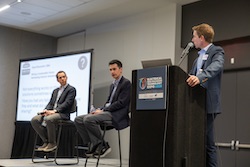
The session, “Wiring a Sustainable Future: Harnessing Industry Solutions in Practice,” drew a full room in Milwaukee, underscoring the growing interest in how sustainability is taking shape across the electronics supply chain. Hosted by the Global Electronics Association, the discussion focused not on abstract environmental ideals, but on practical, achievable steps that harness manufacturers, distributors, and suppliers can take now to move from intention to implementation.
That practical framing resonated with attendees. Across the discussion, panelists emphasized that sustainability is increasingly connected to day-to-day business realities: efficiency, employee engagement, resilience, reporting requirements, and the ability to meet evolving customer demands.
Seth Jacobsen, sustainability program manager for the Global Electronics Association, moderated the session and helped frame the conversation as part of a broader effort to help the industry identify workable solutions.
“We’re working in this space of sustainability for wiring harness to identify and overcome the challenges,” Jacobsen said. “We don’t always have perfect answers. But there are solutions out there, and we want to help connect the dots.”
That message reflects the philosophy behind the Global Electronics Association’s Evolve initiative, which connects standards development, education, policy tracking, regulatory guidance, and industry engagement. Rather than treating sustainability as a separate workstream, the association is encouraging companies to view it as part of how business is done across operations and the supply chain.
From compliance to competitiveness
For many smaller and mid-sized harness manufacturers, sustainability often begins with compliance. Companies are trying to understand what is required today, and what may soon be expected, around chemical restrictions, greenhouse gas reporting, supply chain transparency, and customer disclosures.
That challenge is particularly relevant in a fragmented supply chain where large OEMs and major suppliers may have robust sustainability programs, while smaller operators are still in the early stages of figuring out what to measure and where to start.
Robert “Bob” Bennish, vice president of OEM distribution at Southwire, pointed to that gap in perspective. Large companies may have long-established sustainability frameworks, but many smaller manufacturers and channel partners are just beginning the journey. For those companies, the starting point is often not a comprehensive ESG strategy, but practical questions around customer expectations, reporting obligations, and internal readiness.
The session made clear, however, that the conversation does not stop with compliance. Sustainability is increasingly being viewed as a lever for business value.
Bo Quick, vice president of corporate sustainability at Southwire, said Southwire’s strategy is built on five tenets: Growing Green, Living Well, Giving Back, Doing Right, and Building Worth. He noted that best-in-class companies integrate sustainability into operations to drive innovation, differentiate their brands, and deliver measurable business value.
According to Quick, that value can take several forms: meeting customer expectations, enhancing competitiveness, insulating the organization from policy shifts, and supporting talent attraction and employee engagement.
For companies just getting started, Quick advised focusing on two questions: What quick wins are achievable? And what are customers and other key stakeholders asking for? From there, companies can set targets that are realistic, actionable, and ambitious enough to matter.
Starting small, measuring clearly
A major theme of the session was that meaningful progress often starts with manageable, data-driven initiatives rather than sweeping programs.
Renee Thompson, director of global sustainability & environmental compliance at Wesco, described Wesco’s approach as practical, measurable, and built to scale. Sustainability, she noted, is embedded into operations and the broader value chain rather than treated as a standalone effort. Key elements include setting clear, data-backed goals, improving data quality through consistent reporting and assurance, and driving cross-functional accountability.
One of the most practical lessons from the discussion was the importance of establishing baseline measurements and scaling from existing processes. For many companies, the first step is simply understanding current performance: energy use, waste generation, recycling, supplier information, or other operational indicators, and then building from there.
Brian Arickx, senior director of supply chain & operations at Lapp Tannehill, offered a mid-market perspective that resonated strongly with the audience. He emphasized that companies do not need enterprise-scale resources to build a meaningful sustainability program. Instead, organizations can embed environmental and social goals into strategic planning, build cross-functional teams that include frontline voices, and begin with small, visible actions that help shape culture over time.
His advice was especially practical for harness and wire companies: connect sustainability KPIs to metrics that teams already own. Doing so creates clearer accountability and a stronger sense of ownership than introducing entirely separate reporting structures.
That point echoed a broader takeaway from the session: companies are more likely to make progress when sustainability is integrated into existing business systems rather than layered on top as an extra obligation.
Collaboration across the supply chain
Another message that emerged clearly from the panel was that sustainability cannot be addressed by one function alone. It requires collaboration across procurement, operations, engineering, logistics, HR, and executive leadership and increasingly across the supply chain itself.
Panelists pointed to a range of practical actions already underway in the industry, from energy-efficient lighting and centralized recycling programs to packaging reuse, renewable energy strategies, circularity efforts, supplier engagement, and stronger reporting capabilities. At the material level, initiatives such as responsible sourcing frameworks are also gaining attention as customers and major downstream users seek greater visibility into environmental and social performance.
For the wire harness and cable sector, these shifts matter because sustainability expectations are becoming embedded in sourcing decisions, qualification requirements, and long-term customer and supplier relationships. Companies that can demonstrate progress, even if incremental, may be better positioned to reduce risk, maintain customer confidence, and remain competitive in future bids.
An industry conversation gaining momentum
What stood out most at EWPTE was not just the content of the discussion, but the level of engagement around it. The full room suggested that the industry is ready for a more practical, less theoretical conversation about sustainability.
There was also a notable openness among panelists to share lessons learned, even across different parts of the value chain. That willingness to exchange ideas is important in an industry where many companies are facing similar pressures but may be at very different stages of maturity.
The overarching takeaway from the session was simple: sustainability in the harness industry is not about perfection, and it is not limited to environmental programs. It is increasingly tied to how companies manage operations, respond to customer expectations, reduce waste, strengthen resilience, and prepare for future requirements.
For some companies, the next step may be basic compliance readiness. For others, it may involve improving data quality, formalizing goals, or tying sustainability more directly to business strategy. But wherever a company is starting, the message from EWPTE was clear: progress is possible, and practical steps taken now can create real business value over time.
For an industry built on connectivity, that may be the most important lesson of all. Sustainability is becoming another form of connection, linking business performance, supply chain expectations, customer relationships, and long-term growth.
Industry insights and first-hand experiences implementing sustainability solutions are valuable. The Global Electronics Association wants to harness those insights and experiences and welcomes more opportunities to do so at future events. Contact us to share your story.