








































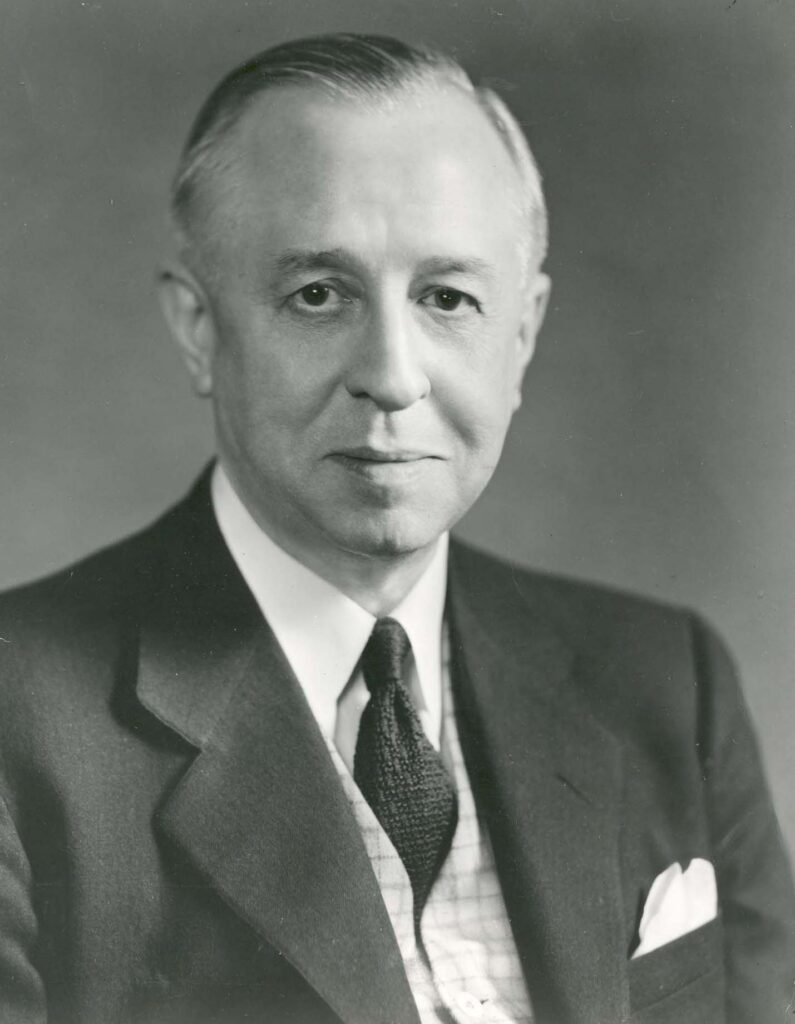
By Carla Slawson, Executive Director, The Arthur J. Schmitt Foundation & Joe DeMan, President of Interconnect Dynamics
Arthur J. Schmitt was born in 1893 in Chicago. When he was 12 years old, the Wright Brothers were just getting noticed for sustaining their airplanes in flight for several minutes at a time. Three years later, when Arthur was 15, he figured out how to build his own airplane and flew it successfully several times… until he didn’t. After a few harrowing crashes, his mother put a stop to his flying days. So Arthur moved on, took the propeller off his airplane and affixed it to a three-wheel chassis, then drove his “car” around town at 55 mph when the average Model T was traveling at 15 mph.
Today Arthur might have been described as a tech genius wunderkind. He dropped out of St. Ignatius High School in Chicago at the age of 15, very likely because he was intellectually bored. He joined the Army as soon as they would take him, where he learned everything he could about electronics. With a natural mind for both business and engineering, as well as a yeoman’s work ethic, he was determined to make his mark in the field of electronics. He had visions for how technology would be the great new hope for the future of mankind.
By 1941, he had started a company that developed inventions which earned him four U.S. patents, generating $3½ million (over $79 million in today’s U.S. dollars). Then World War II arrived in the U.S.
The atrocities of World War II affected Arthur, and he recognized that technology alone would not change the world for the better. In fact, in the hands of immoral and powerful leaders, technology could destroy the world. So the 48-year-old Schmitt focused his energies on a new endeavor. He sold his patents and their future royalties to fund a non-profit engineering school devoted to teaching practical engineering skills alongside moral leadership.
He called it The Fournier Institute of Technology. The Institute encapsulated Schmitt’s vision for engineering education: teach the practical engineering skills that a rapidly advancing society demands while imparting the “keen sense of justice and morality necessary for enlightened leadership.” He wanted to develop not just technical engineers, but “engineers of the soul.”
Though the Fournier Institute closed in 1955, Schmitt’s legacy remains through the Arthur J. Schmitt Foundation, now supporting high school, undergraduate, and PhD programs at 13 selected Midwest educational institutions. Each of these institutions partners with the Schmitt Foundation to provide tuition scholarships and leadership development programs for more than 300 Schmitt Scholars annually.
Similar to its very beginning, the student selection process to become a Schmitt Scholar is rigorous. But it is now more open, including scholarships for women and for students in many fields beyond engineering. The Foundation recognizes that education and moral, values-based leadership are needed in every field for a wide range of diverse young people.
Now, of primary importance for those of us in the interconnect industry, Arthur’s legacy would be incomplete without mentioning the company he started many years ago: American Phenolic Corporation. You may know it better as the company it eventually evolved into, Amphenol (ticker symbol APH), “enabling the electronics revolution.”
Today Amphenol is a global corporation with annual revenues of more than $23 billion, net earnings exceeding $4 billion, and more than 170,000 employees worldwide.
Arthur’s business legacy lives on through both the corporation he founded, Amphenol, and the Arthur J. Schmitt Foundation, which financially supports and empowers outstanding students with great financial need and great promise to change the world for good.
Every Schmitt Leadership Scholar and Fellow is asked to follow the words of Arthur: “Figure out a place for yourself in this world, and then do something about it.”
If you would like to recognize another hero, pioneer, or champion of the wire harness industry, please contact Joe DeMan at [email protected]