























From lab-tested cycle ratings to real-world conditions, understanding what really limits connector life in automotive and high-cycle applications
Connectors are often treated as simple components. Plug them in, unplug them, and move on. But in many applications, especially in automotive and test environments, repeated mating and unmating can become a real reliability concern.
Connector life is not just about whether it works today. It is about how long it continues to perform as intended under repeated use, environmental stress, and real-world handling.
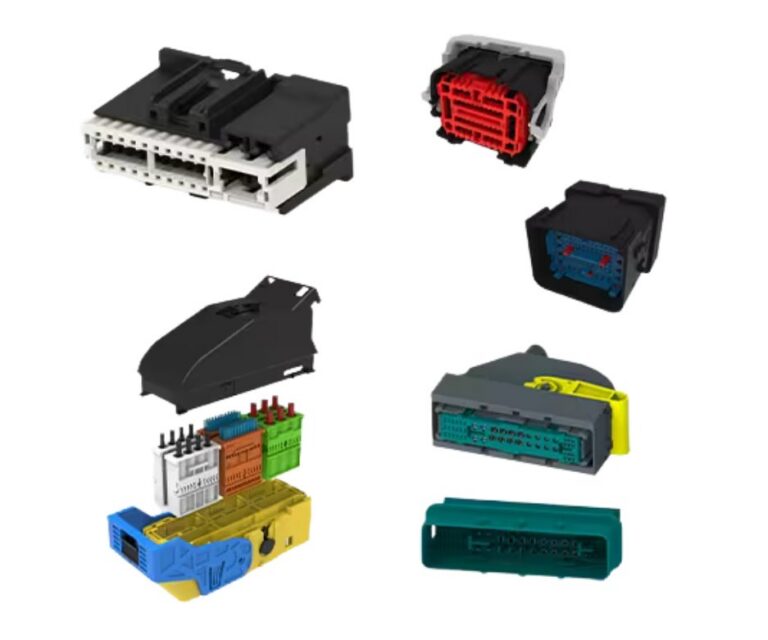
Industry standards such as LV214 and USCAR-2 are widely used by major automotive OEMs and their suppliers to guide connector design and validation. LV214, developed by German manufacturers including Volkswagen, BMW, and Daimler, is commonly applied across European automotive programs. USCAR-2 serves a similar role in North America, supported by organizations tied to Ford, GM, and Stellantis.
Together, these standards help ensure that connectors used in automotive and related markets can meet the demands of temperature, vibration, corrosion, and mechanical stress, while also providing a consistent framework for evaluating mating cycle performance. These standards also help define how mating cycle life is tested and understood.
At its simplest, a mating cycle is one complete insertion and withdrawal of a connector. That number, often listed in a specification, represents how many cycles the connector can withstand while still meeting both electrical and mechanical requirements.
These ratings are established in controlled laboratory conditions. Connectors are repeatedly cycled at defined speeds and forces, with periodic checks on contact resistance and mechanical integrity. The goal is to establish a baseline level of durability with a built-in safety margin.
In practice, real-world performance can differ. Laboratory testing assumes proper alignment, controlled insertion force, and a clean environment. In the field, connectors are exposed to vibration, contamination, temperature swings, and user handling that is not always ideal. Misalignment, side loading, and inconsistent mating force can all accelerate wear beyond what is seen in testing.
From a physical standpoint, connector degradation is gradual. It does not behave like a fuse that suddenly fails. The first area to show wear is typically the contact interface. As plating begins to wear, contact resistance can increase. Over time, this can lead to higher heat, reduced conductivity, and eventually intermittent or failed connections.
As cycling continues, other elements begin to degrade. The elastic properties of the contact system can relax, reducing the normal force that maintains a reliable electrical connection. Mechanical features such as guiding surfaces and housings can wear or lose alignment accuracy. In more advanced stages, base materials may become exposed and susceptible to oxidation.
Plating plays a major role in how long a connector will last. Thicker and more robust plating systems, such as gold over nickel, can significantly extend mating cycle life, especially in high-cycle applications. However, there is always a tradeoff between performance and cost. Not every application requires high-cycle capability, and over-specifying plating can add unnecessary expense.
Connector design is typically matched to the intended application. Some connectors are meant for very limited mating, such as permanent or semi-permanent installations. Others are designed for frequent use, such as test equipment or charging systems. In reality, connectors are sometimes used outside their original intent, especially in development or maintenance environments, which can lead to premature wear if not managed properly.
High-cycle applications require special attention. Contact design becomes critical. Features such as self-cleaning contact geometry, multiple contact points, and stable elastic structures help maintain performance over time. Proper alignment and guidance during mating also play a significant role in reducing uneven wear. In many cases, the life of the connector is limited by the contact interface long before the overall mechanical structure fails.
User behavior is another important factor. Forced mating, misalignment, and repeated cycling under unfavorable conditions can significantly shorten connector life. Even environmental conditions such as heat, dust, and humidity can contribute to wear. Vibration, in particular, can create what is effectively additional micro-cycling at the contact interface, accelerating fatigue even when the connector is not being actively mated and unmated.
Failures are rarely sudden. Most connectors show warning signs before reaching end of life. Increasing insertion force, rising contact resistance, and visible wear or contamination can all indicate degradation. In more advanced systems, these changes can even be monitored to support predictive maintenance.
For engineers and harness designers, extending connector life starts with proper selection. The expected number of mating cycles, the operating environment, and the importance of the connection all need to be considered. Beyond selection, good practices such as ensuring proper alignment, controlling mating forces, protecting against contamination, and avoiding unnecessary cycling can make a significant difference.
Connector life is not defined by a single number in a specification. It is the result of design, materials, environment, and how the connector is actually used. Understanding those factors is key to avoiding premature failure and ensuring long-term reliability.
The author would like to thank Nick Liu, Senior Director, Systems Engineering, Transportation Solutions at TE for his continued contributions and technical insight.
TE’s connectivity solutions for next‑generation E/E architectures enable the shift to zonal and centralized vehicle designs by delivering robust, high‑speed data, signal, and power connections in compact, modular form factors. Designed to reduce wiring complexity, support automation‑ready assembly, and scale with growing compute and data demands, TE’s portfolio helps automakers build more flexible, software‑defined vehicles while improving efficiency, reliability, and future readiness.