









Airmar Technology makes some pretty sophisticated products. Its ultrasonic transducers and sensing technology can be found on recreational boats and commercial fishing vessels, in industrial equipment, and in some applications most people would probably never associate with the company. Airmar’s proximity sensing technology, for example, is used on city buses to detect when someone is too close to the doors, preventing them from closing. Similar technology is used in automated car washes to tell drivers when to stop or pull forward. The company’s technology also extends into defense applications through MSI Transducers, another part of the Airmar organization.
I recently spoke with three people who have a good view of that part of Airmar’s operation: Craig Cushman, Director of Marketing at Airmar; Janet Nadeau, Production Supervisor at Airmar; and Al Sorensen of White Mountain Representatives, who represents Carpenter Manufacturing in the region. I expected to hear about some fairly complicated production challenges. That wasn’t really the case.
“The challenges aren’t drastic,” Janet said. “We cut tubes. We prep the cables using the Carpenter machines. The challenges aren’t really in the processes anymore.” Then she summed it up even more simply. “I mean, the machines really do it for us.”
That turned out to be a pretty good description of Airmar’s approach to this part of its manufacturing operation.
Airmar was founded in 1982, primarily to produce marine transducers for recreational boats, but the company has expanded considerably since then. In addition to its marine business, Airmar now supplies ultrasonic technology for a wide range of industrial sensing applications and produces weather stations that use ultrasonic technology to measure wind speed and direction. There are also related companies within the organization, including Marport, which manufactures commercial fishing electronics systems, and MSI Transducers.
The company was acquired by Amphenol in December 2023 and today operates as part of the much larger Amphenol organization. Craig said that relationship has opened additional opportunities for the company while allowing it to continue operating with considerable autonomy.
One of the more interesting things about speaking with Airmar from our perspective at Wiring Harness News is that the company builds cable assemblies for its own products. Most of the harness manufacturers we cover are contract manufacturers, so it was a chance to look at wire processing from the perspective of an OEM. Airmar’s cable assembly work can still be quite involved. Janet pointed out that the difficulty changes considerably depending on the product. Building a three-wire connector is one thing. A 12-wire connector is another.
Training reflects those differences. Airmar has a full-time trainer who works with new employees during onboarding. Depending on the job, employees may spend anywhere from two to four days in that initial training. Soldering to connectors can take longer because of the small, intricate work involved. Once employees move onto the production floor, trainers within the individual departments continue working with them. When it comes to preparing the wire and cable, however, Airmar has tried to keep things much simpler.
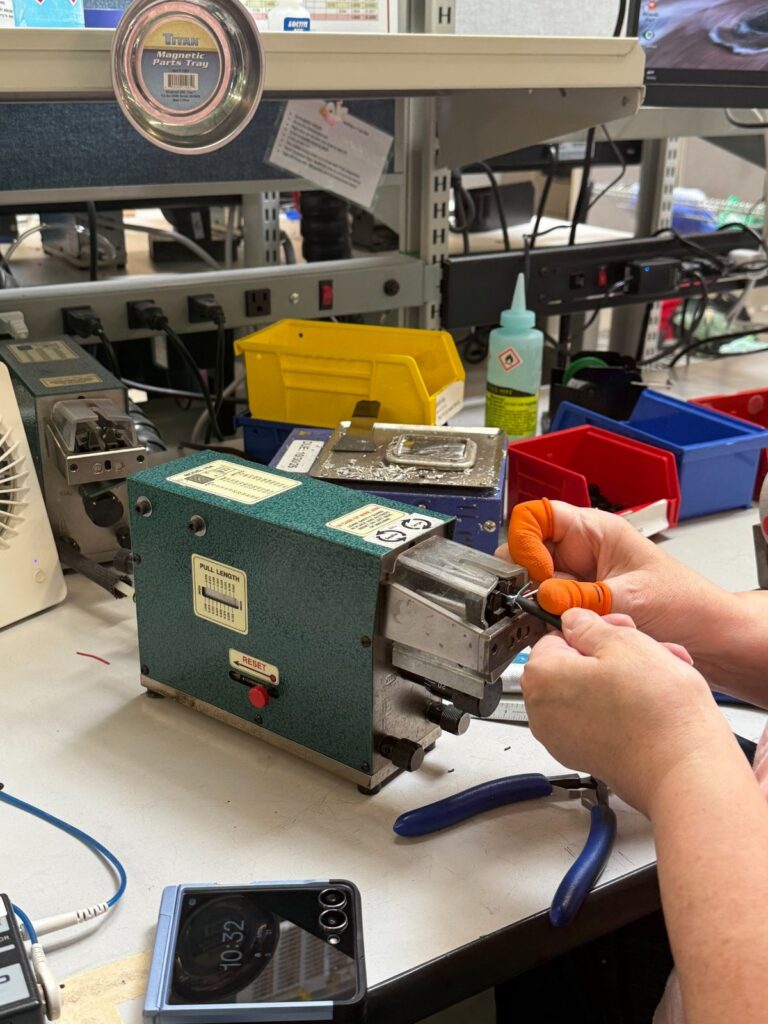
Carpenter Manufacturing equipment is used extensively throughout that part of the operation. Airmar has dozens of Carpenter tabletop machines for processing wire, cable and tubing. Al said having so many similar machines has created a level of uniformity on the production floor.
“They’ve had very good success,” he said. “There were many purchased at that time, so it creates a sense of uniformity in their production. They can take an operator off one bench, send them to another bench, and everybody knows how it operates.”
Craig picked up on the same point during our conversation. With so much familiar equipment on the floor, employees are not encountering a completely different machine every time they move to another station. That doesn’t mean employees are constantly being shuffled from machine to machine. Janet pointed out that the cable department tends to remain fairly stable. But having equipment that operates in a familiar way gives her more flexibility when people do need to work in different areas.
Janet’s reasons for liking the Carpenter equipment are fairly straightforward. “The quality is there,” she said. “They help get our efficiency up. We can produce more. They don’t need a lot of maintenance.” She also likes the fact that the machines don’t add much to the training burden. “They’re very operator friendly,” she said. “Anybody could learn how to do it and not struggle.” Those advantages help explain why Carpenter equipment has maintained such a substantial presence in Airmar’s wire processing operation over the years.
One Carpenter machine at Airmar has been doing its job for quite a long time. A large cable stripper on the production floor is approximately 25 years old, and it is still in use. “That still operates as it should,” Al said. The old stripper continues to work alongside much newer equipment, with Al providing support when needed. That’s probably about as good a durability test as you can give a piece of production equipment.
Al knows Carpenter’s older equipment particularly well. Before founding White Mountain Representatives LLC, he spent nine years working directly for Carpenter. Today, he represents Carpenter and provides local support to Airmar and other manufacturers throughout New England and into New York’s Hudson River Valley. For some of the other companies he represents, his territory also extends through upstate New York. That local support has become an important part of Airmar’s relationship with Carpenter. “Al takes very good care of us,” Janet said.
She said his value goes beyond simply knowing how the machines work. “He’s not only knowledgeable with the machines, but he’s very knowledgeable about our processes that we have here,” she explained. “If we call him with a problem or questions, he can pretty much answer anything.” Because Al is local, he can get to the plant quickly if there is a problem. He also helps with training when needed and works with Carpenter to get replacement parts and items such as blades to Airmar quickly. That gives Airmar a local resource who knows its operation, backed by the manufacturer whose equipment is on the floor.
With the increasingly sophisticated technology Airmar is producing, the company has little reason to add unnecessary complexity to basic wire and cable preparation. Craig sees considerable opportunity ahead as automation expands. Distribution centers are using more autonomous vehicles, creating applications for proximity sensing, and agriculture is another area where automation is moving quickly. “Think about mowing, weeding, spraying any kind of crops, even harvesting crops,” Craig said.
On the production floor, that means equipment needs to be reliable, and people need to be able to learn it without a lot of difficulty. Having similar equipment throughout the operation helps, as does having support available when it is needed. And if a machine has been around for 25 years and still does what Airmar needs it to do, there isn’t much reason to send it out the door just because something newer is available.
That’s why Janet’s answer to my original question about wire processing challenges stuck with me. Airmar has spent years standardizing much of this part of its operation around equipment that its people know, that has proven reliable and that can be supported when necessary. As a result, there just aren’t that many wire processing challenges at Airmar.