


























What if some of the greatest opportunities to improve wiring harness design have less to do with the harness itself and more to do with the decisions made before its development even begins?
That was one of the central themes of a presentation by Dmitry Fudym, Principal Manager, Electrical Distribution & Product Development at Rivian, during the recent automotive wire harness conference in Dearborn, Michigan.
Fudym described how Rivian has applied its corporate COMPASS values to the development of its electrical distribution systems (EDS). Those values, Ask Why, Stay Open, Zoom Out, Build Together, and Over Deliver, provide a framework for challenging established design practices and encouraging collaboration across engineering and manufacturing disciplines.
Although the values were not developed specifically for wiring harness design, Fudym demonstrated how they have influenced decisions involving electrical architecture, harness consolidation, component placement, and manufacturing processes.
The approach has become increasingly important as Rivian transitions from its original R1 vehicle architecture to the newer R2 platform.
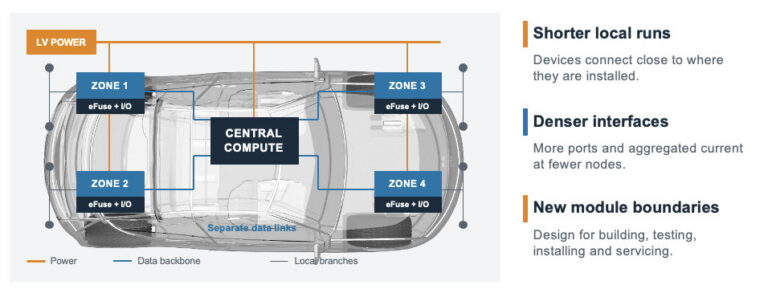
Rivian’s first-generation R1 vehicles utilized a domain-based electrical architecture with 22 electronic control units (ECUs). The arrangement resulted in relatively large, heavy, and costly wiring harnesses. With the introduction of the second-generation R1 architecture in 2024, Rivian transitioned to a zonal approach that reduced the number of ECUs to seven and cut the number of wire leads by approximately 25 percent.
While significant, those improvements were constrained by the existing vehicle architecture. The locations of controllers and other components had already been established, limiting opportunities to optimize harness routing and interconnections.
For R2, Rivian had the advantage of a clean-sheet vehicle design, allowing the EDS team to participate in architectural decisions much earlier.
This distinction became fundamental to the team’s approach. Rather than developing harnesses around predetermined component locations and assembly methods, Rivian sought to make electrical distribution requirements part of the initial vehicle design process.
One of the primary objectives was reducing the number of cut leads, a metric Fudym emphasized because improvements in this area can also reduce wire length, mass, connections, and manufacturing complexity.
The team also challenged traditional harness partitioning practices. During early R2 development, the vehicle contained 42 harness families. Through consolidation and design changes, that number was reduced to 29, including four harness families for which Rivian assumed additional development responsibility.
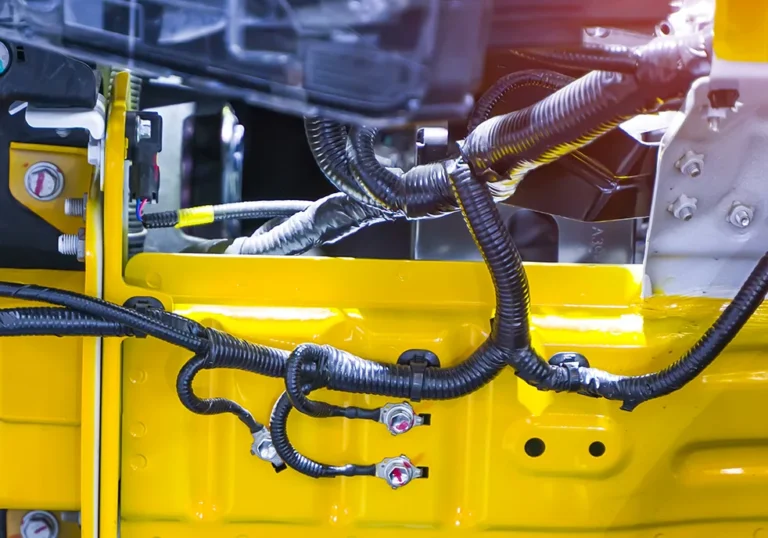
Approximately 80 percent of the vehicle’s electrical content is now concentrated in four major harness assemblies: left body, right body, underhood, and instrument panel.
An example of the COMPASS philosophy involved the elimination of separate door trim harnesses. Traditionally, these harnesses provide connections to switches, lighting, and other devices installed in a door trim panel before it reaches the vehicle assembly line. The arrangement accommodates established manufacturing processes, but Rivian questioned whether a separate harness was necessary.
Working with manufacturing and ergonomics teams, engineers developed an alternative routing path through the door armrest area. A simple fixture supports the trim panel while electrical connections are completed on the moving assembly line.
The change eliminated four separate harness families, along with the associated part numbers, validation requirements, purchasing activities, and assembly logistics.
Another example involved seat control wiring. Rather than routing those circuits through the body harness, Rivian explored connecting seat harnesses directly to zonal controllers.
The proposal initially raised concerns about manufacturing accessibility and potential assembly bottlenecks. However, early collaboration with manufacturing and studio design teams allowed the concept to be evaluated during prototype builds. According to Fudym, the revised approach proved feasible without creating the anticipated manufacturing difficulties.
These examples illustrate an important aspect of Rivian’s thinking. A wiring harness configuration that appears necessary under an established manufacturing process may become unnecessary when the process itself is reconsidered.
The same philosophy influenced the placement and design of Rivian’s zonal controllers. In conventional arrangements, an ECU may connect directly to only one or two harness assemblies, requiring additional circuits to pass through intermediate harness connections.
For R2, Rivian strategically positioned controllers to accommodate direct connections from as many as five harnesses. The team also explored moving certain electrical interconnections and splice functions from the harness into the controller’s printed circuit board assembly.
This approach can eliminate intermediate connections and reduce the number of wires and splices required within the harness system. However, it requires close coordination between harness engineers, ECU designers, and manufacturing personnel before controller packaging and connector selections are finalized.
Fudym also described how relatively small design questions can produce broader vehicle-level improvements. An effort to reduce attachment clips on a front-trunk jumper harness, for example, prompted discussions with manufacturing and studio personnel. Those discussions ultimately led to a shorter harness and the elimination of one lamp, reducing costs beyond the original objective.
Other initiatives focused on reducing component variety, simplifying wire color combinations, and replacing certain conventional splices with joint connectors to improve manufacturability and support future automation.
Looking ahead, Fudym identified high-speed data connections as an emerging challenge. Increasing numbers of ADAS cameras and sensors are creating additional demands for cable routing, connector selection, and harness partitioning. He suggested that greater standardization of connector interfaces, combined with vehicle-specific solutions, could help OEMs and suppliers address these requirements.
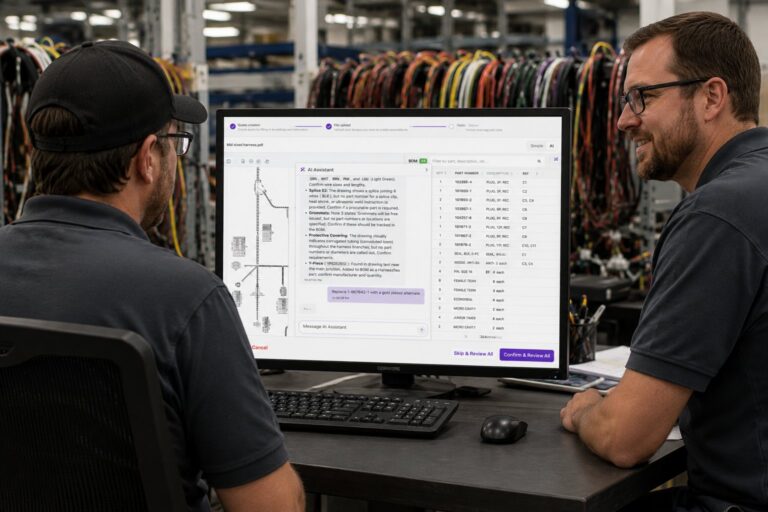
He also discussed Rivian’s development of specialized AI tools intended to bring engineering design, change management, costing, and lessons learned into a more integrated environment. The objective is not to replace EDS engineers, but to reduce administrative work and make accumulated engineering knowledge more accessible.
Throughout the presentation, a consistent theme emerged. Rivian’s COMPASS values are not a substitute for engineering expertise or technical innovation. Instead, they provide a structured way to question assumptions, encourage cross-functional collaboration, and identify opportunities that might otherwise be overlooked.
For harness manufacturers, the broader lesson is that meaningful improvements in electrical distribution systems often begin well before a wire is cut or a terminal is crimped.
Sometimes the most productive design question is simply why a particular harness, connection, or component needs to exist in the first place.