














New findings from WHMA’s Innovation Advisory Team highlight the need for better customer data, more efficient quoting processes, and industry-wide collaboration.
For wire harness manufacturers, preparing an accurate quote involves more than calculating materials, labor, and production costs. It also requires complete and reliable information from customers. When that information is missing, even the most experienced engineering and estimating teams can face significant delays.
According to the 2026 Wire Harness Industry Survey, conducted by the WHMA Innovation Advisory Team (IAT), incomplete customer information, not engineering workload, is one of the biggest obstacles to efficient quoting.
The survey gathered feedback from 23 industry professionals across executive, engineering, operations, and quoting roles, identifying common challenges and opportunities to improve efficiency throughout the wire harness industry.
Incomplete Information Creates Major Quoting Challenges
One of the survey’s most significant findings is the impact of missing or incomplete information on the quoting process.
Seventy percent of respondents identified bill of materials (BOM) or design completeness as a top operational challenge. The same percentage reported that poor or incomplete inputs limit their quoting process.
When asked where innovation could have the greatest impact, 65% identified quoting accuracy and speed, while 61% highlighted the importance of validating customer designs before production.
These findings suggest that improving the quality of information provided at the beginning of the quoting process could help manufacturers reduce delays and improve efficiency.
Why Are Quotes Taking So Long?
Although preparing a quote requires technical expertise, the survey suggests that much of the time spent completing an RFQ (request for quotation) involves waiting for information rather than performing engineering work.
More than half of respondents (57%) reported that RFQs typically take six business days or longer to complete, while 30% said the process takes more than 10 business days.
However, the most commonly reported estimate for active work on a quote was just three to five hours per assembly.
So, what’s causing the delays?
According to respondents:
- 70% cited waiting for supplier pricing and lead times.
- 61% identified waiting for customer clarification.
- 17% pointed to estimating or engineering work.
The survey also identified the information most frequently missing from customer RFQs, including manufacturer part numbers (70%), missing or unidentified parts (61%), and customer specifications or workmanship requirements (39%).
Together, these findings highlight how communication gaps and incomplete documentation can slow the quoting process before production even begins.
Industry Support for a Standardized RFQ Checklist
To help address these challenges, the WHMA Innovation Advisory Team is recommending the development of a standardized RFQ minimum data checklist.
The goal is to establish a consistent set of information that manufacturers and customers can use when preparing and reviewing RFQs.
The survey found strong support for this approach, with 74% of respondents rating a standardized checklist as very or extremely useful.
Additionally, 65% said they would use the checklist internally to evaluate RFQs, while 57% would share it with customers or request its use. Another 57% indicated they would incorporate it into customer onboarding.
“The industry already knows which information is missing from most RFQs,” said David Bergman, Executive Director of WHMA. “A common standard gives manufacturers and their customers a shared starting point, and that benefits everyone in the supply chain.”
By establishing clearer expectations upfront, a standardized checklist could help reduce repeated clarification requests, improve communication, and support more consistent quoting practices.
AI and Automation Offer Opportunities for Improvement
The survey also explored how manufacturers are adopting artificial intelligence and automation to improve their processes.
While adoption is growing, the results show that many companies are still in the early stages of implementing these technologies.
Seventy-eight percent of respondents reported using, piloting, or evaluating AI or automation in at least one area.
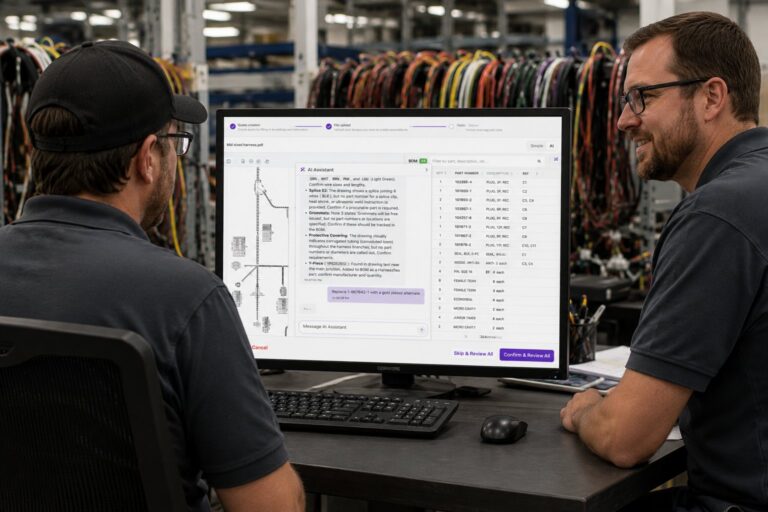
Drawing, PDF, and BOM data extraction was the most common application, cited by 70% of respondents. However, only 26% reported activity involving design-package validation.
The survey also found that only one of the 23 respondents described their quoting process as highly automated and scalable. Meanwhile, 70% still rely on in-house Excel or Word methods for design documentation.
These findings suggest that while automation can help manufacturers process information more efficiently, technology alone may not resolve the challenges caused by incomplete customer data.
“Manufacturers are investing in tools that read customer data faster,” said Arik Vrobel, founder and CEO of Cableteque and co-chair of the WHMA Innovation Advisory Team. “The bigger opportunity is making sure the right data arrives in the first place and catching what’s missing the moment an RFQ is opened.”
Combining standardized data requirements with tools that identify missing information early could offer a more effective approach to improving quoting efficiency.
What’s Next for WHMA and the Industry?
Based on the survey findings, the WHMA Innovation Advisory Team has identified several opportunities for industry collaboration and improvement.
A key priority is developing a minimum RFQ data checklist that addresses essential information such as BOMs, approved parts, accessory definitions, specifications, and revision controls.
The team also recommends piloting the checklist with manufacturers and original equipment manufacturers (OEMs) to evaluate its effectiveness and identify opportunities for refinement.
Additional priorities include developing practical resources related to quoting and AI technologies, as well as expanding future survey participation to better understand how industry challenges evolve over time.
These efforts are intended to provide manufacturers with practical tools and guidance while encouraging greater collaboration throughout the supply chain.
Building a More Efficient Future for Wire Harness Manufacturing
The 2026 WHMA Industry Survey highlights an important opportunity for the wire harness industry: improving quoting efficiency may begin with improving the information manufacturers receive.
While new technologies and automation tools can support faster processes, clear communication, complete documentation, and consistent industry practices remain essential.
Through the work of its Innovation Advisory Team, WHMA is helping identify these shared challenges and explore practical solutions that can benefit manufacturers, OEMs, and the broader industry.
As manufacturers continue to navigate increasing complexity and evolving customer expectations, industry collaboration will play an important role in building more efficient and reliable processes.
The 2026 Wire Harness Industry Survey included 23 respondents from companies of varying sizes. Because the sample was small and non-random, the findings should be viewed as directional insights rather than representative of the entire wire harness industry.