












































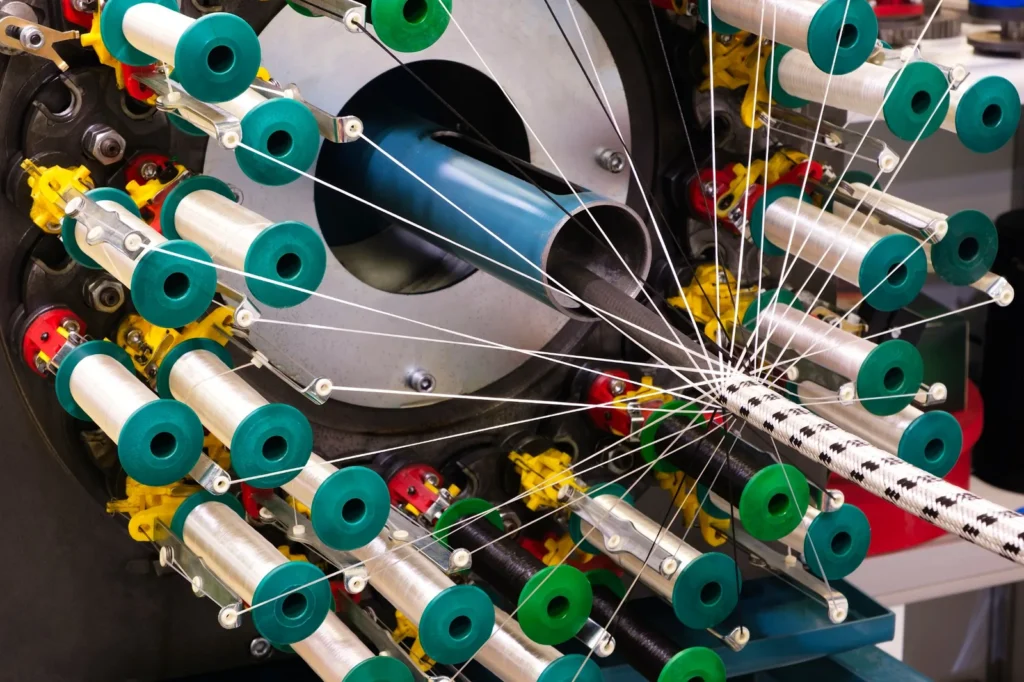
Most braiding plants chase more output by pushing machine speed and uptime. But the order in which references run across the machines can quietly cap capacity more than any mechanical limit — and it is a problem no human planner can fully solve by hand.
When a braiding line can’t keep up with demand, the instinct is almost always the same: run the machines faster, add a shift, or buy another braider. Each of those costs real money, and sometimes one of them is genuinely the answer. But a surprising share of the capacity that braiding operations believe they are “missing” was never a mechanical problem at all. It is sitting in the schedule — in the decision of which reference runs on which machine group, and in what order — and it is being lost every week on machines that are otherwise perfectly capable.
This is one of the most under-examined levers in braided-product manufacturing, whether the end product is metal shielding braid over cable, textile sleeving, reinforced hose, or a technical-textile preform. And the reason it stays hidden is mathematical.
The scheduling problem is far bigger than it looks
Consider a single braiding machine group that has to run a set of references over the coming week. Someone has to decide the sequence. It seems like a small decision. It is not.
For n references, the number of possible orderings is n factorial — every reference multiplied by every remaining choice after it. The numbers escalate violently (see Figure 1):
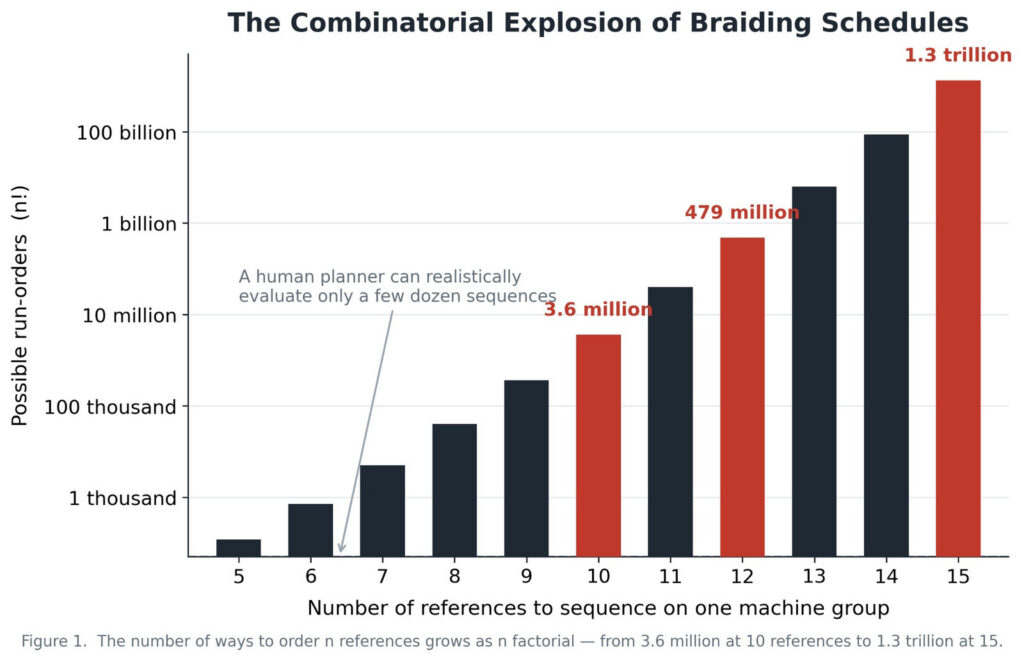
- 10 references → about 3.6 million possible sequences
- 12 references → about 479 million
- 15 references → roughly 1.3 trillion
And that is for one machine group. A plant running several groups, each with its own reference mix, its own capacity, and its own changeover behavior, multiplies those possibilities into a search space so large it has no meaningful physical comparison. This is a textbook example of what mathematicians call an NP-hard problem: the class of problem where simply checking every option to find the best one becomes impossible past a handful of items, no matter how much computing power you throw at it.
Why manual and spreadsheet scheduling can’t win
A skilled planner working in a spreadsheet or on a whiteboard can realistically evaluate a handful of arrangements — perhaps a few dozen, guided by years of hard-won intuition. That intuition is valuable and should not be dismissed. But set against a solution space of millions or billions, even an expert planner is examining a vanishingly small corner of what is actually possible.
There is a subtler problem too. Left to manual judgment, a schedule tends to get optimized for what is easy to see — grouping the obvious reference families — or for what minimizes the planner’s own replanning effort when a rush order lands. Neither of those is the same as minimizing total changeover time or maximizing utilization across the whole floor. The outcome is a schedule that looks reasonable, runs without complaint, and is quietly far from the best one available. The plant never perceives the gap, for the simple reason that the better schedule was never made visible.
The changeover multiplier
In braiding, this matters more than in many processes because changeovers are both expensive and sequence-dependent. Switching yarn or wire type, changing carrier count, adjusting gauge, or moving to a different braid pattern each carries a setup penalty — and that penalty depends heavily on what ran immediately before. Two schedules containing exactly the same jobs can differ enormously in total lost time purely because of the order.
Every changeover is machine-hours that produce zero kilograms. A poorly sequenced schedule stacks up avoidable changeovers, and on a floor of dozens of braiders, a handful of unnecessary changeovers per machine per week compounds into a serious loss of output over a year. It is capacity the plant already owns and already pays for, but never ships.
What optimization actually does
The alternative is not to try harder or to hire more planners. It is to change the method entirely.
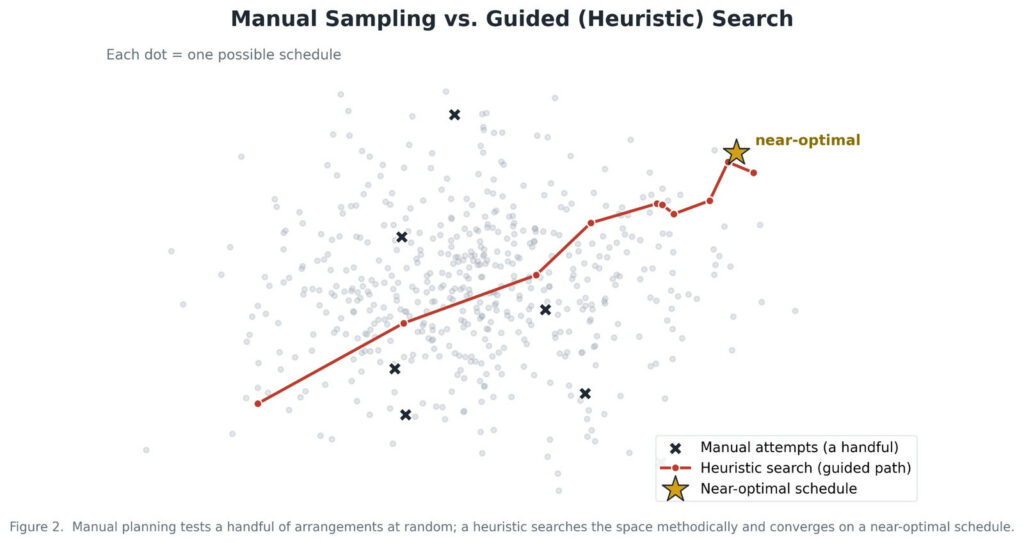
Optimization heuristics — from straightforward dispatching rules for simple cases, to metaheuristics such as simulated annealing, tabu search, or genetic algorithms for the hard ones — do not attempt to enumerate every possible sequence. Instead they search the space intelligently: they generate feasible schedules, keep the good ones, and systematically evolve them toward better solutions, converging on a near-optimal answer in seconds or minutes rather than the impossible lifetimes exhaustive search would demand (see Figure 2).
The important word is feasible. The output is not a theoretical ideal; it is an executable plan that respects real constraints — actual capacity in kilograms per day for each machine group, real changeover costs, and real due dates. It tells the floor which reference to run on which group and in what order, and it does so having effectively considered more arrangements than a team of planners could evaluate in a career.
The payoff, in the language of management
Stripped of the mathematics, the gains are concrete and easy to state to a plant director: higher machine utilization, fewer changeovers, more kilograms out the door on the same equipment, better on-time delivery, and less reliance on overtime and expediting to recover from a schedule that fell behind.
The most compelling part is that this is capacity gained without capital expenditure. There is no new machine, no new building, no additional floor space — only a better use of assets already installed and already running. For a capacity-constrained plant weighing whether to buy another braider, recovering even a few points of utilization from smarter sequencing can defer that purchase entirely, which changes the economics of the whole operation.
How to start
You do not need an enterprise-scale planning system to begin capturing this. The path starts with three practical steps:
- Model reality. Establish your demand per reference and your true capacity, expressed in kilograms per day, for each machine group. This alone is often clarifying.
- Measure where you are. Track current machine utilization and changeover hours per machine. Most plants are surprised by what this reveals.
- Optimize and compare. Apply an optimization approach to the same data and measure the difference against how you schedule today.
Even the measurement step tends to surface capacity nobody knew was there. The underlying shift is to treat the schedule as a decision you actively optimize, rather than a routine you inherit.
In braiding, the next increment of capacity is very often already sitting on your floor. The only question is whether your schedule is letting you reach it.
About the Author
BALLA Mohamed specializes in production capacity optimization for braiding manufacturing, helping producers of braided shielding, sleeving, and technical textiles get more output from the machines they already own. Drawing on hands-on experience on the braiding floor combined with data-driven scheduling and optimization methods, i develop practical tools that turn demand and capacity data into executable, near-optimal production plans — without the cost or complexity of a full enterprise planning system.
To discuss braiding capacity, scheduling, or how optimization could apply to your operation, contact BALLA Mohamed at [email protected] .