



























In 2019, Wiring Harness News published a deep dive into the fundamentals of wire harness test fixturing with ECC (Electrical Continuity & Components). The basics from that piece still hold true today, and readers wanting the foundational overview can revisit that article on our website.
But much has changed in the intervening years. Fixturing now intersects with automation, new connector technologies, EV platforms, supply-chain shifts, and more frequent testing requirements across the entire build cycle. To understand these changes, we reconnected with Ryan Balcom, president of ECC, for an updated look at where fixturing stands today.
“We really moved into end-of-line testing in testers that are functional testers,” Balcom said. “The sophistication in those, and the type of connectors transferring high data rates, that’s the newest stuff.”
Meet with Joe Tito and Ryan Bal…
The fixturing landscape is no longer defined by just the mating plane—it’s defined by the systems around it.
High-Speed Connectors and More Complex Interfaces
Five years ago, fixture makers frequently worked with familiar automotive connectors and repeatable designs. Today’s harnesses, especially those in EVs, driver-assist systems, robotics, and telecom, include coax, LVDS, LIDAR cables, and other high-speed interfaces.
“It doesn’t necessarily mean our fixtures are more complex,” Balcom noted, “but the interface is more complex into those connectors.”
Meet with Joe Tito and Ryan Bal…
The result is tighter tolerances, more specialized probes, and more variation in how and when harnesses must be tested.
Additive Manufacturing: Useful, but Not a Full Replacement
The rise of 3D printing has led some manufacturers to prototype or produce their own fixtures. Balcom sees the benefits—speed and accessibility—but draws a clear boundary.
“3D printing allows faster fixturing to happen,” he said. “But ultimately… the robustness just isn’t there.”
Meet with Joe Tito and Ryan Bal…
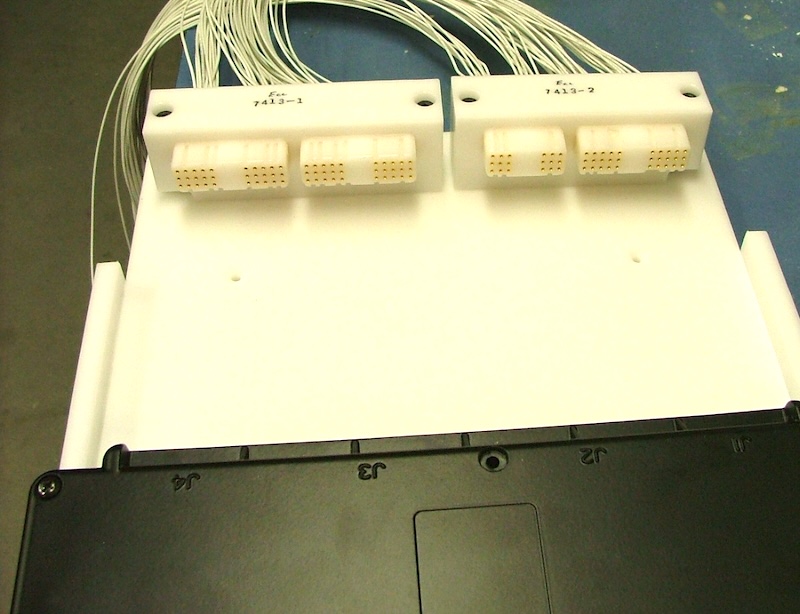
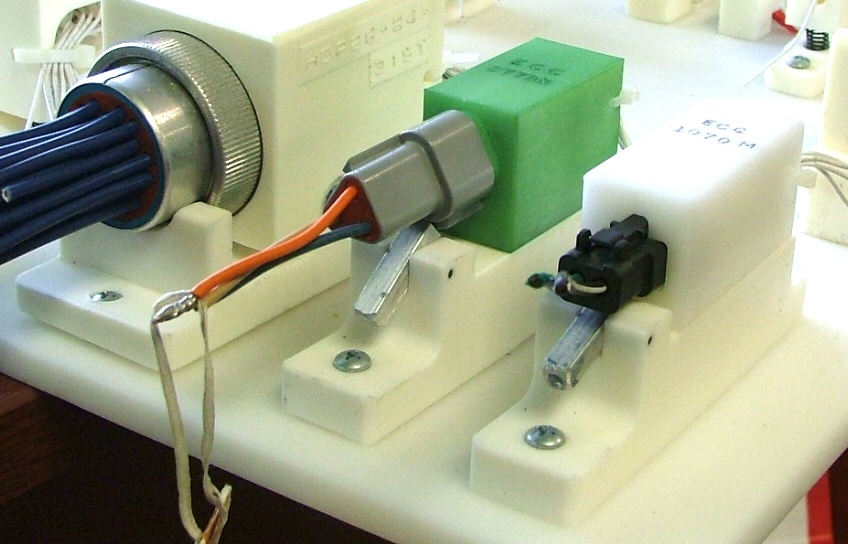
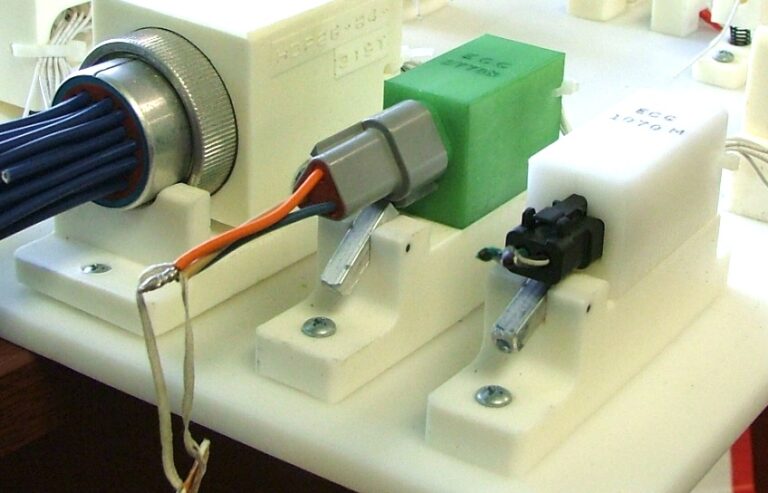
ECC still relies primarily on acetyl for machined mating interfaces, since 3D-printable nylons and resins cannot yet match its durability or precision.
“Acetal’s not available in 3D printing,” he said. “Some nylons get close, but they’re just not there yet.”
Meet with Joe Tito and Ryan Bal…
Even so, he expects a hybrid future: “Our fixture as a whole will be part of an assembly that can accept different style connector interfaces… that part will be machined and the other part will be 3D printed.”
Meet with Joe Tito and Ryan Bal…
Expectations Around Speed, Ergonomics, and Repeatability
As harnesses grow more complex, ECC sees customers prioritizing ease of use without sacrificing connector protection. Shops vary widely—some focus on cycle time, while others simply want fixtures that avoid marking connectors.
“It’s always a balance,” Balcom said. “We could make the most robust fixture in the world, but then it may mark connectors, it may be very costly.”
Meet with Joe Tito and Ryan Bal…
ECC now offers one-handed lever fixtures and alternate retention methods to support faster workflows when needed, while also accommodating customers who operate in low-volume environments where speed is less critical.
Automation: Where Fixturing Meets Robotics
One of the biggest changes since 2019 is the shift toward automated end-of-line testing. ECC increasingly partners with system integrators designing robotic or semi-automated mating systems.
“The request for our fixturing to be part of complex automation solutions would be the one that almost broke us,” Balcom said. “Getting that to work the line and be repeatable was very, very difficult.”
Meet with Joe Tito and Ryan Bal…
Humans can adjust for cable stiffness or slight misalignment. Robots cannot. As a result, ECC has expanded its 3D modeling capabilities and adopted advanced design tools.
“What we’ve had to incorporate is additional 3D design software and the expertise within our design engineers,” Balcom said.
Meet with Joe Tito and Ryan Bal…
Automation is now part of fixture design far earlier than before.
Testing Earlier—and More Often
Perhaps the most dramatic shift is timing. Historically, many harnesses were tested only at the end of the build. Today, testing occurs throughout the process.
“We’re just seeing more testing,” Balcom said. “It’s no longer a luxury or a premium… it’s a necessity.”
Meet with Joe Tito and Ryan Bal…
Supply chain decentralization plays a large role. Harnesses that once came from a single supplier now arrive from multiple vendors with varying processes. OEMs no longer assume uniformity.
“They’re finding a reduction in quality… so they’re forced to set up testing stations as harnesses come in,” he explained.
Meet with Joe Tito and Ryan Bal…
Meanwhile, software-driven build processes require highly reliable mating connectors throughout assembly—not just at the end.
EVs and Dimensional Tolerance Challenges
EV applications introduce thicker, stiffer, high-current cables that demand new fixture considerations. These cables don’t flex or “hide” slack like traditional signal wires. Dimensional verification becomes as important as electrical testing.
“With EVs, the size of the cable… changed the type of harness,” Balcom said. “Because of the cable’s rigidness, the tolerances became much more important.”
Meet with Joe Tito and Ryan Bal…
“You can hide an extra five centimeters of 20-gauge wire pretty easily,” he added. “You don’t do that with a 2/0 cable.”
Meet with Joe Tito and Ryan Bal…
Fixtures in this space often double as dimensional gauges, ensuring assemblies seat correctly in battery trays, junction boxes, and power electronics modules.
OEMs Bringing Harnessing In-House
A striking trend is the number of OEMs—especially in EV, aerospace, robotics, and autonomous vehicles—that now build harnesses internally. Their designs change frequently, and outsourcing slows iteration.
“They feel it’s too critical to outsource,” Balcom said. “There’s new versions of their products so frequently… they need to control it.”
Meet with Joe Tito and Ryan Bal…
ECC increasingly assists companies in setting up entire build and test workflows, from board fixturing to system-level integration.
One autonomous-semi manufacturer recently revealed something surprising: despite advanced sensors and AI, harnessing was their biggest bottleneck.
“It’s one of their largest pain points,” Balcom said. “You wouldn’t think of it, but the hardest part is how they’re going to set up their harness build and test portion.”
Meet with Joe Tito and Ryan Bal…
Modularity and the Build-Board Puzzle
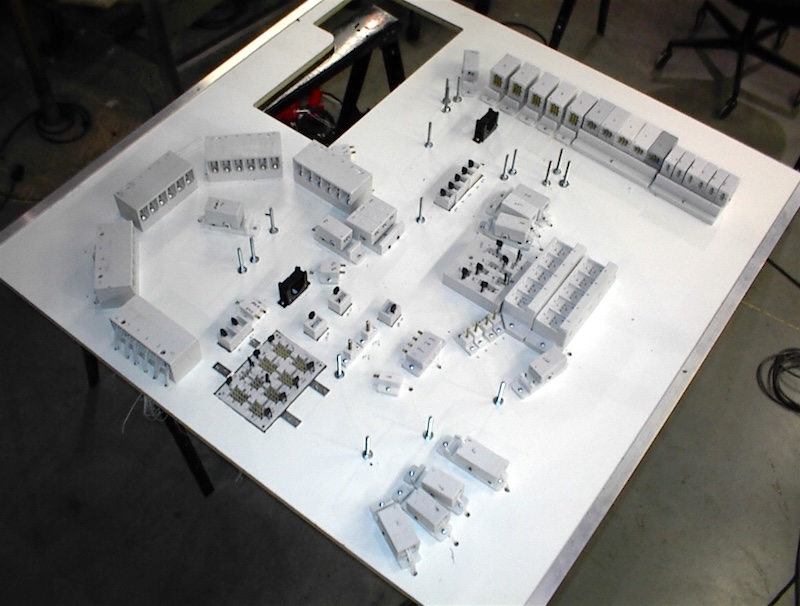
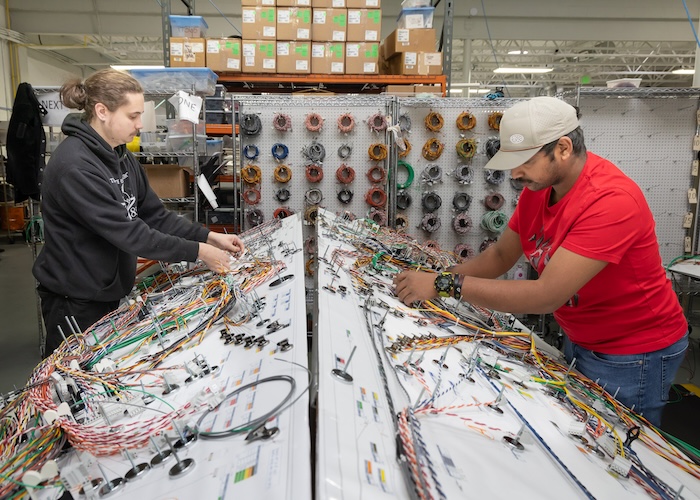
Harness test boards vary widely—magnets, adhesive mounts, grid systems, drilled panels—forcing fixture providers to design flexible mounting solutions.
“There’s a whole bunch of variation in the way people get it done,” Balcom said. “We’ve done magnets, Panduit mounts, Cirris grid systems.”
Meet with Joe Tito and Ryan Bal…
As more small manufacturers bring harnessing in-house, ECC sees increased demand for front-loaded engineering and modular fixture components that adapt to multiple board styles.
Looking Ahead: Hybrid Fixtures and Increased Automation
Balcom expects fixturing to move steadily toward hybrid manufacturing models.
“I think we will be 3D printing about 75 percent of our fixtures,” he said. “The mating part will be machined and the other part will be 3D printed.”
Meet with Joe Tito and Ryan Bal…
Challenges remain—material performance, customer process constraints, and the rapid obsolescence of high-end printers—but the direction is clear.
ECC also anticipates continued growth in automation as companies pursue tighter tolerances, more documentation, and more predictable workflows.
“Automation, understanding how we can gain efficiencies… that will allow us to compete on the world stage,” Balcom said.
Meet with Joe Tito and Ryan Bal…
Conclusion
The fundamentals of fixturing remain, but the world around them has changed. Higher-speed connectors, EV architecture, automation, supply-chain shifts, and the rise of in-house harnessing have pushed fixturing into a more strategic role. It now supports not only electrical testing but dimensional validation, workflow efficiency, and system-level integration.
As Balcom summarized: “Testing is no longer optional. It’s part of the way product is built. And it’s only going to increase.”