


























For aerospace wire harness manufacturers, electrical testing is often one of the most capital-intensive and schedule-critical steps in production. The testers themselves are significant investments, but in many operations, the real long-term cost lies elsewhere: in the adapter cables used to interface the unit under test to the analyzer.
DIT-MCO, a long-time supplier of aerospace-grade wire harness test equipment, believes those adapter cables have historically been treated as consumables rather than the strategic assets they truly are. With its new AMP Cable Manager software, the company is aiming to change that mindset.
To understand why, Wiring Harness News spoke with David Shier, President of DIT-MCO, Kurt Morrison, Product Manager, and Tom Woosley, Marketing Specialist. Together, they outlined both the operational challenges harness manufacturers face today and how AMP Cable Manager is designed to address them.
The Hidden Cost of Adapter Cables
As Kurt explained, adapter cables are often the single largest cumulative investment associated with electrical testing—frequently exceeding the cost of the tester itself over its lifetime.
“Adapter cables used to interface the unit under test to the tester are usually the biggest investment most customers have when it comes to testing,” Kurt said. “Trying to maintain that inventory and the overall health of those cables can be quite daunting.”
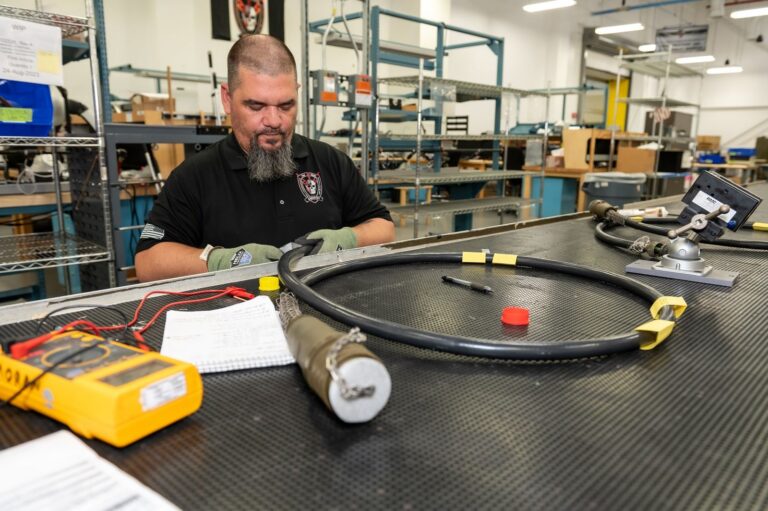
Unlike the product being tested, adapter cables are mated and de-mated repeatedly, often dozens or hundreds of times. They are handled by multiple operators, stored in varying conditions, and moved across work cells or even buildings. Over time, wear accumulates—often invisibly—until failures begin to appear.
David noted that many customers are surprised to learn where their test failures actually originate. “A high percentage of test failures are not in the product—they’re in the adapters,” he says. “The product is clean and new. The adapters get used many, many times.”
Despite this reality, adapter cables are rarely tracked with the same rigor applied to capital equipment or even finished goods. In many facilities, spreadsheets and informal processes remain the norm.
David also pointed out that part of the challenge stems from how adapter cables are treated on the shop floor. Unlike finished products, which are handled carefully and protected throughout production, adapters are often moved, stored, and handled in ways that do not reflect their importance as precision test tools. Over time, that difference in handling contributes to wear, damage, and inconsistent test results—issues that can remain hidden until failures begin to appear. By making adapter usage and condition visible, AMP Cable Manager helps reinforce new behaviors around care, accountability, and preventive maintenance.
Two Core Functions: Inventory and Health Management
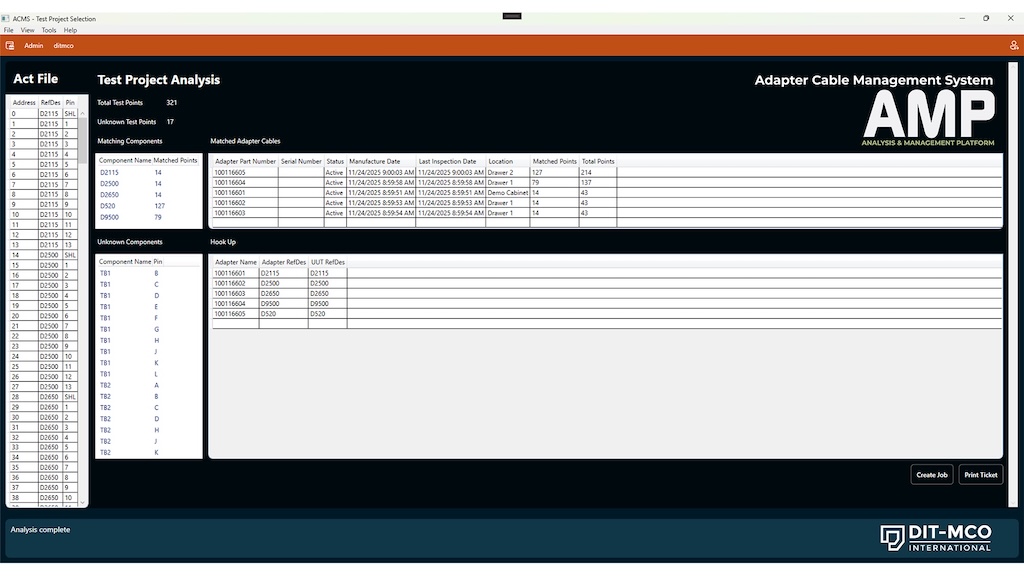
AMP Cable Manager was conceived to address this gap through two tightly integrated functions: inventory management and adapter cable health tracking.
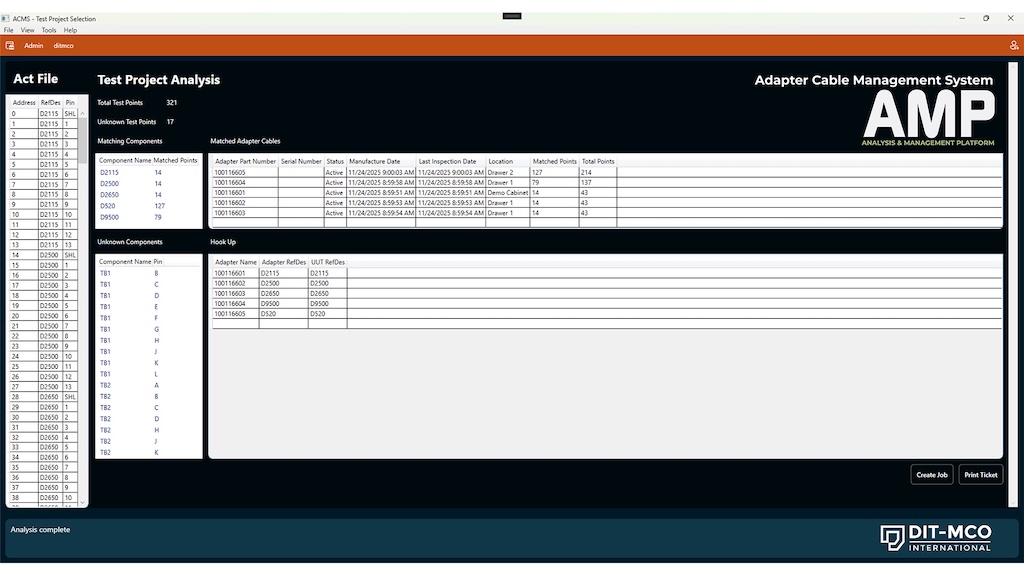
On the inventory side, the software provides real-time visibility into where each adapter cable is located—whether it’s in use, in storage, or undergoing repair. For operations with large cable inventories spread across multiple work cells or buildings, simply finding the right cable can consume significant time.
“With Cable Manager, you always know where every cable is currently being used or stored,” Kurt explained. “That alone saves time and money that otherwise gets lost looking for adapter cables.”
The system also helps identify shortages before they become problems. As tests are scheduled, AMP can determine whether all required adapter cables are available and healthy. If not, users receive early warnings—well before the test station becomes a bottleneck.
As testing programs grow in number and complexity, that level of visibility becomes increasingly important. Knowing where cables are is only part of the equation; understanding whether they are available, serviceable, and appropriate for upcoming tests is what allows teams to keep test operations moving without interruption.
From Reactive to Predictive Maintenance
Where AMP Cable Manager begins to differentiate itself is in how it treats adapter cables as assets with measurable life expectancy.
Each cable can be tracked from its “born-on” date forward, with usage history, mating cycles, repairs, and wear indicators logged continuously. Manufacturer-rated cycle counts are considered, but they are only part of the picture.
“Some connectors are rated for 500 cycles but last far longer,” David explained. “Others—like certain coax connectors—may be rated for 50 cycles, but real-world handling means they may fail much sooner.”
AMP doesn’t rely solely on published specifications. It learns from actual usage patterns within a customer’s environment. Over time, the software can identify when a particular connector type or cable assembly consistently fails earlier than expected and adjust maintenance recommendations accordingly.
“At a certain threshold, we can say, ‘You really need to maintain or replace this cable now,’” David said. “You don’t want to find out there’s a problem when you’re already in test. At that point, it’s very costly.”
Capturing Failure Patterns Others Miss
One of the most powerful aspects of AMP Cable Manager is its ability to surface failure patterns that would otherwise remain hidden—particularly in low-volume aerospace environments where traditional statistical methods fall short. Rather than relying on repeated failures in identical products, the software looks across tests, programs, and adapter usage to identify common threads that might not be obvious to operators or engineers reviewing results in isolation.
David offers a common example: a continuity failure appears during a test and is resolved manually. The adapter is returned to inventory with no indication it may be at fault. Later, a different product, using the same adapter and connector, shows a similar failure.
“After a few occurrences like that, the software can say, ‘This adapter has been associated with failures on pin five multiple times,’” David explained. “Even if no one flagged it, the commonality is the adapter.”
This kind of correlation is extremely difficult to detect manually, especially in low-volume aerospace environments where identical products may not be tested repeatedly. AMP’s ability to surface these patterns allows suspect cables to be removed from service before they disrupt production.
Job Planning and Schedule Protection
Testing is often a production bottleneck, particularly when a product reaches the test stand only to discover a critical adapter cable is unavailable or in repair.
AMP Cable Manager addresses this by tying cable availability directly into job planning. Upcoming tests can be reviewed in advance, required cables identified, and pick tickets generated to stage everything ahead of time.
“If one of the five cables you need is in repair, the system will tell you,” Kurt said, “That gives you time to adjust the schedule rather than discovering the issue at the test station.”
For operations managing multiple programs simultaneously, this capability helps prevent test delays from cascading into missed delivery commitments.
Beyond Adapters: Root Cause Analysis for Products
While AMP Cable Manager is focused primarily on adapter cables, its analytical framework extends to the product itself.
Traditional test systems often rely on repeat failures in the same location on the same product to identify trends. In aerospace manufacturing—where volumes are low—this approach rarely works.
“With AMP, we can identify trends across different products,” David detailed. “If the same solder splice part number appears in failures across different assemblies, even in different locations, we can point that out.”
The same applies to connector insert issues, push-back pins, or crimp-related problems. By aggregating test data across programs, the software enables a level of root cause analysis that previously required extensive manual review—if it was done at all. David noted that this capability aligns closely with AS9100 quality objectives and is protected by a recently issued patent.
Designed for Adoption, Not Disruption
As David emphasized, AMP Cable Manager was designed to integrate into existing manufacturing and quality systems rather than operate as a standalone application. The software is built on a SQL Server database and provides connectivity to common business intelligence and planning tools, allowing customers to incorporate adapter and test data directly into their broader operational workflows. “We’re not creating an island here,” David said. “This data can be used alongside the systems customers already have.”
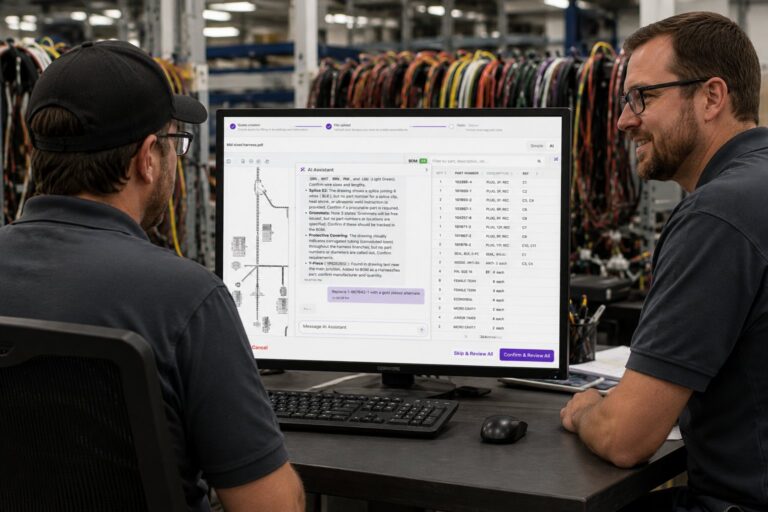
Kurt noted that usability was a core consideration in the development of AMP Cable Manager. The software’s dashboard provides a high-level snapshot of the testing environment, highlighting missing cables, high-use assets, tests currently underway, and anticipated completion times. From there, users can access detailed usage histories, check-in and check-out records, repair activity, aging reports, and forecasting tools designed to support planning and budgeting decisions, all within an interface intended to be intuitive in production settings.
DIT-MCO recognizes that customers already have substantial investments in existing adapter cables. AMP Cable Manager is designed to work with those assets, not force a wholesale replacement. “We know customers aren’t going to rebuild all their adapter cables just to add tracking,” Kurt informed. “So we’ve designed multiple options.”
These include RFID tags, barcodes, and magnetic attachments that can be retrofitted to existing cables and analyzers. Data is stored both locally and within a centralized SQL server database, allowing integration with business intelligence tools and other planning systems.
A Shift in How Adapter Cables Are Valued
Tom sees AMP Cable Manager as more than just software—it’s a catalyst for process improvement.
“There’s a latent need here,” he said. “People know adapter cables are important, but they haven’t had a system that makes managing them practical. This introduces new behavior into the shop.”
By making cable usage visible and measurable, AMP encourages operators and managers alike to treat adapters as critical production tools rather than incidental accessories.
Given that many customers spend ten times—or more—on adapter cables over the life of a tester, the case for better management is compelling.
Looking Ahead
DIT-MCO is currently preparing AMP Cable Manager for broader release and is offering beta testing opportunities, including training and support. Interested manufacturers can engage directly with DIT-MCO to participate or request a trial.
As aerospace harness manufacturers continue to face pressure to improve throughput, reliability, and traceability, AMP Cable Manager represents a thoughtful attempt to bring discipline and data-driven insight to one of the most overlooked areas of the test process.