





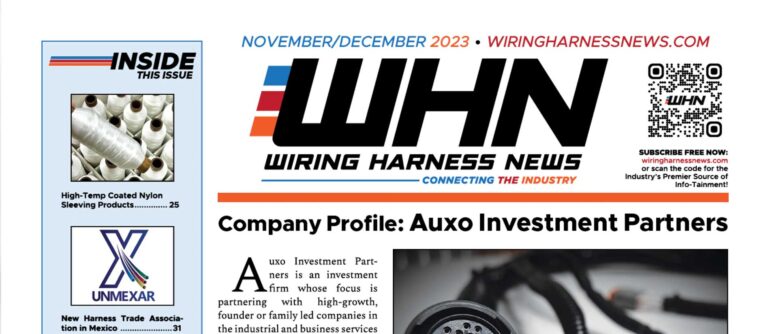
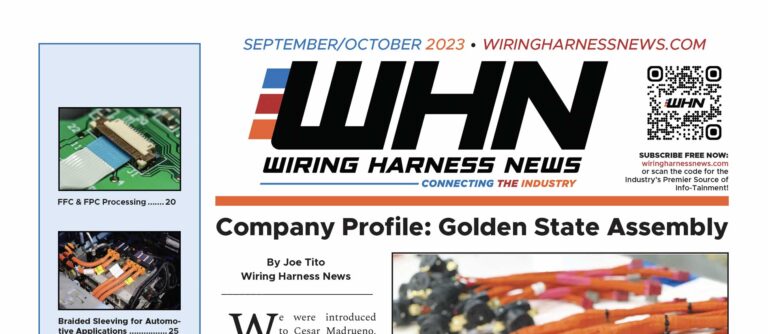



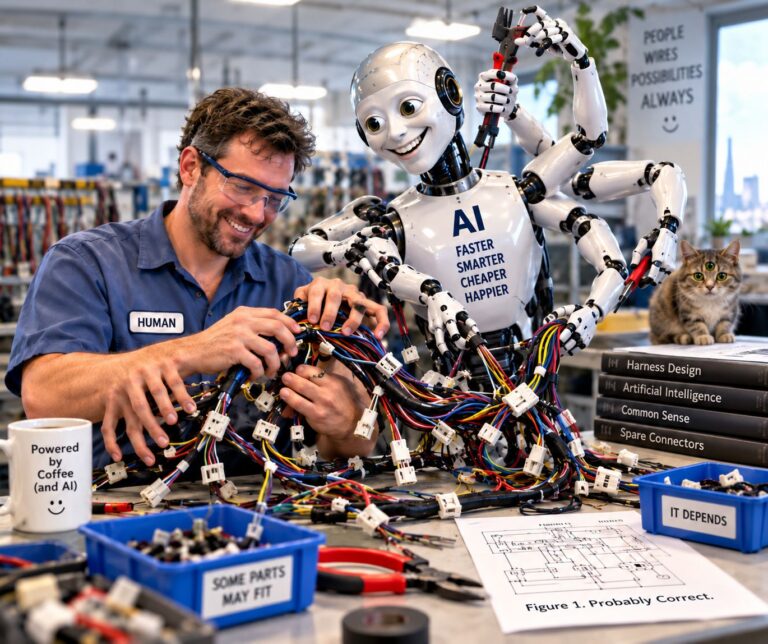









I’ve been putting these company profiles together for Wiring Harness News since 2016. Each one starts the same way a phone call, Teams meeting (or recently a shop visit) with me asking an owner or manager to walk me through their story. What I’ve ended up with is a shelf full of snapshots of companiesscattered from California to Quebec, Florida to Iowa, and even Europe and India. To pull the bigger picture out of them, I recently dumped the whole pile into some AI as an analytical filter. t helped spot what repeats — what threads hold these stories together, when you lay them side by side.
What keeps coming up isn’t flashy. It’s garages and dining-room tables, quiet pivots away from dying markets, an almost stubborn insistence on quality, and a habit of treating people—employees, customers, even competitors—like family. No single company owns these traits; they’re just the tendencies that show up again and again in the shops still growing. Here’s a summation of what AI snagged as some of the themes for success:
The Garage Myth Is Real – Humble Starts Breed Resilience
Almost every long-timer I’ve talked to began small, usually smaller than they’d admit in polite company. Garages, basements, spare bedrooms—these aren’t cute origin stories; they’re pressure cookers that force focus and build muscle memory for lean times.
Gary Martinet of Automatic Coax & Cable in Florida is the one that still makes me smile. In 1986 he went to a garage sale looking for kids’ toys and came home with wire processing equipment instead. The seller’s late husband had planned a business that never launched; Gary bought the whole lot for $1,400 when he had exactly $1,500 in the bank. “This business was an accident—I mean, I went to a garage sale! And I just think that for many people who end up in business for themselves, it’s an accident by the grace of God,” he told me. From that hot, cluttered garage he hired laid-off workers, landed his first order from a friend, and grew into a clean 10,000 sq ft shop serving mil-aero and medical customers.
Cesar Madrueno at Golden State Assembly had a similar spark. He came to the U.S. at 19 dreaming of computer science, wound up in harness quality control, and got fed up with inefficiency. He and his wife started GSA with $5,000, building first articles on their dining room table after work. “We got our business license before we even had our first facility,” Cesar remembered. Limited space forced them to compete on speed and precision; today they run 174,000 sq ft across two sites for power management, medical, and aerospace customers.
Todd Maines’ parents, George and Linda, kicked off TACK Electronics in their Michigan garage in 1996, chasing short-lead, low-volume work the big shops ignored. “The early years were more about surviving day to day, trying to stay afloat, and trying to partner with customers and grow with them,” Todd said. They named the company after their four kids’ initials—Todd, Andrea, Charles, Kim—and that family feel never left. From garage to 20,000 sq ft serving gaming, transportation, and medical, the roots show.
I could keep going: Steve Rowe starting Rowe Electronics in his basement with wireless controls, Z-Tronix beginning as a distributor before adding manufacturing, TCP Cable launching from a Quebec garage for snowmobile harnesses. The pattern is clear. Constraints early on teach you to move fast, waste little, and lean on personal networks. That scrappiness doesn’t vanish when the building gets bigger—it becomes the culture.
Diversification Isn’t Optional – It’s Oxygen
Ask any contract manufacturer about their biggest headache and you’ll hear “hills and valleys.” The shops that smooth those curves earliest are the ones still standing when a market tanks or a big customer pivots overseas.
Gustavo Farell at Cesar-Scott, straddling the Juárez–El Paso border, felt the heat of cutthroat competition on simple harnesses. “We’ve gotten away from simple straight wiring to more complex harnesses, usually in the lower to medium volume levels,” he said. They added U.S. kitting and manufacturing, established a Foreign Trade Zone to defer duties, launched their own appliance technologies when a customer went under, and started distributing cable management products through HST. “Since this business is so competitive, we’ve developed some of our own igniters and switch assemblies for gas stoves.” Tariffs on Asian imports gave the proprietary line extra breathing room.
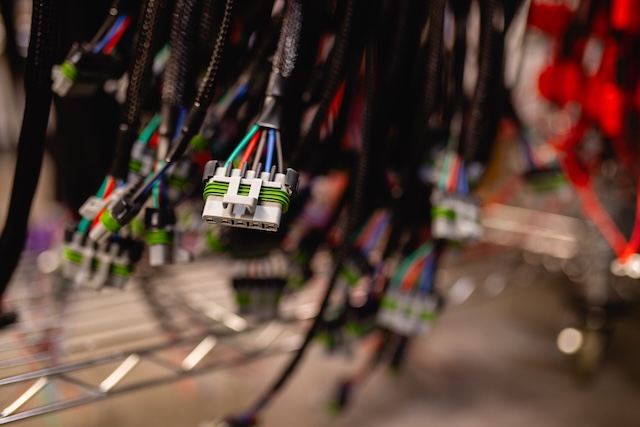
Up in Iowa, Steve Rowe began with wireless agricultural controls but watched that sector crash regularly. Rowe Electronics diversified into contract harnesses, then into trucking, cranes, and industrial remote controls. When motorcycle enthusiasts on staff kept adding accessories to their own bikes, the company built the PDM60—a compact, programmable power distribution module for 12-volt systems. “Leveraging that with the company’s expertise in DC high-amperage control led to the PDM60’s development,” business manager Larry Penner explained. It became a buffer against contract work’s ups and downs.
Pacer Group in Florida stayed laser-focused on marine but went deep instead of wide—manufacturing their own wire in Sarasota, building panels and harnesses in Wauchula, running distribution in Hollywood. “What truly makes us unique is that we control the quality of the product from basic wire and cable, through the finished assembly; and this is generally how we are known in the industry,” president John Swaitowski said.
George Klus at MNSTAR, new to ownership but quick to act, spread across marine, government, agriculture, and industrial while standardizing on premium components. “We’re a grower, not a maintainer,” he declared, already planning to double the facility.
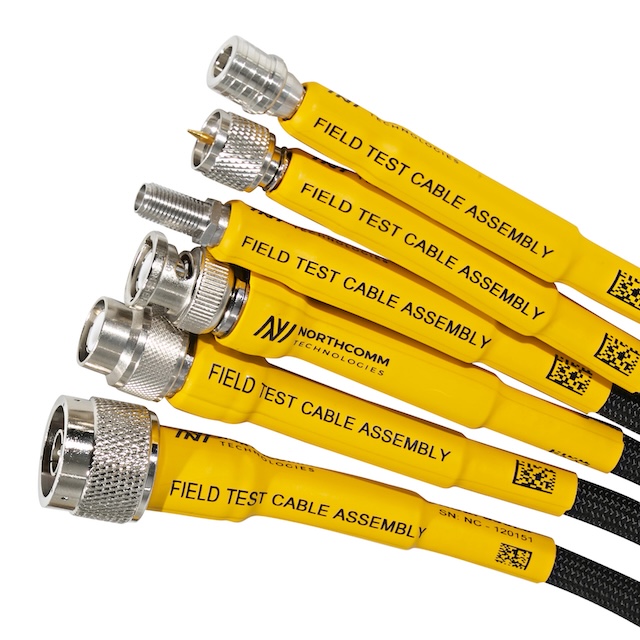
Mark Dannon at Northcomm Technologies started small making cable assemblies for public safety radio transmitters. He then moved into custom RF coaxial cable sets for rail systems with serialized performance data, and later into patented circuit boards that replaced bulky harnesses in transmitter interfaces. “It’s an entire product portfolio,” Mark said, “and I’m always thinking about what we are going to do next.”
For some companies, diversification meant moving from contract work to core IP. More than a handful took the problems they solved every day and turned them into proprietary products that strengthened their core business. Kinney Industries followed this path, developing its own solution to a testing challenge and ultimately partnering with DIT-MCO on the HT-128 tester. The innovation came from real shop-floor pain points—not blue-sky R&D—and resulted in owned IP that complements contract manufacturing and helps smooth out the inevitable ups and downs of customer programs.
The takeaway theme echoed everywhere: waiting for a single market to carry you forever is risky. Proprietary products, adjacent services, or vertical integration don’t just add revenue—they buy stability.
Quality and Trust – The Only Sustainable Moats
In a world where anyone can crimp a wire, the shops that endure treat quality as religion and trust as currency.
Mark Dannon, a former NYPD officer who founded Northcomm Technologies, put it bluntly: “Impeccable quality, and 100% perfection is what I’m after every time.” Starting with one public-safety transmitter cable, he added rigorous testing and serialization on every piece. “We offered them the performance data and serialization for each cable, and that gave them the confidence to know that they were not going to have any problems with our products because they are tested in a very rigorous and verifiable way.”
Doug Chowning at American Syscomptel echoed the trust theme: “Customers trust we are going to do the right thing, that we are flexible, and will respond to them where others may not.” They built an in-house IPC/WHMA-A-620 instructor, so every employee gets certified.
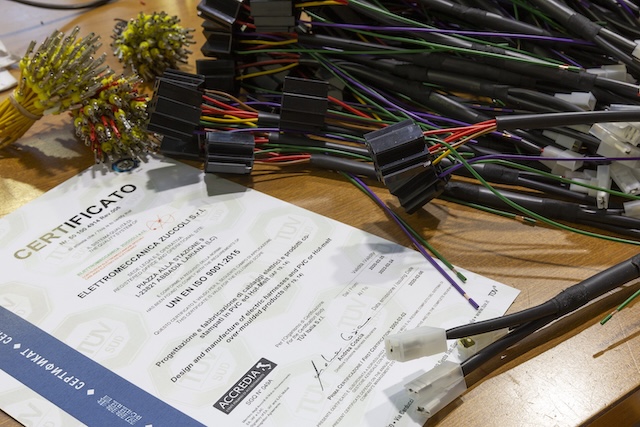
RPI of Racine embraces the ISO 9001 standard daily, with serialization and a proprietary ERP system that doubled efficiency. “We live the ISO 9001 standard. It’s ingrained in who we are,” Matt Zeilhofer told me.
Federal Electronics catches design flaws early: “We’ll get prints where someone’s trying to put a 24-gauge wire into a 20-gauge terminal. We’ll recommend changes,” Ed Evangelista said.
These aren’t isolated perfectionists. The pattern across dozens of shops is investment—in training, in testing, in catching issues before they leave the dock. When a harness can ground a fleet or fail in the field, “almost good enough” isn’t an option. The moat isn’t price; it’s the quiet assurance that comes with a box you never have to worry about.
People Over Transactions – Relationships Compound
Time and again I’ve heard owners say their best marketing budget is zero—because referrals and retention do the heavy lifting. That only happens when relationships come first.
Todd Maines at TACK summed it up simply: “As long as they know they can depend on us, and we won’t let them down, we will have established a partner for life.” His parents built the company on that principle, and it shows in almost nonexistent turnover.
George Klus at MNSTAR, stepping in as a new owner, made community central: “These employees have made MNSTAR what it is, and it belongs to this community, and I want everyone to know that I came in to grow the business, because I’m a grower, not a maintainer.”
Electrex’s prison training program yields an astounding recidivism rate—far below national averages—while building a loyal workforce. “The recidivism rate for people who go through our program is only 8%,” Randy Johnson said proudly.
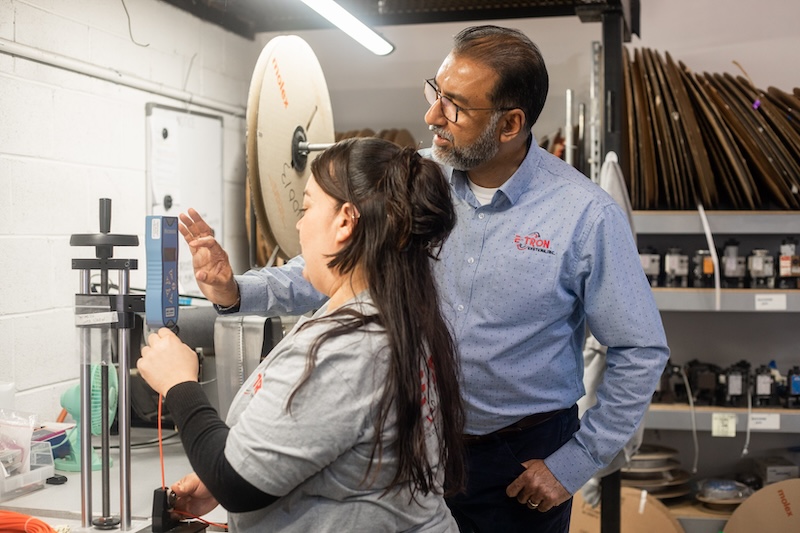
E-Tron Systems supports employees with disabilities: “At the end of the day, I leave for home feeling gratified that I have touched the lives of the 15 supported employees,” George Jacobs shared.
Even in high-stakes sectors, it’s personal. Gary Martinet at Automatic Coax: “The number one thing is the level of trust we have with our customers. We work with them the way we would like our vendors to work with us.”
The compounding effect is real: happy employees build better product, loyal customers send referrals, suppliers cut slack when parts run short. Shops that treat everyone like family don’t just survive—they grow steadily, almost quietly.
Engineering Proximity and DFM: Why the Best Shops Collapse the Distance Between Design and Build
Another pattern that appears repeatedly across successful harness manufacturers is the deliberate collapse of distance between engineering and production. In these companies, engineering is not a remote function that hands drawings downstream. It is a mindset that lives close to the work.
This does not mean every company has a large engineering department. In fact, many do not. What they share instead is an insistence that whoever is responsible for design decisions understands how those decisions play out at the bench.
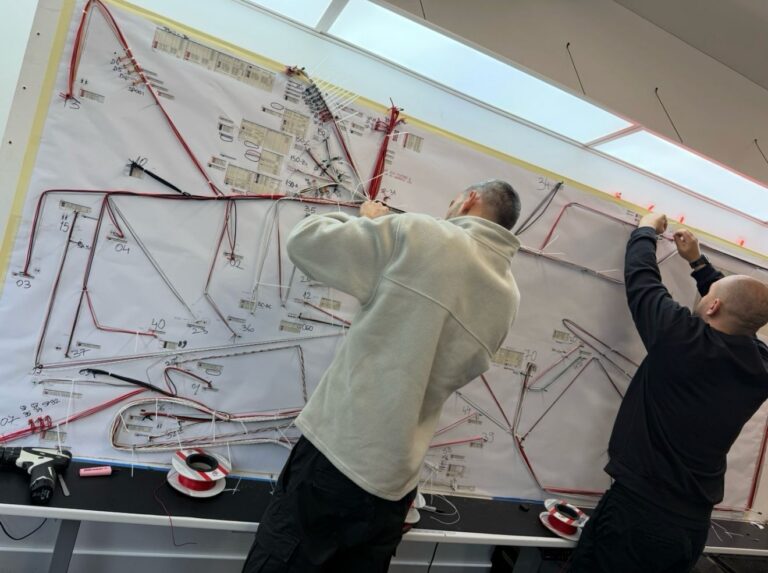
Across interviews, leaders spoke less about formal design authority and more about empathy for the build process. Drawings are created, reviewed, and revised with an awareness of how wire will be cut, stripped, terminated, routed, tested, and packaged. Complexity is questioned early. Tolerance stack-ups are discussed before they become problems. Assemblies are designed with the assumption that real people—not idealized processes—will build them.
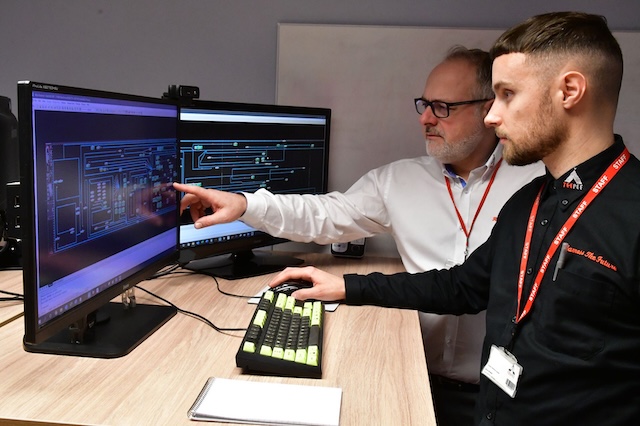
Many leaders credited fast quoting and short lead times not to heroics, but to clarity. When engineering understands the work, quotes are fast and grounded. When builders understand the intent, rework drops. When both speak the same language, decisions happen quickly and confidently.
Design for manufacturability is another theme that is ubiquitous in successful harness companies. They repeatedly described simplifying harnesses for their customers—not to reduce value, but to increase reliability and component availability. This might mean rethinking connector choices, consolidating branches, adjusting breakouts, or changing how assemblies are tested. In each case, the goal was the same: reduce ambiguity before it reaches the floor.
Several leaders noted that their best customer relationships are the ones where DFM conversations happen early and openly. In those relationships, engineering support is not reactive. It is collaborative. Problems are solved upstream, where they are cheapest and least disruptive.
The lesson for readers is straightforward but demanding: engineering excellence in a harness shop is not just about software, titles, or headcount. It is about closeness to the work. Companies that excel do not allow design decisions to drift away from reality. They bring engineering into the build, and they bring the build into engineering.
Automation as a Tool, Not a Religion
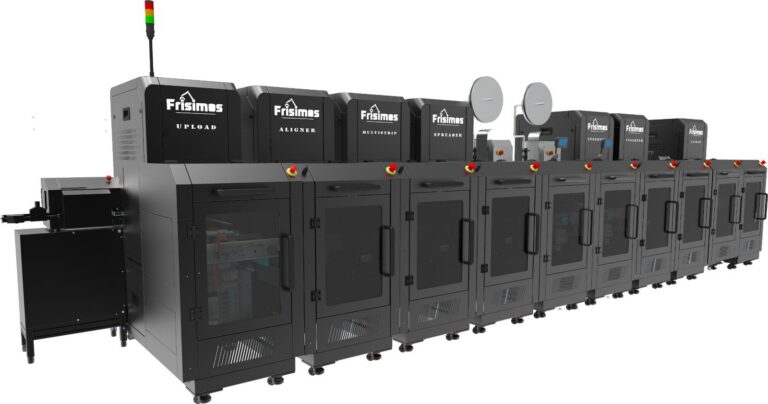
Automation appears frequently in Company Profile discussions, but almost never as a silver bullet. Successful harness manufacturers talk about automation cautiously, pragmatically, and often with caveats. The prevailing mindset is that automation should support stability, not introduce fragility.

Across interviews, leaders described evaluating automation investments based on repeatability, variability, and long-term workload—not novelty. Processes that are stable, well understood, and high in volume are candidates. Processes that are variable, evolving, or poorly defined are not. This distinction shows up again and again.
Several leaders noted that premature automation often creates more problems than it solves. When upstream processes are unstable, automating them simply locks in inefficiency. As a result, many successful companies focus first on simplifying designs, clarifying work instructions, and improving flow before considering automation.
Automation is also discussed as a way to protect people, not replace them. Leaders talked about reducing ergonomic strain, improving consistency, and freeing skilled workers to focus on higher-value tasks. In this framing, automation becomes an extension of craftsmanship rather than its enemy.
Importantly, automation decisions are often tied to diversification and risk management. Investments are justified not just by cost savings, but by flexibility—the ability to handle different volumes, product mixes, or customer requirements without disruption. Where automation increases rigidity, leaders tend to hesitate.
Another notable pattern is how automation is introduced gradually. Pilots are run. Assumptions are tested. Lessons are absorbed before scaling. This incremental approach reduces risk and builds internal confidence.
For readers, the takeaway is nuanced: automation is powerful, but only when deployed intentionally. The companies that endure treat it as a tool in a broader system, not as a strategy in itself. They automate to reinforce discipline—not to compensate for its absence.
The Quiet Discipline – Self-Imposed Rules
The most thoughtful owners I’ve interviewed all have boundaries they won’t cross, even when it costs short-term revenue. They protect culture, margins, and sanity with rules only they enforce.
Parker Garrett at EMSCO, long active in WHMA leadership, is blunt about it: “Successful owners set rules for themselves to protect culture, margins, and execution.” One of his is walking away from chronic price-shoppers who treat harnesses like commodities.
John Swaitowski at Pacer: “We really focus on staying in our lane.” They’ve dabbled elsewhere but always pulled back to marine, where their vertical control shines.
Gustavo Farell at Cesar-Scott requires customer sign-off on every design-for-manufacturability change—for liability, yes, but also to keep the relationship collaborative rather than adversarial.
These aren’t loud policies posted on walls. They’re quiet lines in the sand: no race-to-the-bottom bids, no markets that don’t fit the culture, no shortcuts that erode trust. Saying no more often than yes keeps the shop healthy enough to say yes when the right opportunity appears.
Growth Without Losing Soul
When shops do scale—through acquisition, new facilities, or offshore arms—the ones that keep their character put culture fit first.
Auxo Investment Partners built a national platform by rolling up Golden State Assembly, Mississippi River Industrial, SOS, and Tack Electronics. “Customers need a supplier they can trust as their partner for wire harnesses,” Glen Fish explained, emphasizing shared values over pure financials.
TCP Cable merged Terminal & Cable with competitor Prodam (and its Mexican arm Prodamex) to gain scale and low-cost capacity. “We were now a sizable organization with Canadian operations and a low-cost facility in Mexico,” Marc April recalled—yet they kept the original facilities and certifications intact.
Cesar-Scott moved headquarters from Minnesota to El Paso, remodeled an old industrial building, and added the FTZ without abandoning their Juárez foothold.
The common thread: growth works when it amplifies what already made the shop special—capability, geography, or culture—rather than diluting it.
A Final Reflection
After all these years of profiles, what lingers isn’t the square footage or the customer lists. It’s the decency running through these shops: the owner who buys equipment at a garage sale and builds an empire anyway, the one who turns a dying customer’s product into his own lifeline, the leader who walks away from bad-fit business to protect his people.
If I could sit down with anyone just breaking ground on a new harness operation—I’d say this: Start small and scrappy, diversify before you’re forced to, make quality and trust non-negotiable, treat every relationship like it could last decades, draw your own lines in the sand, and grow only in ways that feel true to why you started.
Our industry isn’t glamorous, but it rewards grit, fairness, and quiet innovation more than most. Here’s to the next round of garages, dining tables, and accidental beginnings. And thanks to all who took time with me over the years and giving me the best seat in the house.