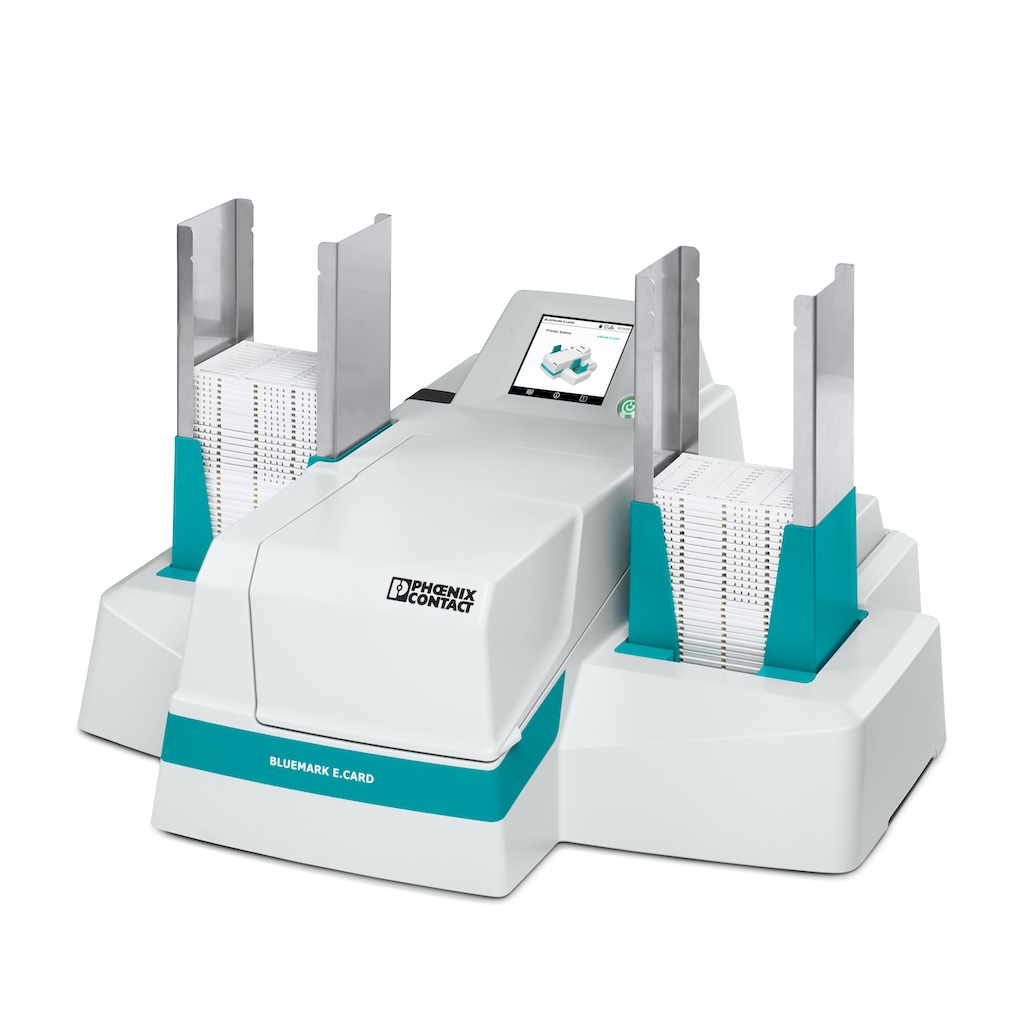














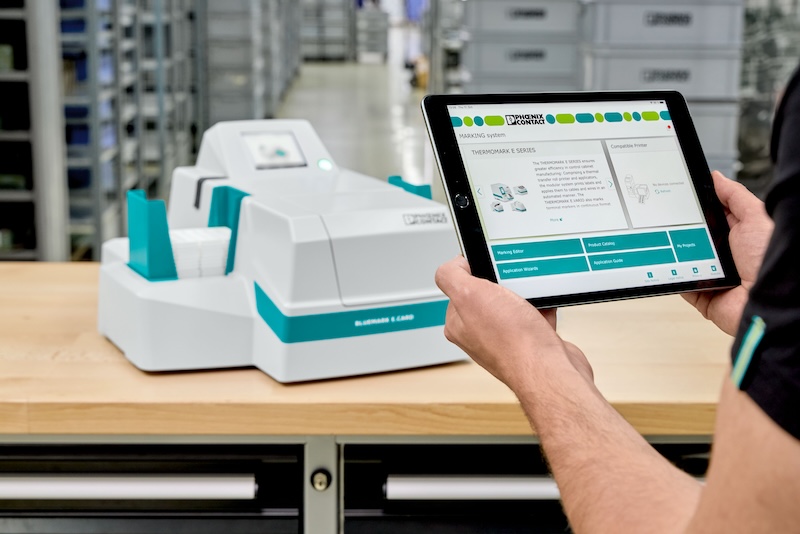
When Phoenix Contact issued its fall press release introducing the BLUEMARK E.CARD, the announcement drew a quick ripple of attention across the marking and identification space. UV inkjet printing in a compact, automated format? Self-aligning material detection? A printhead that replaces itself with every cartridge change?
It was enough to get our attention—so we sat down with Matt McLaughlin, Product Marketing Specialist for Marking & Identification at Phoenix Contact, to take a deeper look at the machine behind the headlines. The result is a story not only about a new printer, but about the evolution of a product family that has shaped how panel shops, machine builders, and now data centers approach terminal identification.
From BLUEMARK X1[MM1] [MM2] to BLUEMARK E.CARD: A Fifth-Generation Redesign
The BLUEMARK E.CARD isn’t a minor update—it’s the fifth generation of a platform that traces back through the BLUEMARK ID, CLED, LED, and the original X1 models. Each step refined print quality, durability, and throughput. But as Matt explained, the E.CARD represents something different: a fundamental redesign centered on efficiency, permanence, and ease of ownership.
“Thermal transfer is still the most widely adopted card-printing technology in the field,” Matt noted, “but thermal inkjet with UV curing is in a different class. It’s the highest resistance you can get short of laser engraving.”
That distinction matters for industries where terminal markers face real-world punishment—chemical splash-down, elevated temperatures, or long service intervals where you only get one chance to make a legible mark. The BLUEMARK E.CARD prints on Phoenix Contact’s UniCard terminal-marker cards, as well as metal equipment tags, giving shops the flexibility to handle both standard panel work and more rugged environments without changing printers.
600-DPI UV Inkjet Printing
Much of the conversation around the E.CARD centers on its print technology. It’s a monochrome printer (black only), but what it lacks in color it makes up for in process sophistication.
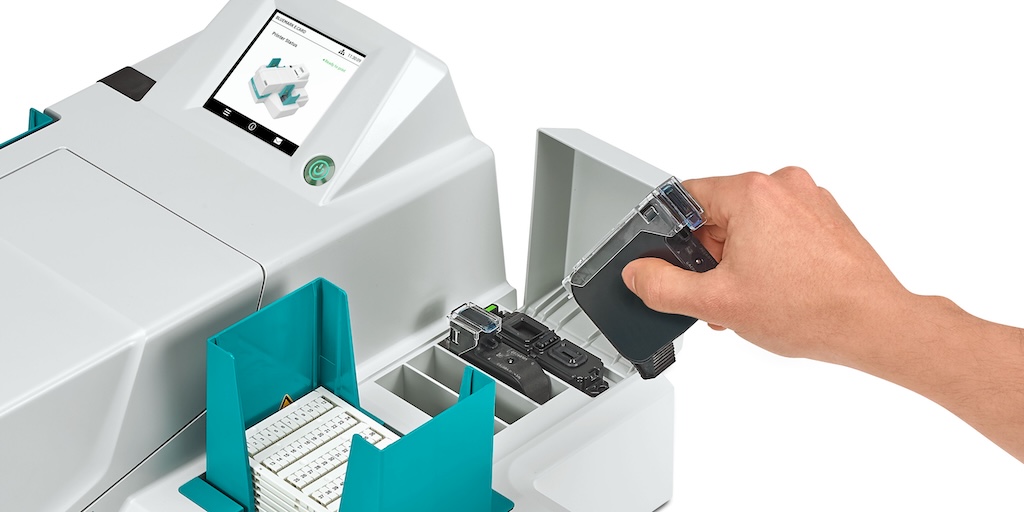
The machine uses two ink cartridges: a black UV-curable ink and a clear ink. On certain media—especially metal—the printer lays down a UV-cured clear coat first, essentially acting as a primer layer. The black ink is then applied and cured on top, producing Phoenix Contact’s most durable print to date.
This new generation also standardizes at 600 dpi, double the traditional 300-dpi resolution used in many competitive systems. With terminal blocks trending toward denser layouts and ever-smaller legends, the increased resolution allows for sharper text, tighter symbols, and even micro-sized QR codes without sacrificing legibility.
A Printhead You Don’t Have to Maintain—Because You Never Keep It
In most thermal inkjet systems—office printers included—the printhead is a long-term component. It’s also the most common failure point. Once clogged or worn, it can be an expensive repair or a reason to retire an otherwise functional machine.
The BLUEMARK E.CARD sidesteps the problem entirely. “Every ink cartridge contains its own printhead,” Matt said. “There’s no fixed printhead inside the machine. When you replace the cartridge, you’re replacing the entire print mechanism.”
For shops that print frequently or sporadically—both of which can be hard on inkjet systems—this design eliminates most maintenance routines, reduces downtime, and ensures print quality remains consistent over multiple print jobs and the life of the machine.
Set It, Stack It, Walk Away: Automated Card Handling
While the print technology is what grabs attention, the operational efficiency may ultimately be what wins over panel shops. The BLUEMARK E.CARD holds 20 cards by default, and an optional accessory doubles that capacity to 40 cards, all fed automatically without operator action.
It also allows adding cards mid-job—a detail that matters in high-mix environments.
If cards are inserted out of sequence, the printer detects the mismatch and resolves the order automatically. A shop no longer needs to babysit a print run. Instead, the operator loads the stack, sends the job, and moves on to higher-value work.
Software Designed for Full Workflow Automation
Alongside the hardware release, Phoenix Contact introduced its next-generation MARKING System software. For many customers, this may prove as transformative as the printer itself.
The software now supports integrations with EPLAN, AutoCAD, various SCADA environments, and ERP systems[MM3] , enabling near-automated job preparation. When combined with the E.CARD’s unmanned operation, the workflow becomes:
- Import the project
- Validate the terminal list
- Press print
- Return later to a finished batch
For panel shops facing tight schedules or data centers managing high-density infrastructure, this combination moves marking from a manual task to a digitally driven, largely automated one.
A Compact Machine Built for Today’s Panel Shop—and Tomorrow’s Data Center
Compared to the larger BLUEMARK ID, the E.CARD has a smaller footprint and simpler interface, making it easier to position at workstations or deploy across multiple production cells. Connectivity includes Bluetooth (for app-based operation), Ethernet, and direct USB—useful for shops with varied workflow styles.
Phoenix Contact expects the E.CARD to have strong visibility at upcoming trade shows, including EWPTE in Milwaukee, where live demonstrations will help customers see the performance firsthand.
Why It Matters for the Wire Harness and Control Panel Industry
Not every application needs UV-cured ink or 600-dpi micro-precision printing. Thermal transfer printers still dominate for good reasons—low cost, broad material support, and reliable performance. But as Matt pointed out, the E.CARD shifts the conversation when you factor in time savings, maintenance elimination, and long-term print durability.
For shops building panels destined for unpredictable or harsh environments, or managing high throughput where labor hours are tight, the premium print process becomes less of a luxury and more of an operational advantage.
And in an era where data-rich labeling (including QR codes) is increasingly used for traceability and service visibility, the added resolution and permanence aren’t just nice to have—they’re becoming strategic features.
Final Thoughts
The BLUEMARK E.CARD reflects Phoenix Contact’s broader trend toward integrated, automated marking workflows. It pushes print quality to the highest levels available short of laser marking, while removing much of the maintenance burden that traditionally accompanies inkjet systems.
For many panel shops and machine builders—and especially emerging applications in data centers—the shift toward automated, high-resolution UV printing is arriving at the right time. The E.CARD isn’t simply a new model; it’s a rethinking of what terminal marking can look like in a modern production environment.