










By Steffen Dosch – Schäfer
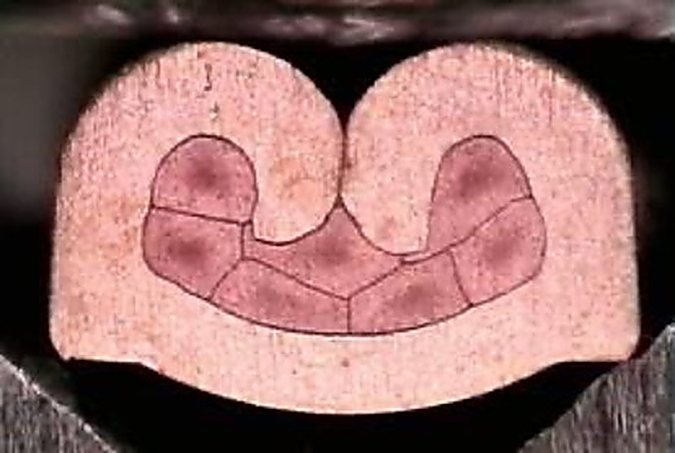
For wire harness manufacturers, crimp quality remains one of the most critical and closely monitored steps in the production process. Even small deviations in crimp force can indicate problems such as missing strands, insulation in the crimp, or other defects that may compromise electrical performance and long-term reliability.
To address these challenges, manufacturers increasingly rely on monitoring systems that can detect variations in the crimping process while production is running. One such system is CrimpWise, developed by the German technology company Schaefer.
Schaefer provides equipment and solutions across the wire processing chain, including automation systems, crimping machines, tooling, and software-based quality assurance systems. CrimpWise is designed as a flexible monitoring platform that can be integrated directly into Schaefer equipment or installed as an external module on other presses.
Wiring Harness News recently spoke with Steffen Dosch, Manager of R&D department at Schaefer, about the development of CrimpWise and how the system helps manufacturers monitor crimp quality and production performance.
WHN: How did the CrimpWise system originate, and what need in the market led to its development?
Steffen: CrimpWise is Schaefer’s quality management solution for crimp force monitoring, with integration into machines or as an external module. Both are available as a solution for Schaefer machines and can also be used for non-Schaefer machines. Development began a few years ago and is ongoing, with new features and enhancements continuously being added. The product addresses a clear market need in cable and harness production, ensuring consistently high-quality crimp connections by detecting deviations in crimp force early.
WHN: How does CrimpWise fit into Schaefer’s overall approach to crimp quality and production monitoring?
CrimpWise fits into Schaefer’s strategy of offering comprehensive, end-to-end quality assurance for wire manufacturing. It complements recent developments for quality control carried out with partners. Schaefer supports customers holistically to secure crimp quality across design, process, and testing.
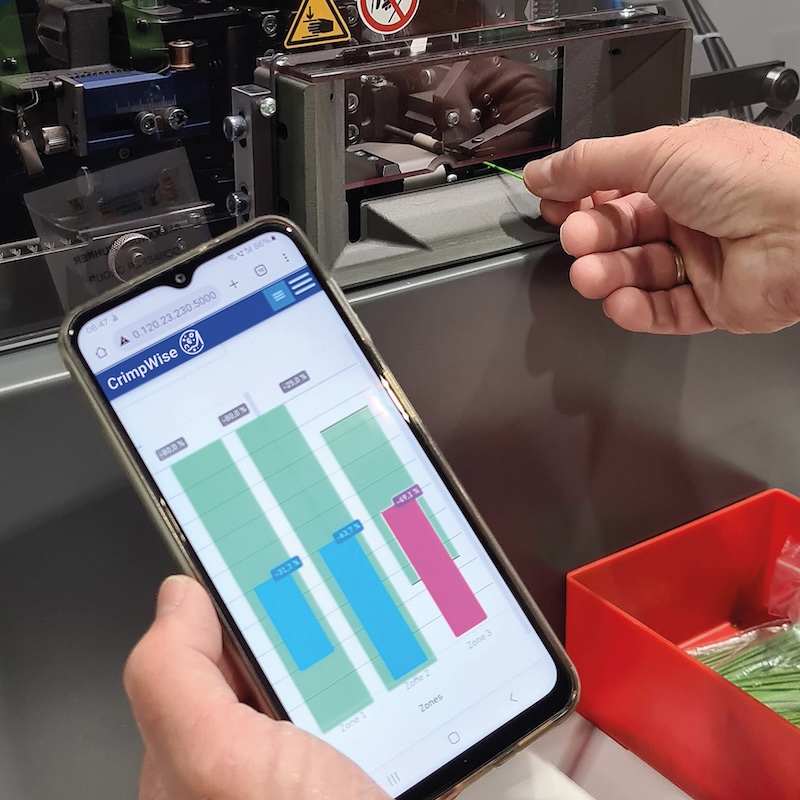
CrimpWise contributes by delivering centralized, real-time monitoring of crimp force that can be embedded in Schaefer equipment or deployed as an external module on other presses. The system is built on a modern, flexible PC-based architecture and combines proven sensor-based measurement technology with an intuitive browser and mobile user interface.
WHN: How does CrimpWise monitor and evaluate crimp force during production?
CrimpWise monitors the crimp force during cable and harness production by continuously measuring the force profile of each crimp and comparing it to a learned reference curve.
When the measured profile deviates beyond defined limits, the system detects the bad result and can raise an alarm. If a bad-part cutter is installed, the system can cut the wire to prevent defective cables from proceeding.
All measurement data are centrally collected and stored for traceability, analysis, and quality assurance reporting.
WHN: What are the core components of the system?
Two main deployment options are available: CrimpWise iS, an integrated system designed for installation in a machine control cabinet, and CrimpWise eM, an external module for mounting directly on the machine.
Measurement is typically performed using the SDS200 sensor, which can be mounted on the press connecting rod or on the side of the press. A dedicated adapter is also available for piezoelectric sensors.
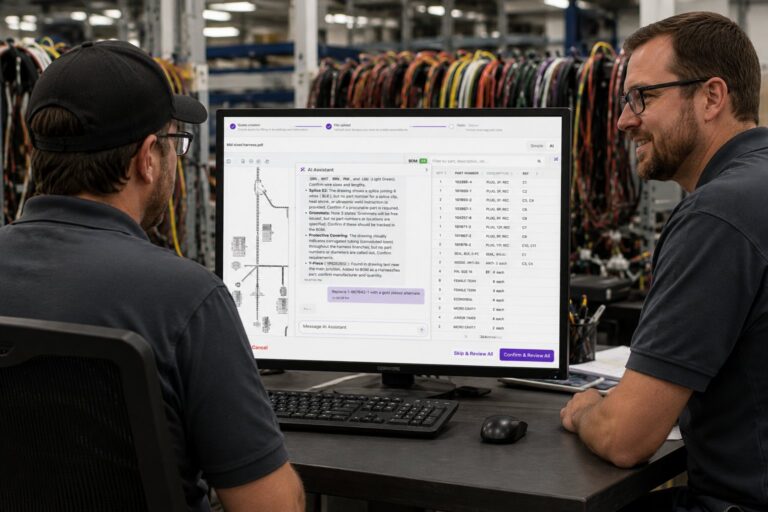
The software runs on a PC-based platform and provides a browser-based user interface accessible from desktop and mobile devices. It supports real-time monitoring, configuration, data logging, statistical analysis, and network integration.
WHN: What types of defects can be detected through crimp force monitoring?
Missing strands reduce the material cross-section being deformed, which typically lowers peak force and reduces the area under the force–time curve. The system compares these features to the reference curve and flags strokes that fall outside configured tolerances.
Insulation between the conductor and the terminal delays engagement and often increases required displacement and peak force, producing a delayed onset and altered force plateau. The system detects these amplitude changes against the reference curve.
WHN: Is CrimpWise monitoring every crimp in real time?
Yes. The system monitors crimp force during production and responds to deviations in real time to prevent defective cables from advancing.
This real-time capability improves immediate defect detection, traceability, and corrective action during production.
WHN: How does the browser-based interface support production and quality teams?
The browser-based interface enables role-based access. Operators can manage and monitor production, while quality teams can inspect data and adjust settings for future production runs within the same system.
Because the interface is browser-based, the system can be accessed from multiple devices without requiring specialized software.
WHN: How important is network integration in modern crimp monitoring?
The software platform enables secure communication with customer networks and IT or MES environments via OPC UA.
Relevant data points, such as pass/fail results, job names, and peak force values, can be made available so downstream systems can reliably consume and analyze the data.
WHN: What types of machines can CrimpWise be installed on?
CrimpWise can be installed on any crimping machine that supports a Schaefer sensor or compatible piezoelectric sensors.
As an external module, the system connects to the sensor and integrates directly with the press I/O for communication.
WHN: What kinds of benefits do customers typically report?
Customers report high measurement accuracy and reproducible results, with robust long-term data quality across production life cycles.
Additional benefits include faster production changeovers, flexible configuration of monitoring zones, retrofit capability for other presses, and comprehensive statistical analysis through centralized data collection.
WHN: What developments are planned for the future?
Future developments include advanced analytics and optimization capabilities. The system will also integrate AI-based error evaluation to recognize and classify specific defect types.
In the future, monitoring solutions at the factory level and across multiple production sites are also conceivable.
Interested in this product?
Ask for your application: [email protected]
See the product in detail: www.schaefer.biz/en/portfolio/crimp-force-monitoring-system-crimpwise/
Schaefer Group
Headquarters: Schäfer Werkzeug und Sondermaschinenbau GmbH
Check the website of the company: www.schaefer.biz