













Presented by Robert McClelland, Director of Advanced Technologies, North America, One Mobility – AutoKabel
At the Automotive Wire Harness & EDS Conference in Dearborn, Michigan, Robert McClelland, Director of Engineering for North America at One Mobility (formerly AutoKabel), presented a compelling look at how aluminum and busbar technologies are reshaping electrical power distribution. His talk, “Efficient Materials in Power Distribution – Aluminum & Busbars,” examined the shift from traditional copper wiring toward lightweight, formable, and thermally efficient aluminum busbars that are finding increasing relevance across both low- and high-voltage systems.
From Cable to Busbar
One Mobility’s journey into aluminum conductors began in 2000, when it introduced aluminum cables for rear battery applications in the Volkswagen Phaeton. The objective was to reduce both mass and cost, but aluminum’s lower conductivity required roughly a 60 percent larger cross-section to achieve the same ampacity as copper. This introduced new packaging challenges and ultimately spurred the development of extruded, semi-rigid busbars as a next-generation solution.
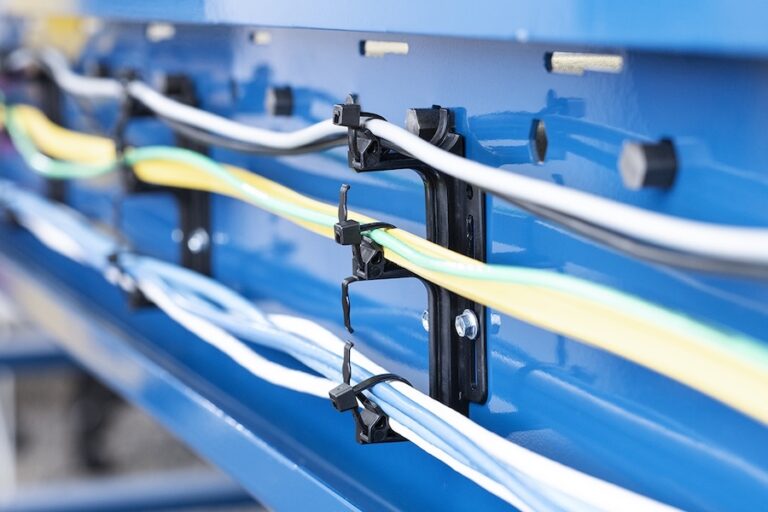
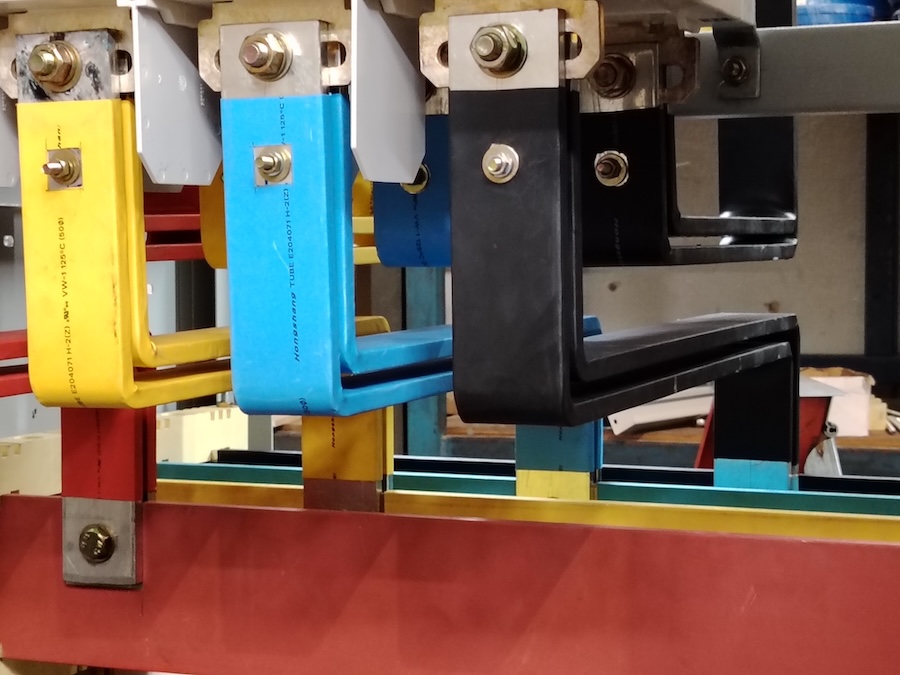
Unlike the stamped rigid busbars typically associated with power distribution, One Mobility’s 3D-formed aluminum busbars are spooled goods produced using the same extrusion lines and insulation materials as traditional cables—most often PVC, PA-12, or silicone. The result is a unique hybrid product that behaves “80 percent busbar, 20 percent cable,” combining rigidity in the X and Y axes with minor flexibility in the Z axis. This blend of stiffness and compliance simplifies installation at the OEM level, often requiring fewer fastening elements and less space in assembly.
Aluminum’s Advantage
McClelland illustrated the benefits of transitioning from round cable to flat busbar using an 80 mm² example. Under identical current and environmental conditions, the busbar achieved a 20 percent mass reduction and a measurable decrease in temperature rise due to its greater surface area and heat dissipation characteristics. The net result is higher ampacity and improved system efficiency, even when comparing aluminum to aluminum.
As electrical demands continue to grow with electrification, automation, and advanced driver assistance systems, the balance of mass, thermal management, and packaging efficiency becomes increasingly important. “Packaging, ampacity, and in-plant assembly all benefit from busbar technology,” McClelland observed, emphasizing that aluminum’s cost and weight advantages remain a major driver of adoption across multiple OEMs.
Manufacturing and Joining Technologies
Because most of One Mobility’s 3D-formed products use pure aluminum for optimal formability, traditional bolted connections are unsuitable due to the long-term creep potential of the core material in its annealed state. Instead, the company employs welded terminations to ensure durable and stable joints.
The cornerstone of One Mobility’s busbar business is its expertise in joining methods-friction welding, ultrasonic welding, resistance welding, and laser welding – each selected for specific geometries and load conditions. With over 25 years of aluminum welding experience be it similar or dissimilar materials, overlapping joints or buttwelds, One Mobility has the welding technology for application.
As production volumes grow, One Mobility continues to invest in automation. McClelland shared images of fully automated manufacturing cells capable of converting spooled aluminum conductors into finished assemblies, boxed and ready for shipment. Such automation ensures consistent quality and efficiency, key factors as OEMs move toward higher volumes of electrified platforms.
Expanding from 12 Volt to High Voltage
The company’s early busbar programs served traditional 12-volt architectures, typically spanning four to five meters from front to rear. Today, One Mobility’s busbars are critical components in high-voltage battery systems and DC charging applications as well. Within modern EV packs, busbars range from a few hundred millimeters to more than two meters and must balance electrical conductivity, heat management, and mechanical stability.
Some OEMs have already transitioned to aluminum busbars for high-voltage use, while others are evaluating the move. McClelland noted that the shift introduces new considerations such as thermal propagation, cooling strategies, and compatibility with automated assembly.
Enabling New System Architectures
Beyond component-level improvements, McClelland challenged the audience to consider how busbar technology could enable more efficient vehicle electrical architectures. As wiring harnesses expand with increasing electrical content, opportunities exist to simplify power distribution while reducing copper usage and harness complexity.
One concept, referred to as the “energy backbone,” envisions a centralized power distribution path running through the vehicle with localized fusing or smart e-fusing modules at key nodes. This approach can reduce the size and complexity of branch harnesses. For systems requiring redundancy—such as autonomous or safety-critical networks—a ring-style architecture can provide selective fault tolerance without duplicating entire wiring systems.
An early case example of this approach was developed for a carbon-fiber supercar, where a central power backbone and integrated grounding strategy provided efficient distribution while minimizing overall weight.
Choosing the Right Material
In concluding his presentation, McClelland summarized the trade-offs among current busbar technologies. Laminated busbars remain cost-effective for short, flexible sections requiring tight bends. Stamped copper bars make sense for smaller, complex shapes or where high levels of stiffness are required. For longer runs or larger cross-sections, 3D-formed aluminum busbars deliver the most significant benefit, combining low mass with superior thermal and packaging performance.
The key, he emphasized, is to consider busbar and joining technology early in the vehicle development process. Early collaboration between harness suppliers, busbar suppliers, and the OEMs can help optimize routing, assembly, and system cost from the outset.
About the Speaker
Robert McClelland serves as Director of Advanced Technologies, North America, for One Mobility. With more than 25 years of automotive experience spanning General Motors, AutoKabel, and now OneMobility, he has held key roles in vehicle development and quality systems. McClelland holds a Bachelor of Science in Mechanical Engineering and an Executive MBA. At One Mobility, he partners with global OEMs to reduce mass and cost in electrical power distribution through the adoption of aluminum technologies, blending technical depth with strategic leadership across the automotive sector.
About One Mobility – AutoKabel
One Mobility – AutoKabel is a global supplier of lightweight electrical distribution systems, delivering advanced busbar and cable solutions for next-generation vehicle architectures. With deep engineering expertise and highly automated manufacturing, the company partners closely with OEMs and Tier 1s to reduce system complexity and support the evolving demands of modern mobility, including EV platforms.