









When Dave Wiegand talks about harness manufacturing, you can tell he’s not reading from a sales deck. He’s describing a craft. As Director of Sales and Marketing for American Cable & Harness (ACH) in Fort Atkinson, Wisconsin, he works alongside a team that treats every wire, board, and breakout as a matter of pride. Their sister company, Electronic Technologies International (ETI) , carries that same ethic—each serving different needs but guided by one purpose: to deliver reliability their customers can trust. Together, ACH/ETI operate with a shared mindset that blurs the line between harness manufacturing and printed circuit board assembly. .
ACH traces its roots back to 1990, when its founder began building printed circuit board assemblies for a local medical equipment manufacturer. Over time—and through seven acquisitions—the company evolved into a diversified operation offering printed circuit boards, complex harness assemblies, and box builds. “Our current owner, Bill Brink, has held the company for 22 years,” Dave said. “I’ve been with the company for nine years as Director of Sales and Marketing, and the focus has been on the wire harness arena.” The Iowa facility was one of the acquisitions Dave spoke of and focuses on shorter, higher-volume wire assemblies that supply industrial and OEM engine manufacturers sought by the most demanding outdoor brands and turf care professionals across North America.

“Our culture at both locations is one of Midwest craftsmanship, pride, and ownership,” Dave said. “We spend time making sure everyone knows where our products go and how they’re used. When you understand that the harness you built today might end up in a cement boom truck pumping cement 50 stories up in Manhattan or a critical piece of forestry equipment, you take extra care with every crimp.”
Building Big and Building Right
When Dave joined the company, he saw opportunity in scale. “Before that, most of the work was small wire assemblies—cut, strip, terminate,” he said. “I wanted to go after larger, more complex builds. The kind where skill matters.”
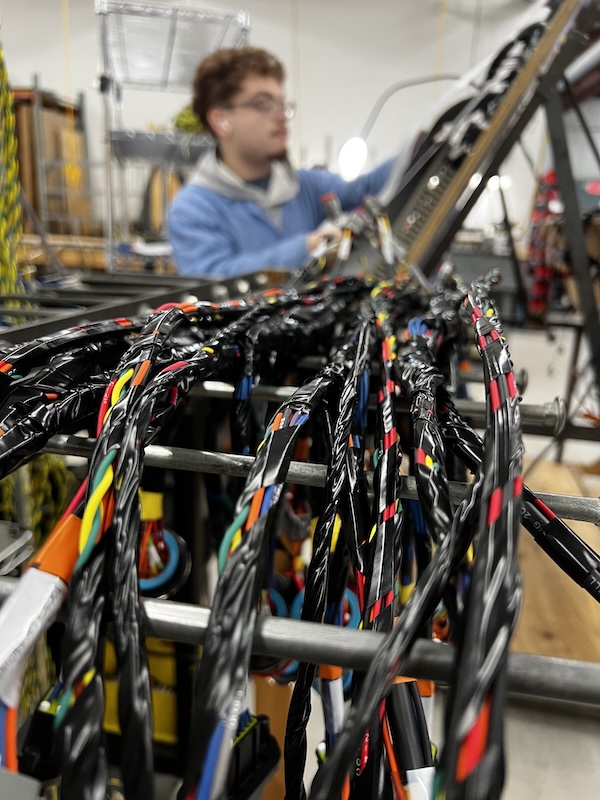
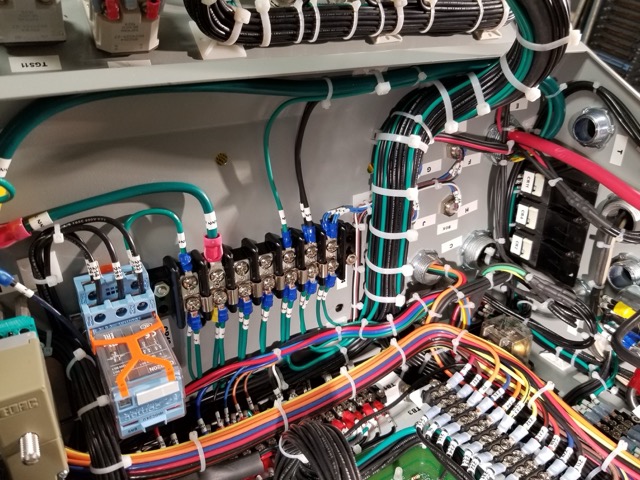
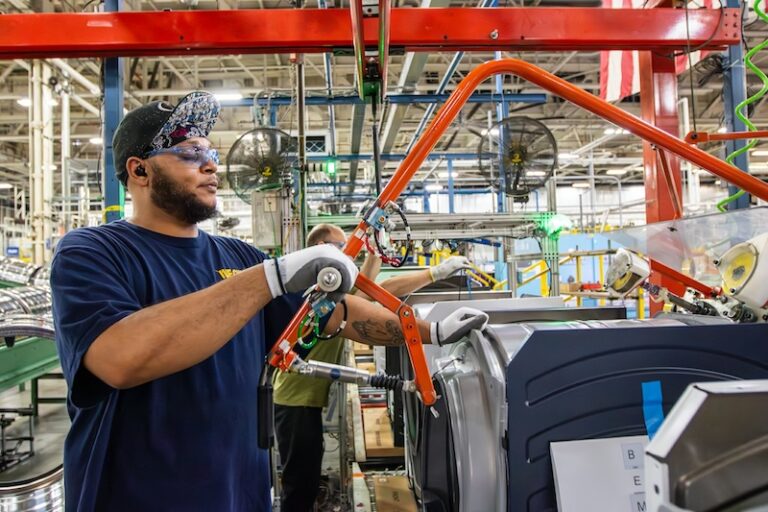
That vision led the company deep into heavy equipment harnesses—45- and 50-foot builds with multiple breakouts. These are not “kitchen table” assemblies; they demand precision, discipline, and teamwork. “If you’re just cutting and terminating small assemblies, anybody can compete with you,” Dave said. “When it gets into the large harnesses, it comes down to your labor force…the highly trained talented people that we have on board who build these huge harnesses.”
Quality at Every Connection
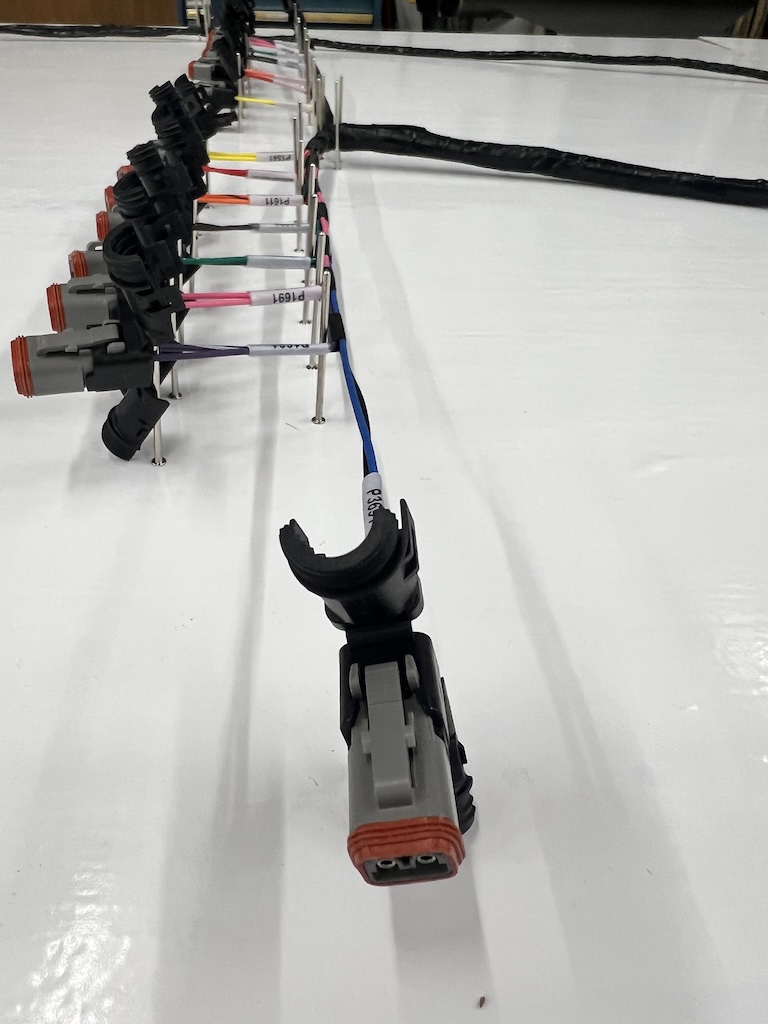
For ACH/ETI, quality isn’t an afterthought—it’s a process that begins on the harness board itself. “We use CAMI CableEye® testers, like many of our competitors do,” Dave said. “But what we’ve done differently—because we’re also in the printed circuit board world—is we’ve developed test systems that are built right into the harness board.”
That means testing happens continuously, not just at the end. “As you’re building a fifty-foot harness with multiple breakouts, we’re doing continuity testing along the way,” Dave explained. “You don’t want to have to tear one of those down after it’s braided. That’s not the place you want to be.”
Each board includes test ports to check the main spine and every breakout during assembly. The result is a near-perfect first-pass yield—and some amazing customer confidence. “One of our customers actually told us they don’t even look at our harnesses when they come in,” Dave said. “They just install them in the truck. There’s no better compliment in the world.”
That consistency helped ETI earn Kawasaki Motors’ Customer Service Award at its Missouri plant—an honor Dave called “huge.” “They’re demanding about process and quality,” he said. “To be their only supplier to win that award for the year—that’s something we’re all proud of.”
An Eye on the Curve Ahead

That trust is also built on collaboration. ACH doesn’t design harnesses from scratch, but they work closely with customers on Design for Manufacturing. “When we get drawings, we build an NPI (New Product Introduction), and adjust from there,” Dave said. “We make recommendations, send them back for signoff, and only proceed once everyone’s aligned.”
Sometimes, those changes stem from real-world physics. “Think of a wire harness like a racetrack,” Dave said. “If you’re on the edge of that racetrack, it takes longer to get around than the lane on the inside. When you’re building a harness, the same thing happens—outer wires are longer. We redline drawings to adjust lengths, send them back to the customer, and get approval.”
That “racetrack” insight has become a signature of ACH’s approach—small details that separate experts from assemblers. Their expertise allows them to anticipate problems before they show up in the customer’s finished assembly.
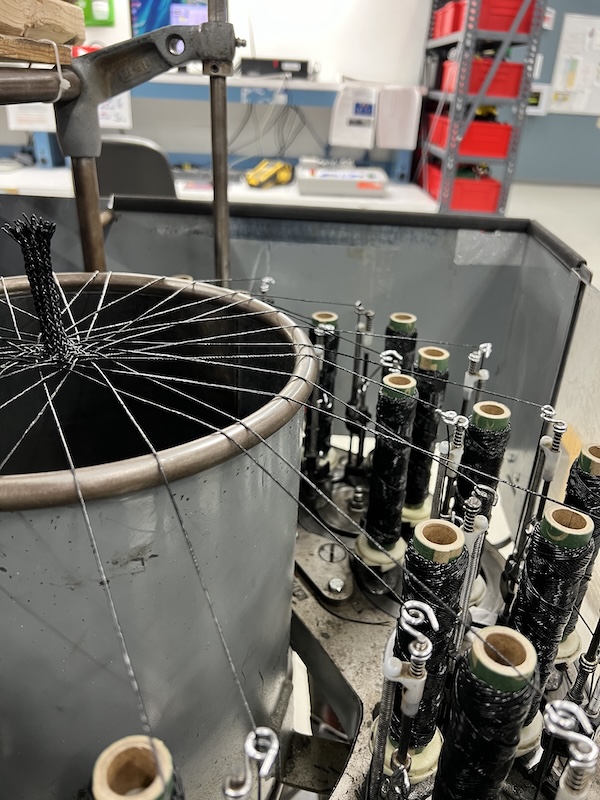
There are many other examples of how that learned expertise creates reliable outputs. Dave mentioned they don’t like to do fold-overs and tape-ups before they braid. “That’s an opportunity for a wire harness to fail. You might pinch it, break the wire or crack the insulation.”
Preventive Maintenance: The Unsung Hero
While testing capabilities tend to grab the spotlight, Dave insists their preventive maintenance program deserves equal credit. “We use a software tool to log every calibration—machines, applicators, everything,” he explained. “Every time an applicator gets used, it’s tagged so our maintenance department knows to inspect it for nicks, clean and lubricate it, and log it for tracking purposes.”
Maintenance requests are digital, visible to everyone, and acted on immediately. “Anybody can enter a note if something seems off,” he said. “Our in-house maintenance team handles daily issues, and twice a year, outside technicians from the equipment manufacturers come in for full service. When that happens, we shut the machine down completely, and they go end-to-end.”
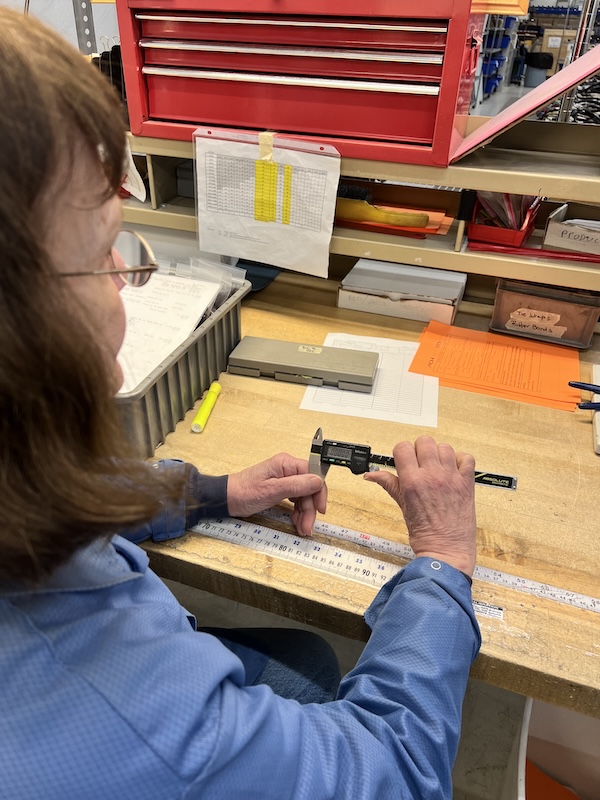
The payoff? “Our machine downtime has dropped dramatically since we put this program in effect about three years ago,” Dave said. “And that directly improved our overall quality. It’s simple—equipment that runs right builds better harnesses.”
Automation Where It Counts
In an era where automation dominates conversation, Dave’s approach is measured. “We’re not automating for automation’s sake,” he said. “We’ve upgraded our wire cutting equipment—more accurate, faster, better labeling—and we’ve replaced heat guns with a ceramic heater conveyor system for shrink tubing. It improved consistency and safety.”
He recalled why that change mattered. “We had an operator burn her arm with a heat gun. That was enough. Now we control heat and speed automatically, and the parts come out uniform. It’s safer, faster, and just better all around.”
Safety is the priority with automation at ACH. That means using technology where it improves people’s work—not replaces it.
The Tug on the Sleeve
If there’s one phrase that sums up the ACH/ETI culture, it’s “tug on our sleeve.” It’s what employees are encouraged to do if something doesn’t look right. “We always tell our people—if the documentation’s off, if a machine feels wrong, tug us on the sleeve,” Dave said. “Let’s look at it together and fix it before it becomes a problem.”
That openness has built a culture of accountability that’s visible on the shop floor. “If you ask anyone out there what they’re working on, they can tell you exactly what and why,” Dave said. “We encourage visitors to do just that because they’re the experts.”
ETI and the Iowa Partnership
While Fort Atkinson focuses on complex assemblies and printed circuit boards, the Des Moines-based Electronic Technologies International (ETI) handles smaller harnesses and higher-volume builds. That location is also home to one of the company’s most unique and socially meaningful collaborations: its partnership with Iowa Prison Industries.
For the past four years, ETI has sent product to be processed at the prison’s manufacturing area, where about 35–40 incarcerated individuals perform basic, non-critical tasks such as pinning connectors and applying heat shrink. “There’s no ETI equipment up there,” Dave clarified. “They’re handling simpler prep work. Everything comes back to us for full inspection.”
The program began as a way to manage fluctuating demand—but it quickly proved its human value as well. “We use it as a buffer,” Dave said. “If customer demand slows, we scale back what we send there so our employees stay busy at ETI. If things spike, we ramp it up to meet delivery schedules. It protects our people from layoffs and keeps the business responsive.”
The partnership has also led to second chances. “We’ve hired several individuals after they were released,” Dave said. “Some stayed a few months, some longer. But they left with work experience and money saved to rebuild their lives, so it’s been good for them and good for us.”
Renewed Energy in Manufacturing
Caitlin McCabe, ACH/ETI Director of Marketing, sees that same sense of purpose in the workforce overall. “People are excited to be part of manufacturing again,” she said. “You can feel it in the building. There’s this renewed interest—especially among younger people. I went to a high school career fair recently, and kids were lining up to talk about manufacturing careers.”
She credits a shift in perception. “For years, manufacturing had a PR problem,” she said. “It was seen as dirty or dangerous. But now you look around—tradespeople are thriving. They’ve got boats houses in Florida and take their families to Disney every year. And with automation and AI, the skill sets are changing. We’re starting to compete with tech companies for talent.”
That change is reflected on the shop floor, where even traditional roles now involve digital processes, machine learning, and collaborative tools. “It’s not just turning wrenches anymore,” Caitlin said. “It’s smart manufacturing.”
A Modern Take on Marketing
Caitlin’s marketing approach mirrors that evolution. “AI has changed how we reach people,” she said. “We’re using it to identify potential customers who are showing intent—companies looking for new suppliers or trying to minimize risk in their supply chain. It’s helping us find the right people faster.”
The real breakthrough came when they let go of polish and focused on authenticity across channels like YouTube. “We were nervous about not having a professional video budget,” she admitted. “So I grabbed one of our leads and said, ‘Hey Barry, let’s shoot a ten-second clip.’ He said, ‘Absolutely not!’ I said, ‘Come on, just one question.’ He explained the difference between a single- and double-sided PCB—and I posted it.”
The clip went viral by wire harness standards—hundreds of views in hours—and sparked an ongoing series of videos titled “Hey Barry.” “People recognize him now,” she laughed. “It proved something: you don’t need corporate gloss. You just need authenticity.”
A Relationship Business
For Dave, that authenticity applies to everything they do. “We don’t just build harnesses,” he said. “We build relationships. Most of our top customers have been with us for over ten years. We’re not so dumb as to think our competitors aren’t knocking on their doors, but they stay with us because they know we care.”
That care shows up in small things—quick communication, safety stock programs for volatile markets, and a simple rule: always tell the truth. “We do what we say we’re going to do,” Dave said. “That’s the Midwest work ethic. If there’s a problem, we fix it. If a customer needs help, we’re there. We’re not perfect, but we’re consistent and that what keeps customers coming back.”
In an industry where precision and dependability define success, American Cable & Harness and Electronic Technologies International have built something rare — a partnership of people and process that quietly delivers both. From the engineers who design test boards to the operators who “tug on the sleeve” when something doesn’t look right, every connection in their workflow mirrors the connections they’ve built with their customers. It’s not a story about technology or growth so much as one about trust that’s earned, one harness at a time.