




















Headquartered in Milford, Connecticut, Bead Industries, Inc. is proof that legacy and innovation can coexist. The fifth-generation, family-owned manufacturer has spent more than a century evolving from a small household invention into a global supplier of precision-engineered connector pins, rivets, and interconnect components.
Today, Bead products power everything from automobiles and medical equipment to datacom networks, smart lighting, and industrial and aerospace controls.
From Pull Chains to Precision Engineering
Bead’s story began in the early 1900s with a simple but clever solution: the electric light pull. When founder Calvin Bryant found imported beaded chains to be inconsistent and low quality, he decided to make his own. In 1914, Calvin and his son, Gerald, launched the Bead Chain Manufacturing Company, laying the foundation for what would become a multi-division manufacturing enterprise rooted in reliability and innovation.
During World War II, Bead produced more than 22 million Bead Chain® “dog tag” necklaces for the U.S. and Canadian armed forces, without a single reject, earning the prestigious Army-Navy Double “E” Flag for excellence.
As decades passed, Bead’s precision metal-forming techniques opened doors to new industries: electronics in the 1920s, fluorescent lighting in the 1960s, and telecommunications and automotive in the 1990s. Each evolution reflected the company’s signature blend of craftsmanship, adaptability, and curiosity.
Today, Bead Electronics, a division of Bead Industries, manufactures custom contact pins, continuous reeled pins, hollow contact pins, and pin assemblies designed to replace multi-part or machined components. Using its proprietary swaging process, Bead engineers form components that are lighter, stronger, and more cost-efficient without sacrificing precision.
“People don’t realize how important the quality of our products is. If the contact pin fails, the electrical connection fails—and the product fails.”
— Jill Mayer, Vice President of Bead Electronics
That focus on reliability drives Bead’s partnerships with OEM engineers across industries. Most parts they produce are custom-engineered, often starting with a legacy component, rough sketch, or a specific performance challenge that can’t be solved with an off-the-shelf part.
Case in Point: Reinventing a Wiring Harness Connector
A recent project demonstrates how Bead’s century of experience meets today’s engineering demands.
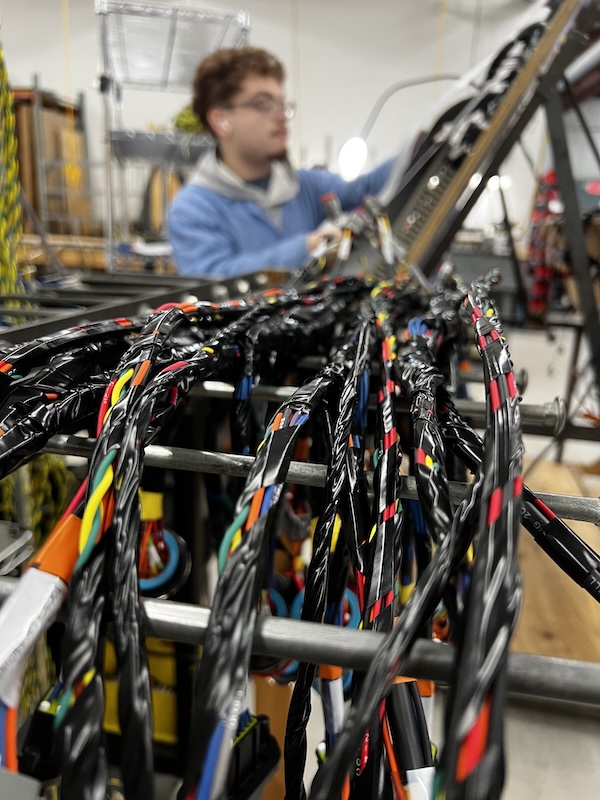
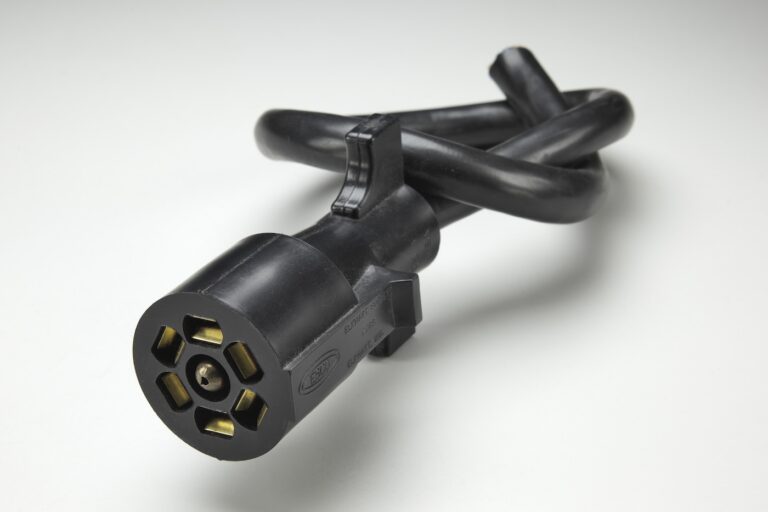
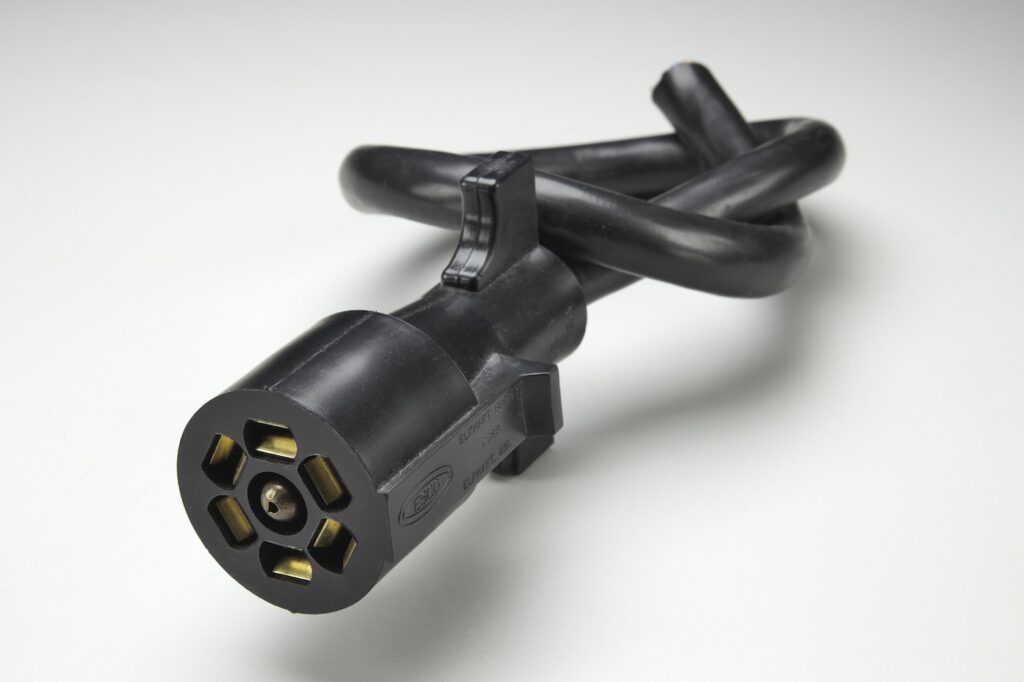
A U.S. manufacturer of electrical and plumbing supplies approached Bead with a challenge: their solid screw-machined auxiliary power pin, used within a seven-way SAE standard trailer cable, was costly and inefficient. The pin, a crucial component in a trailer’s wiring harness, connects power and signals between a tow vehicle and the trailer it pulls, enabling lights, brakes, and auxiliary power.
Bead’s engineering team developed a functionally equivalent hollow contact pin using its unique swaging process. The result:
- 73% material savings (9.5 lbs. vs. 35.2 lbs. of brass per lot)
- Faster production times compared to screw-machined parts
- Lighter component weight, reducing shipping and assembly costs
The new hollow brass pin retained full electrical performance while addressing concerns about oxidation. Because the system operates at a higher voltage (12V+), any surface oxidation has a negligible effect on conductivity. Small surface bumps were added to the plastic connector housing for improved retention. At the same time, the open-ended design allows a wire to be crimped directly for a durable cable-to-cable connection.
The result was a lighter, faster, and more cost-efficient component ideally suited for rugged, real-world environments, proving that Bead’s engineering innovation continues to drive measurable value more than a century after its founding.
Built in the U.S., Built to Scale
Bead forms millions of pins each month at its Milford facility, combining IATF 16949 and ISO 9001 certification, vertical integration, and domestic manufacturing with the agility of a startup.
“Our size is an advantage. Customers get direct access to our team of engineers, tooling and samples provided quickly, and flexible production schedules.”
— David Brenton, Director of Engineering at Bead Electronics
While large suppliers focus on catalog parts, Bead excels in high-mix, low-to-medium volume manufacturing: the space where customization, speed, and problem-solving are most crucial.
A Legacy of Ingenuity, A Future of Innovation
Now in its fifth generation of family leadership, Bead continues to invest in automation, product development, and people, ensuring its 111-year-old legacy remains firmly future-focused.
“We’re stewards of something bigger than ourselves. Our responsibility is to keep jobs in our community, keep innovating, and make sure this business thrives for another hundred years.”
— Jill Mayer, Vice President of Bead Electronics
Whether reimagining a connector pin or redefining what American manufacturing can look like, Bead Industries continues to prove that the most enduring companies are those that never stop inventing and never stop caring: about precision, excellence, and, most of all, the people their products are built to serve.